
LED Floodlight vs Street Light: Which One Suits Public Outdoor Areas Better?
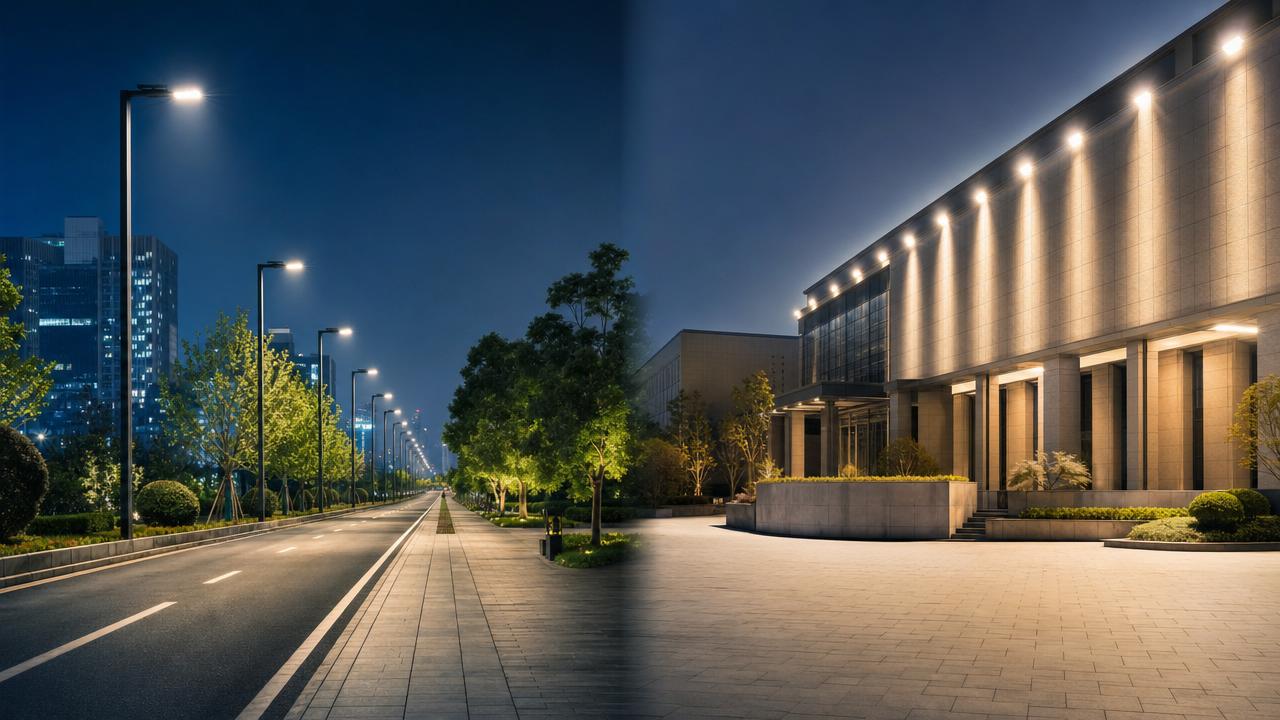
Choosing between an LED Floodlight and a street light is not just a technical decision for public outdoor projects — it directly affects coverage, safety, energy use, and long-term maintenance costs. For business evaluators managing roads, plazas, parks, or urban spaces, understanding how each lighting solution performs in real project conditions is essential to selecting a reliable and cost-effective option.
In most public outdoor areas, the better choice depends on how people use the space. Street lights are usually the right option for roads, walkways, and structured traffic zones. An LED Floodlight is often better for open areas, irregular spaces, façades, sports zones, and places needing flexible beam coverage.
For commercial and public project evaluation, the question is not which product is universally better. The real issue is which fixture delivers safer illumination, simpler project execution, lower lifecycle cost, and better long-term performance in a specific outdoor environment.
What Business Evaluators Really Need to Decide First
Before comparing fixture types, evaluators should define the project objective clearly. Is the priority vehicle guidance, pedestrian safety, public security, visual comfort, architectural visibility, or multi-functional space use? Different goals change the most suitable lighting solution immediately.
If the site is a road or a pathway network, light distribution consistency matters more than raw brightness. If the site is a plaza, park node, loading zone, or building perimeter, directional flexibility becomes more valuable than linear spacing efficiency.
This is why product selection should start from usage patterns, pole layout, maintenance access, smart control compatibility, and operating hours. These factors often have more business impact than comparing wattage or lumen output alone.
LED Floodlight vs Street Light: The Core Functional Difference
A street light is designed mainly for linear lighting tasks. It distributes light along roads, lanes, and sidewalks in a controlled pattern that helps reduce glare while improving visibility for drivers, cyclists, and pedestrians.
An LED Floodlight is designed for broader or more targeted area illumination. It can project light over open spaces, highlight vertical surfaces, and adapt to complex site conditions where standard roadway optics may not perform effectively.
In practical terms, street lights are optimized for uniformity and route guidance. Floodlights are optimized for flexibility and coverage control. That difference directly affects pole quantity, installation strategy, aiming, and future adjustments during project operation.
Which One Performs Better in Different Public Outdoor Areas?
For municipal roads, residential streets, bike lanes, and pedestrian corridors, street lights usually perform better. Their optical design supports consistent forward distribution, helping teams meet roadway lighting requirements with fewer dark spots and better spacing logic.
For squares, public gathering areas, transport yards, parking zones, park entrances, and building surroundings, an LED Floodlight may be the more suitable choice. It can illuminate wider or asymmetrical areas without forcing the design into a road-lighting pattern.
In mixed-use urban environments, many successful projects combine both. Street lights manage circulation routes, while floodlights support nodes, activity zones, landmarks, or security-sensitive areas. For evaluators, this hybrid approach often brings better functional coverage than choosing only one type.
How Coverage, Uniformity, and Glare Affect Real Project Outcomes
Coverage alone is not enough. A lighting system that looks bright on paper may still create poor visibility if the distribution is uneven. Business evaluators should pay close attention to uniformity because it influences safety perception, surveillance quality, and user comfort.
Street lights generally provide better longitudinal uniformity for roads and walkways. This reduces visual fatigue and supports predictable movement. In contrast, an LED Floodlight can create excellent area coverage, but only when beam angle, mounting height, and aiming are planned carefully.
Glare is another critical issue. Poorly positioned floodlights can produce discomfort or visual disturbance, especially near traffic routes. Street lights usually handle glare more effectively in transport scenarios, while floodlights need more precise engineering to avoid overexposure and spill light.
What About Energy Efficiency and Operating Cost?
From a procurement perspective, energy efficiency should be evaluated at system level, not fixture level alone. A more efficient luminaire may still cost more to operate if it requires more units, poor spacing, or frequent maintenance interventions.
Street lights often deliver stronger efficiency in road projects because their optics are purpose-built for long, narrow coverage. This can reduce wasted light and improve pole-to-pole performance. For roadway applications, that usually means better energy value over time.
An LED Floodlight can still be highly cost-effective in open areas because it reduces the need for custom pole arrangements or multiple fixture types. In irregular public spaces, flexibility can lower overall infrastructure complexity and improve return on investment.
Smart control also matters. Dimming schedules, motion-based adjustment, and centralized management can significantly reduce operating cost for both categories when integrated properly into larger outdoor lighting systems.
Maintenance, Reliability, and Project Risk: Often More Important Than Purchase Price
Business evaluators should not focus only on initial fixture price. In public outdoor projects, maintenance access, failure rate, spare parts consistency, and system integration often have a larger financial impact over the project lifecycle.
Street lights are typically easier to standardize across long routes, which simplifies maintenance planning. Floodlights, however, may require more site-specific aiming and adjustment, especially when used in visually sensitive or multi-purpose public spaces.
That said, a well-engineered floodlight solution can reduce risk when the space is architecturally complex. The key is selecting fixtures with durable housing, stable thermal performance, and dependable driver quality for continuous outdoor use.
For large-scale urban projects, evaluators should also consider supplier support. Product consistency, technical documentation, control compatibility, and project execution experience can reduce delays and help avoid costly redesign during installation or later operation.
When an LED Floodlight Creates More Value Than a Street Light
An LED Floodlight creates stronger value when the project requires adaptability. This includes public plazas, landscape zones, façade surroundings, event-support areas, transport hubs, and mixed-use developments where lighting needs may change over time.
It is also a strong option when vertical illumination matters. If the goal includes enhancing perceived safety, supporting cameras, improving spatial identity, or lighting walls and structures, floodlights often perform better than conventional street lighting layouts.
Some public spaces increasingly combine lighting with visual communication or immersive experiences. In those cases, supporting technologies may also become relevant. For example, in landmark urban environments or large-scale outdoor experiences, an Laser Engineering Projector can complement lighting infrastructure by adding high-brightness projection to buildings, landscapes, or stages.
With 8000 ISO lumens, WUXGA resolution, 4K compatibility, and industrial-grade design, this type of projection solution can support engineered public presentations without replacing the core need for functional outdoor lighting.
A Practical Selection Framework for Evaluators
If you are evaluating lighting for a public outdoor project, start with five questions. First, is the area linear or open? Second, what level of uniformity is required? Third, is glare risk high? Fourth, how flexible must the lighting be? Fifth, what are the maintenance constraints?
If the area is primarily a road, lane, or pedestrian path, choose street lighting first and test whether its optical distribution matches safety and spacing goals. If the area is broad, irregular, or multi-functional, evaluate an LED Floodlight solution first.
Next, review lifecycle cost rather than procurement cost only. Include poles, brackets, controls, energy use, aiming time, maintenance frequency, and replacement strategy. This gives a more realistic basis for comparing options in business terms.
Finally, assess the supplier’s engineering support. In complex public projects, execution quality often depends on application guidance, photometric planning, and integration capability just as much as fixture performance itself.
Final Verdict: Which One Suits Public Outdoor Areas Better?
Neither product is better in every situation. Street lights are the better choice for structured transport and pathway environments. They provide more appropriate uniformity, traffic-oriented distribution, and efficient linear coverage for public circulation areas.
An LED Floodlight is often the better choice for open public areas, irregular layouts, architectural surroundings, and spaces needing flexible illumination strategies. It offers stronger adaptability and can solve lighting challenges that road-style optics cannot handle efficiently.
For business evaluators, the smartest decision is to match the lighting type to the real function of the space, then compare total project value, operational reliability, and long-term control potential. That approach leads to better safety, better performance, and better investment outcomes.
◉ MESSAGE
Blog
- LED Street Luminaire Specifications That Matter for Roadway Projects
- What to Evaluate When Selecting a Smart Street Lamp Manufacturer
- How to Prepare a Compliant Solar Lighting Bid for Public Infrastructure Projects
- LED Street Lighting Solutions for Urban and Municipal Roads
- LED Street Light Installation Guide for Road Projects
- LED Street Light Lifespan: How Long Do LED Road Lights Last?
- LED Street Light IP Rating: What Should Buyers Choose?
Message