
LED Floodlight Specifications Guide: Lumens, Beam Spread, Color Temperature, and IP Rating
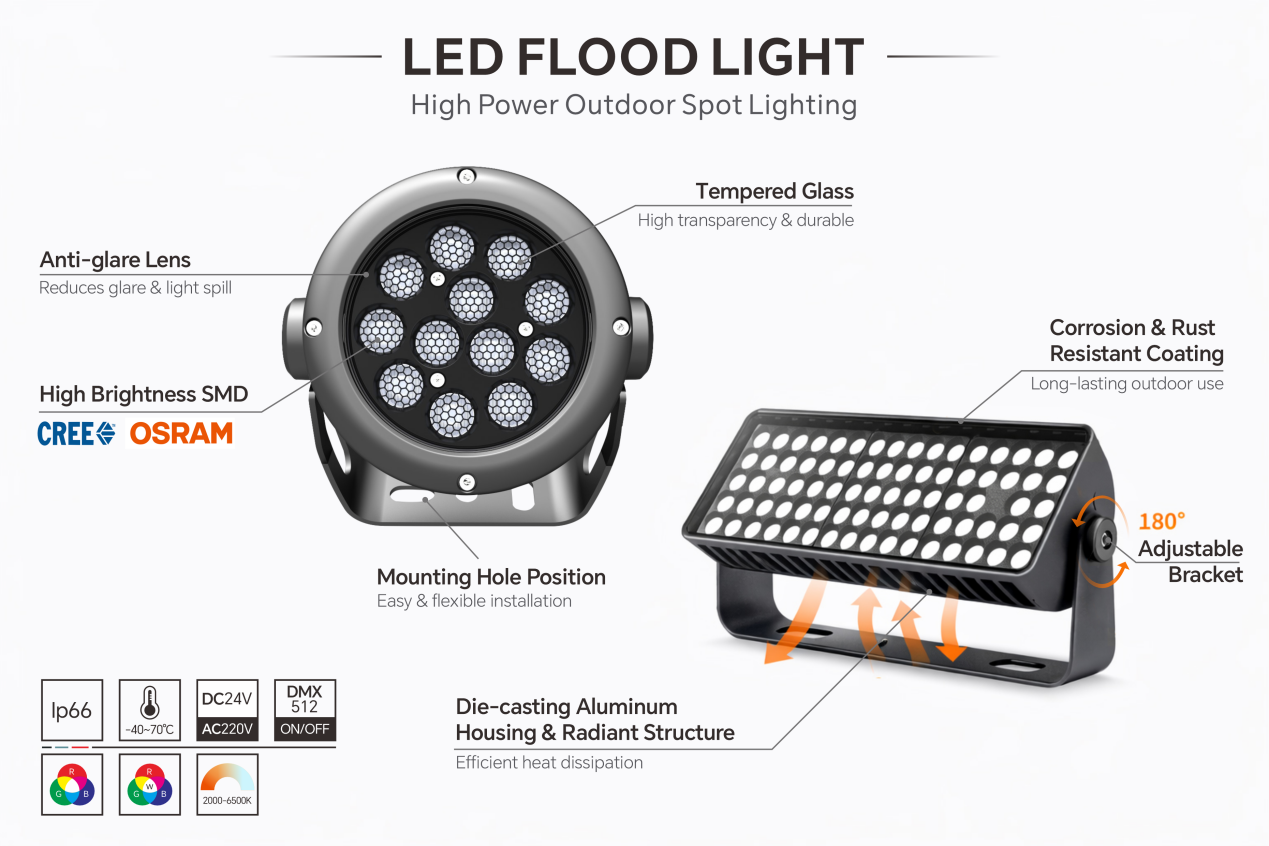
Choosing the right LED Floodlight for a large-scale outdoor project requires more than comparing wattage. Technical evaluators need clear insight into lumens, beam spread, color temperature, and IP rating to balance performance, durability, and project cost. This guide explains the key specifications that affect lighting quality and long-term reliability, helping contractors and project owners make informed decisions for roads, public spaces, and demanding urban environments.
What Technical Evaluators Really Need to Confirm First
When reviewing an LED Floodlight, the key question is not “How many watts?” but “Will this fixture deliver the required illumination reliably in the real project environment?”
For technical evaluation teams, the most important specifications are those that directly affect visibility, uniformity, maintenance cycles, weather resistance, and system compatibility over years of operation.
That is why lumens, beam spread, color temperature, and IP rating deserve closer attention than simple power consumption figures during product comparison or tender-stage screening.
Lumens: How Much Useful Light the Floodlight Actually Delivers
Lumens measure the total visible light output of an LED Floodlight. In practical terms, this tells you how much light is available for illuminating roads, facades, parking zones, yards, and public areas.
Higher lumens do not automatically mean a better result. The real issue is whether the light output matches mounting height, target area, and required lux levels on the ground.
For example, a fixture with high lumen output but poor optical control may create bright spots and dark gaps. That can reduce visual comfort and fail project lighting standards.
Technical evaluators should also look beyond nominal lumen figures and ask about luminous efficiency, optical losses, and lumen maintenance over time. Initial brightness alone is not enough for lifecycle assessment.
In large-scale outdoor projects, stable performance matters. A system rated at high efficacy can reduce energy demand while still supporting illumination targets across multiple installation points.
As a reference, some integrated outdoor systems such as Smart Street Lighting | SSL-CH are designed with luminous efficiency of at least 140 lm/W, showing how efficacy affects both operating cost and planning flexibility.
Beam Spread: The Specification That Determines Coverage and Uniformity
Beam spread defines how the light is distributed across a target surface. This specification is critical because it determines whether the LED Floodlight can cover the intended area efficiently.
Narrow beams concentrate light over a longer distance or onto a smaller target. Wide beams distribute light across broader spaces but with lower intensity at any single point.
For roads, pedestrian zones, plazas, loading areas, and building exteriors, the wrong beam angle can create either wasted spill light or insufficient coverage where visibility is needed most.
Technical evaluators should review beam spread together with pole height, fixture spacing, and mounting angle. Optical design should support uniform lighting, not just high center-beam brightness.
This is especially important in urban environments, where glare control, neighboring properties, signage visibility, and public comfort all influence final acceptance and long-term usability.
A good evaluation process includes checking lighting simulation data, not just catalog descriptions. Photometric files help confirm whether the floodlight performs as expected in the actual layout.
Color Temperature: Matching Visibility, Comfort, and Scene Requirements
Color temperature, measured in Kelvin, affects how the illuminated environment looks and feels. It also influences perception, contrast, and suitability for different outdoor applications.
Warmer options such as 3000K usually create a softer and more comfortable atmosphere. They are often preferred in parks, residential-adjacent spaces, and some public environments.
Neutral white options such as 4000K are common in roads, municipal areas, and commercial outdoor zones because they provide a balanced mix of clarity, comfort, and practical visibility.
For technical evaluators, the correct choice depends on project goals, local standards, and environmental context rather than personal preference or assumptions about brightness.
It is also important to understand that a higher Kelvin value does not necessarily mean better lighting quality. Overly cool light may increase harshness or visual discomfort in certain settings.
Products intended for large outdoor infrastructure often offer standardized options such as 3000K and 4000K, allowing teams to align lighting appearance with operational and planning requirements.
IP Rating: A Direct Indicator of Outdoor Reliability
IP rating shows how well the fixture resists dust and water ingress. For outdoor lighting, this is one of the most practical indicators of long-term reliability.
An LED Floodlight installed in roads, open plazas, industrial zones, or coastal environments must tolerate rain, dust, humidity, and temperature variation without rapid performance decline.
For demanding exterior use, technical evaluators often look for high protection levels such as IP66 or IP67, depending on exposure conditions and project specifications.
A stronger IP rating helps protect optical chambers, drivers, and internal connections. This reduces the risk of early failure, unexpected maintenance, and uneven performance across the site.
However, the rating should not be viewed in isolation. Housing materials, sealing quality, heat management, and production consistency all contribute to real field durability.
In harsh climates, operating temperature range is also relevant. Outdoor systems built for environments from -40℃ to +70℃ offer stronger confidence for year-round deployment.
Why These Specifications Must Be Evaluated Together
Each specification matters, but no single value should decide the product selection. A strong LED Floodlight balances light output, distribution, visual quality, and environmental protection as one system.
For example, high lumens with an unsuitable beam spread may still fail the site requirement. A good IP rating without stable thermal performance may still shorten service life.
Likewise, an appropriate color temperature improves usability, but only if the fixture also delivers uniform illumination and withstands local weather and maintenance realities.
This is why experienced evaluators compare specifications in context: application type, mounting conditions, lighting standard, smart control integration, and total lifecycle cost.
Questions Technical Evaluators Should Ask Before Approval
To make a sound decision, evaluation teams should ask for more than a datasheet headline. The goal is to confirm measurable suitability for the exact project environment.
Key questions include: What is the maintained lumen output? What beam options are available? Is there lighting simulation support? What is the true ingress protection structure?
Teams should also ask about driver quality, LED chip brand, surge protection, thermal design, communication compatibility, and expected maintenance intervals under local operating conditions.
Where smart infrastructure is involved, compatibility with remote control and monitoring becomes another practical requirement rather than a value-added extra.
In project-based urban lighting, integrated systems may also support functions such as real-time alerts, remote management, and communication protocols including MQTT, TCP/IP, or HTTP.
Considering Long-Term Project Performance, Not Just Initial Purchase
For contractors and project owners, the most cost-effective LED Floodlight is not always the lowest-priced unit at procurement stage. Long-term reliability usually has greater financial impact.
Failures in outdoor lighting create service interruptions, replacement labor, equipment access costs, and possible project reputation risks, especially in municipal or public-use installations.
That is why evaluators should value service life, stable luminous performance, material durability, and resistance to severe weather as part of the technical review process.
In broader outdoor lighting programs, related smart pole solutions can also support cost reduction and operating efficiency through centralized control and more responsive maintenance planning.
For instance, Smart Street Lighting | SSL-CH combines smart-city connectivity, stainless steel construction, wind resistance of at least 150 km/h, and IP67 protection for demanding outdoor applications.
Final Takeaway for LED Floodlight Selection
When selecting an LED Floodlight, technical evaluators should focus on whether the fixture can deliver the right light, in the right pattern, with the right visual effect, and with proven outdoor durability.
Lumens indicate available light output. Beam spread determines coverage and uniformity. Color temperature affects visibility and scene suitability. IP rating shows how well the fixture can survive real exposure.
The best decision comes from evaluating these specifications together, supported by photometric data, environmental requirements, and lifecycle thinking rather than wattage-based comparison alone.
For roads, public spaces, and complex urban environments, this approach leads to more reliable installations, fewer performance surprises, and better long-term project outcomes.
◉ MESSAGE
Blog
- LED Street Luminaire Specifications That Matter for Roadway Projects
- What to Evaluate When Selecting a Smart Street Lamp Manufacturer
- How to Prepare a Compliant Solar Lighting Bid for Public Infrastructure Projects
- LED Street Lighting Solutions for Urban and Municipal Roads
- LED Street Light Installation Guide for Road Projects
- LED Street Light Lifespan: How Long Do LED Road Lights Last?
- LED Street Light IP Rating: What Should Buyers Choose?
Message