
How to Choose Solar Street Lighting for Low-Sun Areas
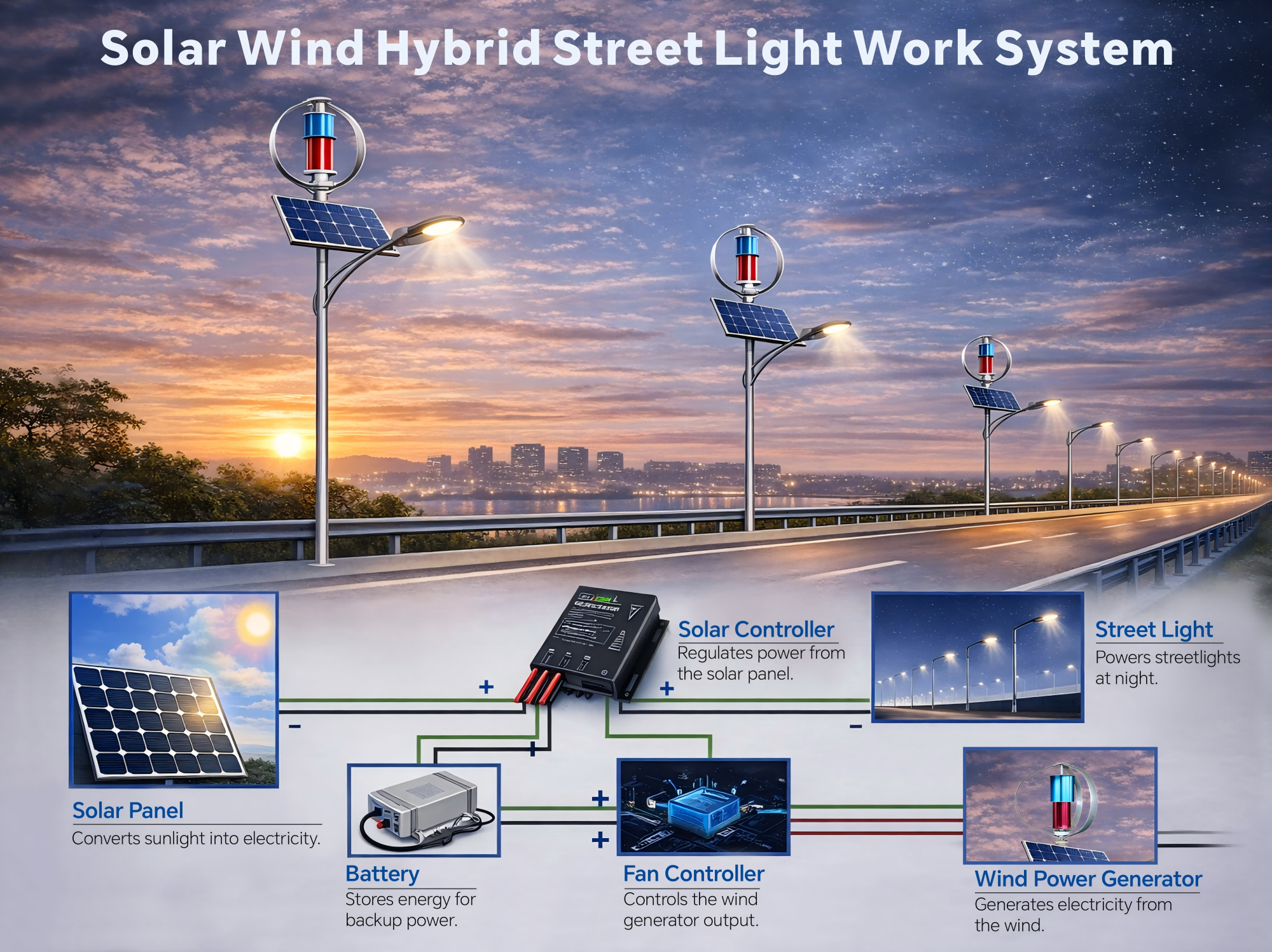
How to Choose Solar Street Lighting for Low-Sun Areas
Choosing solar street lighting for low-sun areas requires more than comparing wattage or price.
Low irradiation, frequent cloudy days, and longer winters can quickly expose weak system design.
That is why specification review should start with energy balance, not fixture appearance.
For large projects, the right solar street lighting solution must keep roads and public spaces safely lit, even during difficult weather cycles.
Start with Real Solar Conditions
The first step is to understand the actual solar resource at the project site.
Do not rely on annual averages alone.
For solar street lighting in low-sun areas, the critical data is usually the worst month.
Review peak sun hours, seasonal irradiation, shading risk, fog frequency, and snow coverage.
If nearby buildings, trees, or terrain reduce panel exposure, theoretical output becomes irrelevant.
What to verify early
- Peak sun hours during the lowest-yield month
- Shading during morning and late afternoon
- Local temperature range and snowfall pattern
- Panel tilt restrictions from pole or site layout
Size the System Around Autonomy
In low-sun regions, autonomy is a core decision factor for solar street lighting.
Autonomy means how many days the system can operate without enough charging input.
Many failures happen because autonomy is undersized to meet bid cost targets.
For roads, parks, and municipal corridors, three to five backup days are often a practical baseline.
Higher-risk sites may require more, especially where maintenance access is limited.
Battery review points
- Usable battery capacity, not only nominal capacity
- Discharge depth limits under winter operation
- Battery thermal protection in low temperatures
- Expected cycle life under partial-charge conditions
Lithium battery chemistry is common, but chemistry alone does not guarantee reliable solar street lighting performance.
Match Lighting Demand to Available Energy
Another common mistake is selecting solar street lighting by LED wattage only.
Wattage says little without lumen output, optical distribution, pole spacing, and operating profile.
A lower-power fixture with better optics may outperform a higher-power one in real conditions.
This matters even more in low-sun areas, where every stored watt-hour counts.
Instead of maximum brightness all night, consider dimming profiles that preserve uniformity and battery reserve.
A better evaluation method
- Define required road class or area lighting standard.
- Check illuminance or luminance targets, not only fixture power.
- Review dimming schedules against battery autonomy.
- Confirm uniformity and dark-zone control across the full layout.
Look Closely at the Controller and Charging Logic
The controller is often overlooked during solar street lighting selection.
However, in low-sun environments, charging efficiency and intelligent energy management are decisive.
MPPT control is usually preferred because it improves harvesting under unstable irradiance.
You should also review low-voltage protection, dimming logic, remote monitoring, and fault alarms.
For large-scale projects, smart control reduces maintenance uncertainty and improves lifecycle visibility.
This is where integrated support matters. Lishida Smart Lighting helps align products, controls, and project execution requirements for complex outdoor environments.
Check Reliability Beyond the Datasheet
Datasheets are useful, but they rarely show how solar street lighting performs after years in the field.
Focus on enclosure sealing, corrosion resistance, thermal design, and component traceability.
Low-sun regions often combine moisture, low temperature, and long operating hours.
Those conditions can accelerate failure if the fixture and battery housing are poorly protected.
Ask for project references, component brand details, test reports, and maintenance history when possible.
In mixed outdoor projects, supporting products may also need similar protection levels. For façade or landscape zones, LED Wall Washer options with IP66 protection, flexible RGB or DMX control, and up to 50000 hours lifespan can help keep performance standards consistent across the site.
Use a Practical Comparison Framework
A simple comparison table can make solar street lighting decisions more objective.
Final Decision Criteria
The best solar street lighting choice for low-sun areas is rarely the lowest-price offer.
It is the option with a credible energy model, stable autonomy, suitable optics, and proven reliability.
In practical terms, selection should answer one question clearly.
Will this solar street lighting system still meet project needs during the most difficult weeks of the year?
If the answer depends on ideal weather, the specification is still too weak.
A stronger decision process combines site data, lighting calculations, battery logic, and supplier engineering support.
That approach lowers execution risk and improves long-term operating results across large outdoor lighting projects.
When reviewing proposals, prioritize verifiable performance under low-sun conditions and choose partners that can support the project from specification through delivery.
◉ MESSAGE
Blog
- LED Street Luminaire Specifications That Matter for Roadway Projects
- What to Evaluate When Selecting a Smart Street Lamp Manufacturer
- How to Prepare a Compliant Solar Lighting Bid for Public Infrastructure Projects
- LED Street Lighting Solutions for Urban and Municipal Roads
- LED Street Light Installation Guide for Road Projects
- LED Street Light Lifespan: How Long Do LED Road Lights Last?
- LED Street Light IP Rating: What Should Buyers Choose?
Message