
Which battery alerts matter in remotely monitored solar street lighting?
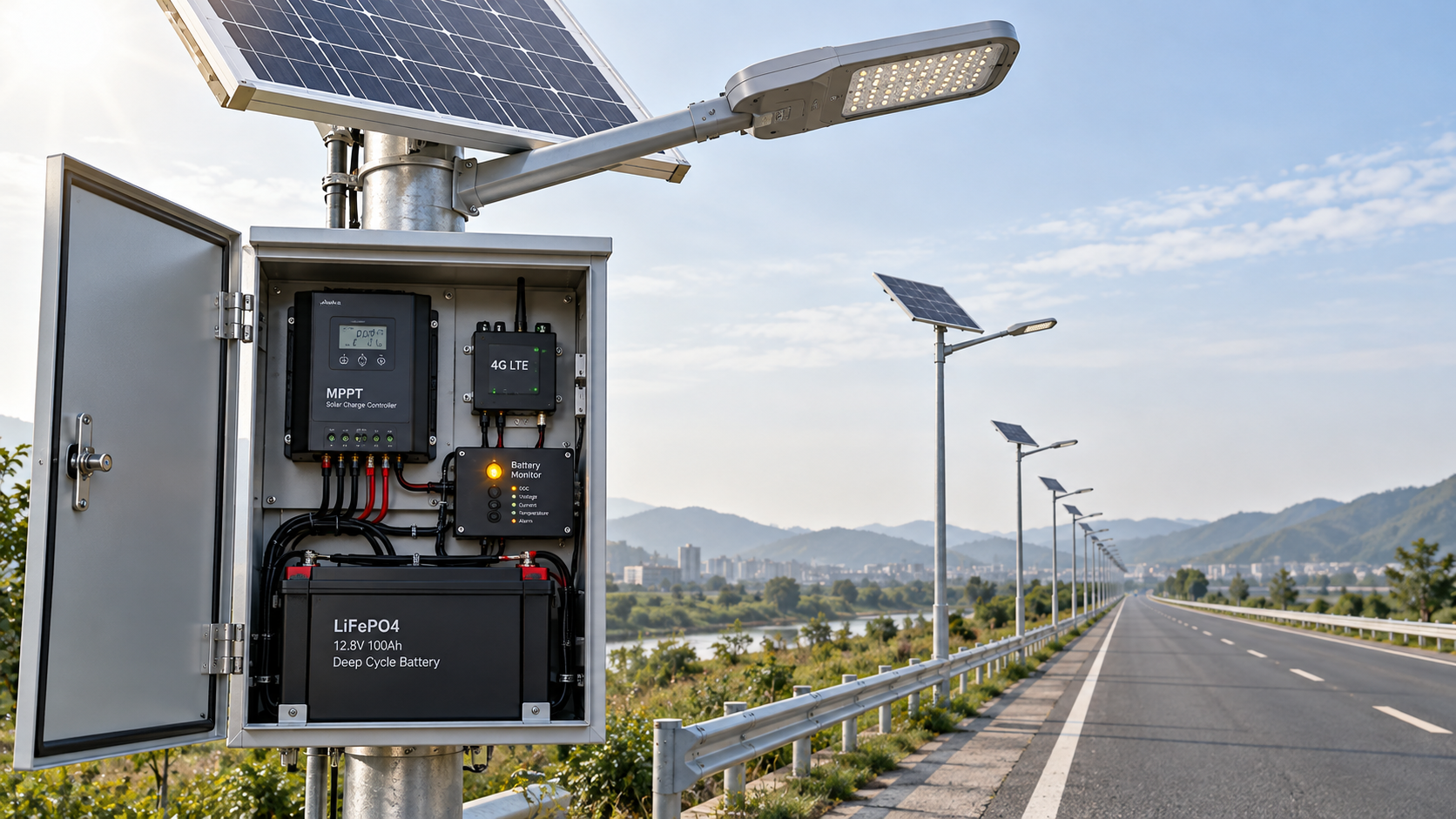
The battery alerts that matter most are sustained low state of charge, repeated undervoltage shutdowns, abnormal temperature, overvoltage, charging failures, and evidence of declining usable capacity. When a monitoring dashboard shows warnings across a street-lighting installation, these signals help distinguish a developing outage from normal overnight discharge. A brief voltage dip alone is rarely enough to justify replacing a battery.
In solar powered street lighting with remote monitoring, maintenance decisions should combine alert severity, duration, recurrence, and operating context. Safety-related battery management system (BMS) faults need prompt attention; energy-shortfall warnings usually require comparison with solar input and lighting demand. Missing or stale telemetry must be investigated separately, because an unavailable reading does not prove battery failure.
Separate urgent faults from warnings that need a trend
Alert names vary between controllers and monitoring systems. Before assigning work orders, confirm what each alarm actually represents: a measured limit, a BMS protection event, a controller estimate, or a communications timeout.
A protection event is not simply a dashboard notification. Remote monitoring supports diagnosis, but local BMS and controller protections must remain effective without network connectivity. Never bypass protection or repeatedly restart a faulted battery to restore illumination.
Low SOC: look at recovery, not just the overnight minimum
A battery is expected to discharge after sunset. A low-SOC warning becomes operationally important when the remaining energy cannot support the required lighting schedule, or when daytime charging no longer restores an adequate reserve.
Compare several complete charge-discharge cycles rather than isolated readings. A falling dawn SOC followed by incomplete afternoon recovery suggests an accumulating energy deficit. Potential causes include prolonged cloud cover, panel shading or soiling, charging restrictions, and a lighting schedule that consumes more energy than the system collects.
Different patterns point elsewhere. Normal daytime recovery followed by unexpectedly early shutdown can indicate reduced usable capacity, excessive load, or voltage drop in the battery circuit. Compare neighboring units with similar panel exposure and operating schedules; a shaded pole is not a useful reference for an unobstructed one.
SOC accuracy also depends on its source. Voltage-based estimates are affected by load and temperature, while current-integrating estimates can drift if configuration or synchronization is incorrect. Lithium iron phosphate batteries have a relatively flat voltage curve through much of their operating range, making voltage alone a poor mid-range SOC indicator.
Temperature alarms can explain an apparent charging fault
Battery temperature should be evaluated against the limits for the installed chemistry and pack—not a generic outdoor temperature threshold. Some lithium batteries restrict charging at low temperatures even while discharge remains permitted. A “not charging” alarm during such a restriction may indicate correct protection behavior rather than a failed controller.
High temperature deserves greater urgency when accompanied by rising pack voltage, abnormal current, repeated BMS trips, or physical damage. Ambient conditions, enclosure solar gain, sensor placement, and resistive connections can all affect readings. A remotely reported temperature is meaningful only when its measurement location is known.
Swelling, smoke, leakage, unusual odor, or abnormal heat requires the site's battery emergency procedure. Restrict access and have authorized personnel handle isolation and inspection. Do not open a suspect pack or attempt charging as a diagnostic shortcut.
Trace charging failures from the solar input toward the battery
A flat SOC trace during daylight does not automatically mean a defective battery. The battery may already be full, charging may be intentionally inhibited, or incoming solar energy may be insufficient. Establish those conditions before sending a replacement pack.
- Validate the record. Confirm timestamps, data freshness, battery identity, and any recent controller replacement or configuration change.
- Check available solar input. Compare PV voltage and current with daylight conditions. Examine shading, soiling, damage, and accessible connection faults.
- Read controller status. Look for charging inhibition, input faults, incorrect battery profiles, or a BMS charge-disable signal.
- Examine the battery path. Qualified personnel should inspect fuses, terminals, connectors, and cable condition using approved isolation procedures.
- Confirm recovery. After correction, verify that charging resumes and stored energy recovers over a suitable charging period.
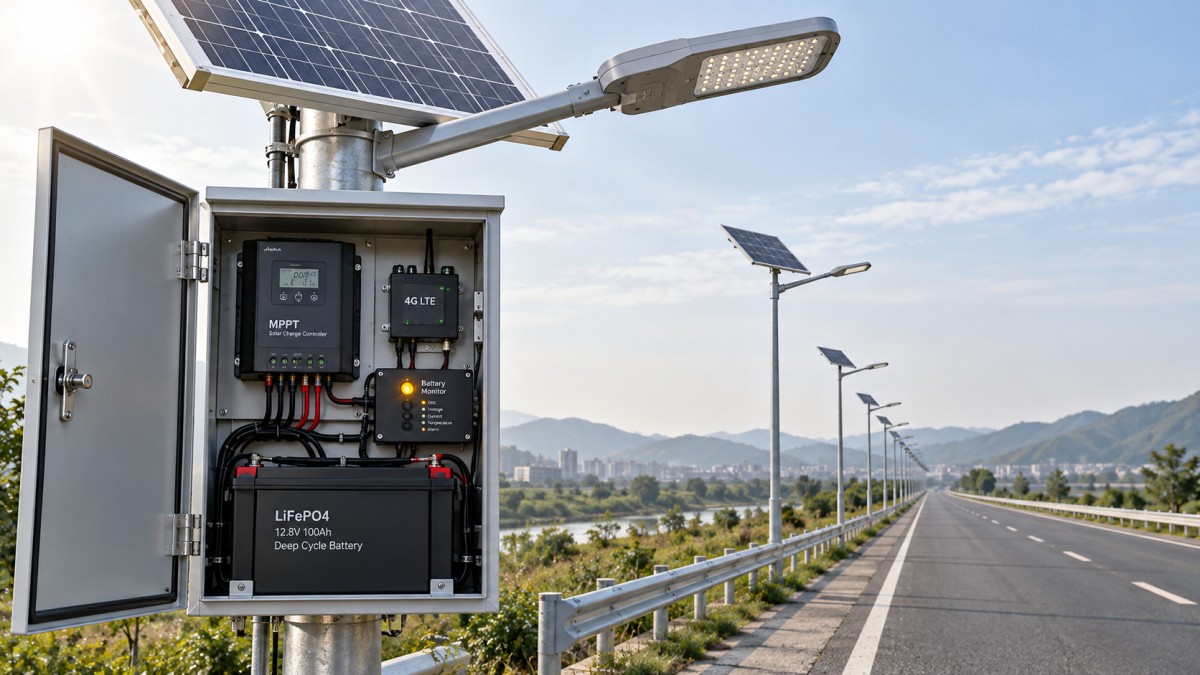
Where simultaneous measurements are available, compare controller output voltage with battery-terminal voltage under load or charge. An unexpected difference can indicate resistance in the wiring path. Intermittent connections may otherwise resemble sudden battery voltage collapse. Physical testing must use suitable instruments and follow the equipment's electrical safety instructions.
Repeated cutoffs and imbalance need more than a reset
A battery that reconnects after sunrise has not necessarily recovered its usable capacity. Repeated low-voltage cutoff can result from inadequate charging, increased lighting demand, cold conditions, deteriorating cells, or connection losses. The useful evidence is the sequence: current demand, voltage response, protection activation, and subsequent recovery.
For packs that expose cell-level telemetry, examine whether the same cell repeatedly reaches the low-voltage limit during discharge or the high-voltage limit during charging. Pack voltage can appear acceptable even when one cell forces a shutdown. Interpret cell spread at comparable SOC, temperature, and current; a single imbalance reading does not establish permanent damage.
Capacity decline is better supported by reduced delivered energy or runtime under comparable conditions, with charging completeness and load verified. Any capacity test should follow the battery manufacturer's procedure and protection limits. Do not deep-discharge an installed pack merely to prove that it is weak.
Configure alerts around the installed system
There is no universal low-voltage or SOC alarm setting for every solar street light. Use the battery manufacturer's operating limits, BMS settings, controller instructions, and project lighting requirements. Confirm whether voltage thresholds apply to individual cells or the complete pack, and distinguish a maintenance warning from a protective cutoff.
Routine warnings benefit from persistence timers and hysteresis: the condition must remain abnormal before notification, and recover sufficiently before clearing. This reduces repeated alarms around a boundary. Do not apply long delays to genuine safety faults. Preserve event logs and align sampling intervals with the faults being investigated; sparse cloud uploads can miss brief local protection events.
Load configuration belongs in the investigation too. For a project considering Modern Street Lighting|MSL-XM, the listed 150–250 W light-power range must be reconciled with the actual operating schedule and energy budget. Those luminaire specifications do not establish solar compatibility, battery capacity, or remote BMS integration; these require confirmation for the proposed configuration.
Close a maintenance ticket only when the relevant behavior has recovered: charging resumes, the required lighting period is sustained, or the protection fault remains cleared under valid operating conditions. Retain before-and-after traces and configuration records so recurring alarms can be distinguished from a new fault.
◉ MESSAGE

Blog
- How to avoid vendor lock-in in a government smart lighting project
- Sizing the communications power budget for smart city solar street lights
- How energy-saving mode affects solar bollard light operating time
- Comparing lead times from LED street light luminaire suppliers in Europe
- What spare parts support should a smart street light exporter offer?
- Where to place a solar garden light in a partially shaded garden
- Which battery alerts matter in remotely monitored solar street lighting?
Message