
Sizing the communications power budget for smart city solar street lights

A communications module’s nominal power rating is not enough to size a solar street light. The relevant quantities are its battery-side energy consumption over a complete day and its peak current during connection and transmission. Daily energy determines autonomy; peak current determines whether the supply remains stable when the radio operates.
For solar powered street lighting for smart cities, the largest error can come from overlooking equipment around the radio: an always-awake processor, a continuously listening receiver, or a converter whose standby consumption exceeds the module’s sleep demand. A defensible budget therefore covers the complete communications subsystem under both normal service and degraded network conditions.
Define what stays powered, and for how long
Establish the electrical boundary before comparing wireless technologies. Include the modem or transceiver, host processor, interface circuitry, sensors needed for reporting, and their power converters. Separate these from lighting-controller consumption already included elsewhere in the system budget to avoid double counting.
The operating schedule matters as much as the hardware. A node that uploads status periodically and sleeps between reports has a different energy profile from one that must accept commands immediately at any hour. “Remote control” does not define that distinction: the required command-response time must be specified.
Network roles also change the calculation. A mesh endpoint that sleeps cannot be budgeted like a routing node that listens and forwards other devices’ traffic. Likewise, a cellular modem’s power-saving features depend on network support and configuration; a datasheet sleep figure does not establish the achievable daily average.
Define reporting intervals, receive windows, acknowledgment handling, connection attempts, and outage behavior. Include commissioning and firmware updates as separate operating cases rather than hiding them inside an unexplained safety factor.
Convert the operating profile into watt-hours
For operating states measured at a regulated supply rail, daily radio energy is:
Eradio = Σ(Vi × Ii × ti)
Voltage is in volts, current in amperes, and time in hours, giving energy in watt-hours. Use mutually exclusive states whose durations total 24 hours. Where supply voltage or current varies substantially, integrate measured power instead of multiplying nominal values.
The following hypothetical profile illustrates the calculation; it is not a performance claim for any particular wireless technology.
At an assumed conversion efficiency of 85%, the radio requires approximately 0.108 Wh/day from the battery. An independent host consuming 0.025 W continuously adds 0.60 Wh/day at its battery-side input. An additional converter quiescent draw of 0.8 mA from a nominal 12.8 V battery adds approximately 0.246 Wh/day.
The combined demand is therefore about 0.95 Wh/day—almost nine times the radio’s converted energy alone. This example assumes the efficiency figure excludes the separately counted quiescent draw. If measured input power already includes that draw, it must not be added again.
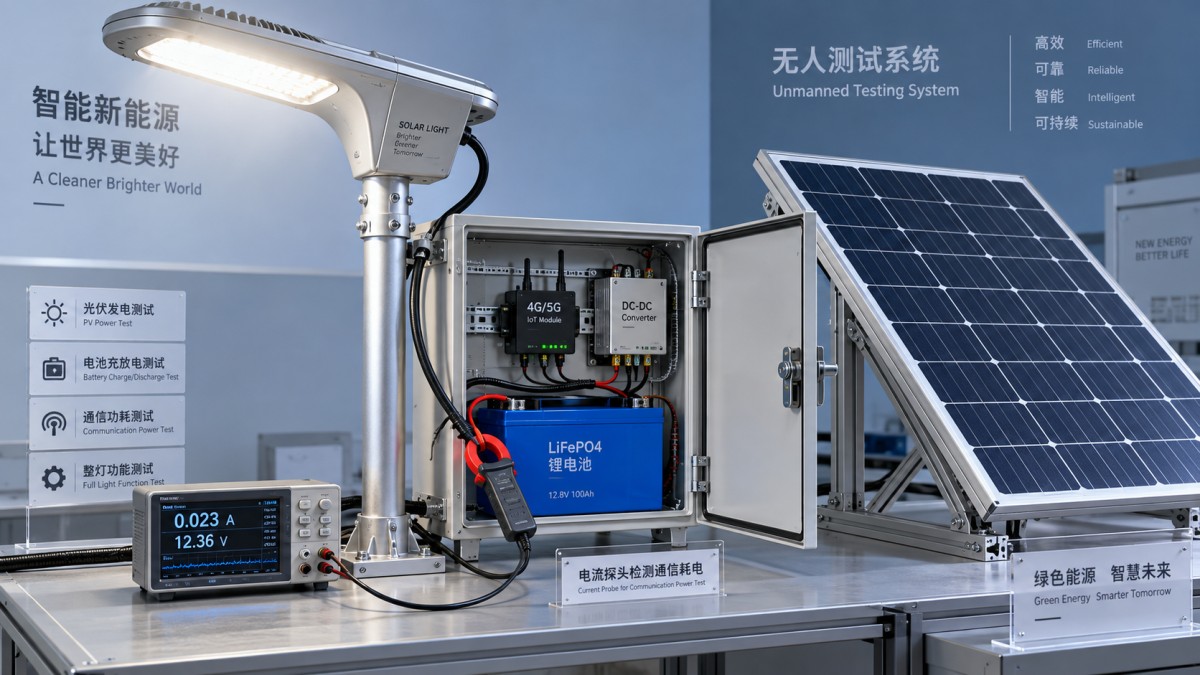
Converter efficiency should correspond to the actual load range. A peak efficiency quoted near rated output says little about operation at microampere sleep currents. Battery-side measurement of the complete subsystem is the cleanest check on the calculation.
Network failure needs its own energy case
Reporting frequency alone cannot predict consumption. A successful report may involve network registration, synchronization, channel access, reception, transmission, and acknowledgments. Weak coverage can extend active time or trigger retransmissions. Loss of service can produce repeated connection attempts without delivering useful data.
Specify at least a normal-service profile and a sustained-outage profile. The outage case should have a defined retry limit, backoff schedule, and recovery behavior. Without those limits, repeated reconnection attempts can consume energy precisely when remote monitoring is unavailable.
For mesh systems, include forwarding traffic at nodes with routing responsibilities. For cellular systems, verify supported sleep modes and reconnection behavior with the intended operator configuration. For long-range low-power links, account for the selected data rate, airtime, receive windows, and retry policy rather than assuming every message has the same energy cost.
Firmware updates deserve a separate allowance: downloading, verification, flash writing, and potential retries can keep the electronics awake much longer than routine telemetry. Where operationally acceptable, defer nonessential updates during low battery conditions.
Check peak current independently of daily consumption
A low daily average does not guarantee reliable transmission. A radio burst can cause a voltage dip across the battery’s internal resistance, wiring, connectors, protection devices, and converter. The result may be a modem reset or repeated attachment cycle, increasing energy consumption further.
Verify peak current, burst duration, converter transient response, and minimum acceptable module voltage. Test with the LED operating, at low battery state of charge, and at the lowest specified operating temperature. Battery aging must also be represented in the supply-impedance assessment.
Local capacitance can support short bursts, but cannot compensate for an undersized supply during prolonged connection activity. The approximation C = I × Δt / ΔV estimates ideal capacitance for a current shortfall; capacitor resistance, temperature, and converter dynamics still require validation.
Carry the demand into battery and generation sizing
Add communications consumption to the existing battery-side lighting and control budget. For a simplified no-generation autonomy calculation:
Nominal battery energy ≥ daily battery-side demand × autonomy days ÷ (allowed depth of discharge × retained-capacity factor)
The retained-capacity factor should represent the specified temperature and end-of-life conditions using battery supplier data. Conversion losses must already be included in battery-side demand, or accounted for separately without duplication.
For illustration, assume lighting and existing controls require 180 Wh/day. Adding 0.95 Wh/day of communications gives 180.95 Wh/day. Five days of autonomy, 80% allowed depth of discharge, and an illustrative 80% retained-capacity factor require approximately 1,414 Wh of nominal storage, or 110 Ah at 12.8 V.
The communications increment is small in that example. A continuously powered 0.5 W subsystem, however, consumes 12 Wh/day and increases the original daily load by about 6.7%. Its significance depends on the complete lighting schedule, not the luminaire’s maximum wattage.
For photovoltaic sizing, an initial incremental estimate is:
Additional panel watts = additional daily battery-side energy ÷ (design peak-sun-hours × net charging-path yield)
Using illustrative values of two peak-sun-hours and 70% net yield, 12 Wh/day requires about 8.6 W of additional panel capacity just to balance average consumption. Recovery after several low-generation days requires additional charging headroom. Site-specific seasonal analysis must also address shading, temperature, soiling, and consecutive poor-weather periods.
Hybrid generation does not remove this requirement. The Wind-Solar Hybrid Street Lighting | SHL-007 lists solar panels, a wind turbine, lithium storage, and an MPPT hybrid controller. For that architecture, communications sizing still requires battery voltage, usable storage, controller self-consumption, and site-specific generation estimates. Battery ampere-hours without voltage, or turbine rated watts without wind-resource data, cannot establish autonomy.
Make the budget verifiable at acceptance
No wireless protocol label or luminaire compliance certificate establishes a communications energy allowance. IEC 60598-1 addresses general luminaire safety requirements and tests; it does not replace a project-specific autonomy calculation. Applicable radio, EMC, battery, and installation requirements remain separate compliance checks.
An acceptance specification should define maximum battery-side Wh/day for agreed normal and outage profiles, peak current limits, supply-voltage limits, reporting performance, and command latency. Record firmware version, network settings, signal conditions, temperature, and battery voltage with each test result.
Use instrumentation capable of capturing both low sleep currents and short transmission bursts. Measure complete reporting cycles, force network loss, and confirm that reconnection attempts remain bounded. Then verify the integrated light with simultaneous lighting and communications loads. The decisive evidence is not the lowest advertised sleep current, but a reproducible energy profile that preserves lighting autonomy while meeting the required connectivity service.
◉ MESSAGE

Blog
- How to avoid vendor lock-in in a government smart lighting project
- Sizing the communications power budget for smart city solar street lights
- How energy-saving mode affects solar bollard light operating time
- Comparing lead times from LED street light luminaire suppliers in Europe
- What spare parts support should a smart street light exporter offer?
- Where to place a solar garden light in a partially shaded garden
- Which battery alerts matter in remotely monitored solar street lighting?
Message