
What spare parts support should a smart street light exporter offer?

A smart street light exporter should offer identifiable replacement parts, documented compatibility, agreed delivery times, and a workable warranty process. These commitments belong in the purchase agreement because a low replacement-part price offers little protection when the wrong driver arrives or a controller cannot reconnect to the lighting network.
The cost comparison should include freight, fault diagnosis, access equipment, configuration, and repeat site visits. A slightly more expensive spare that restores service during one maintenance visit can cost less overall than a cheaper component requiring rewiring or another trip to the pole.
Define the replacement scope before comparing prices
“Spare parts available” is too vague for a project quotation. The parts schedule should identify which components are replaceable on site, which require workshop repair, and which are supplied only as complete assemblies. A sealed LED module, for example, may require replacement together with its optical cover or thermal interface.
The initial schedule should cover LED drivers, surge protection devices, control nodes, LED modules where serviceable, and the connectors and seals needed to complete a repair. Gateways and communication accessories also belong in scope when their failure would interrupt control across several luminaires.
A matching wattage does not establish interchangeability
Two drivers marked with the same wattage are not automatically substitutes. For a constant-current LED module, the replacement must deliver the specified current and have an output voltage range that covers the module’s operating requirements. An incorrect current setting can change light output and thermal loading even when the lamp illuminates normally.
Mechanical fit matters just as much. Driver dimensions, fixing positions, lead lengths, cable exits, and clearance inside the housing determine whether installation is straightforward. A replacement that fits only after drilling or improvised wiring creates additional work and may compromise the enclosure.
Request a compatibility matrix linking every luminaire model and production revision to approved spare-part codes. Where a programmable driver is used, the documentation should state whether it arrives configured and how its settings are identified. A driver supplied with default settings should not be treated as ready for installation.
For LED modules, matching power and color temperature alone is insufficient. The board must suit the existing optics and heat-transfer arrangement. A substitution that changes the light distribution requires technical assessment, particularly where road illumination depends on a specific lens configuration.
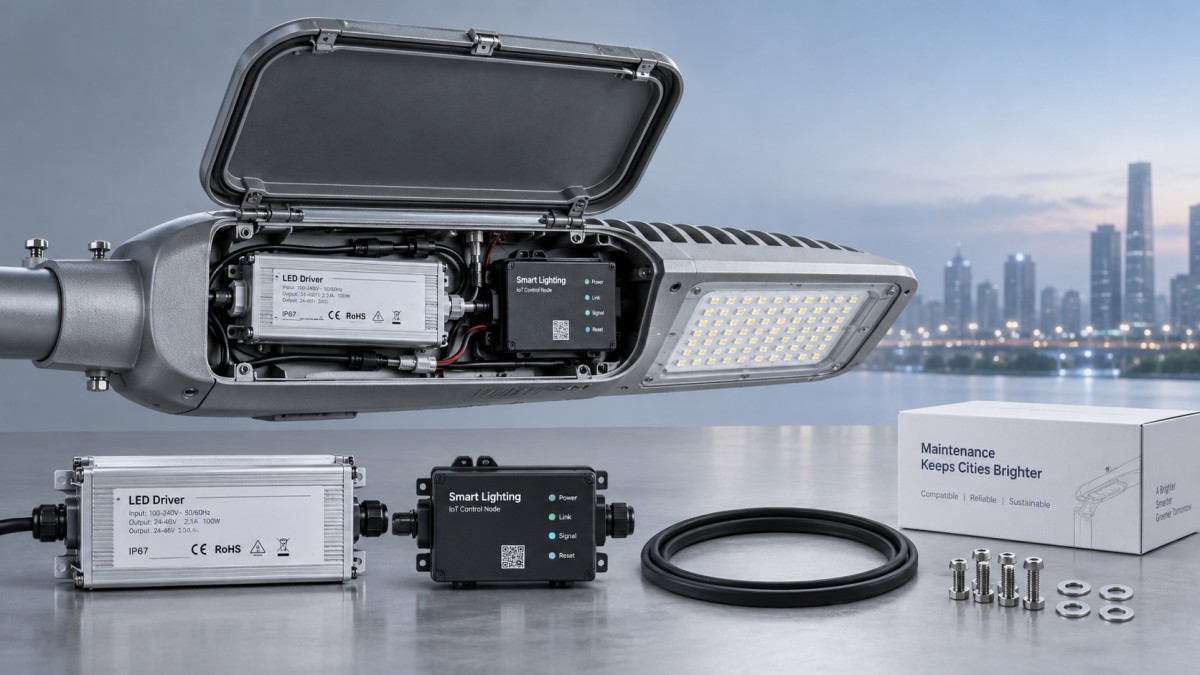
Smart controllers need a documented route back onto the network
A replacement controller can fit its socket and still fail to restore remote operation. Compatibility also depends on the communication protocol, supported firmware, network credentials, and the management system’s enrollment process. A shared connector shape establishes only part of the connection.
The spare-parts package should explain how the old controller is removed from the system, how the replacement is assigned to the correct pole, and how schedules and dimming settings are restored. It should also identify any credentials, tools, or remote assistance required. Without this information, a physical repair can leave the asset incorrectly mapped or reporting incomplete data.
Any recurring connectivity charge or device activation fee should appear in the commercial terms. Where control depends on a gateway, its replacement procedure needs similar attention: configuration backup, supported device capacity, and recovery of network settings affect the time required to restore service.
For proposed controller substitutions, require evidence of operation with the installed system. A protocol name in a brochure does not establish that every required function, such as fault reporting or schedule updates, will work across different implementations.
Stock quantities should reflect repair exposure
A universal spare-parts percentage is a weak basis for purchasing. The useful stock level depends on the installed quantity, number of component variants, replenishment time, maintenance access, and consequences of an outage. A project with several incompatible drivers needs a different stock plan from one using a common driver across its luminaires.
Ask for an opening stock proposal with its assumptions stated. Separate parts needed for isolated failures from components exposed to common events. An electrical disturbance can affect several fittings together, so a stock calculation based only on scattered component failures leaves a different exposure unaddressed.
Lead times should distinguish stocked items from parts assembled after ordering. The agreement should also separate dispatch time from transit and customs clearance. “Available on request” gives no reliable basis for scheduling maintenance.
Storage requirements deserve attention where spares will remain unused for long periods. Packaging should preserve identification, protect electronics against handling damage, and keep seals and connectors in suitable condition. Any shelf-life limitations or periodic inspection requirements should accompany the parts.
Mixed lighting projects need separate parts records
Roads, parks, and adjacent landscaped areas often use different fittings within one contract. For example, LED Garden&Lawn Lighting | GLL-TY is listed for gardens, parks, and commercial landscapes, with a rated power range of 45–75 W and an IP67 protection level. Those specifications do not establish driver or controller interchangeability with a roadway luminaire.
Each lighting family needs its own parts mapping, including the actual electrical configuration supplied. Where an enclosure is opened during repair, the service instructions should identify the required gasket, sealing surfaces, cable-gland arrangement, and tightening procedure. The original protection rating alone does not demonstrate that an incorrectly reassembled fitting will resist water ingress.
Warranty support should shorten diagnosis and avoid repeat visits
A dark luminaire does not identify the failed component. Supply faults, a damaged driver, a failed LED module, and a control command can produce similar symptoms. Useful technical support provides a fault-isolation procedure that separates these causes before a replacement is shipped. Electrical testing and component replacement require appropriate competence and safe isolation.
The warranty process should specify the evidence needed for a claim: product and component identifiers, fault symptoms, relevant photographs, and test results where appropriate. Excessive evidence requirements delay straightforward claims, while incomplete records make recurring failures harder to investigate.
Commercial terms should answer three practical questions:
- Is a replacement dispatched after initial diagnosis, or only after the failed part is returned and examined?
- Responsibility for freight, duties, site labor, and access equipment must be explicit; a free component does not cover these costs automatically.
- For repeated failures, the escalation process should include engineering review of the installation conditions and the proposed replacement.
Agree on support through component changes
A long luminaire service-life claim does not establish how long its electronics will remain available. The purchase agreement should define the spare-parts support period, how component changes are communicated, and what happens when an original part is discontinued.
Acceptable alternatives need documented compatibility and clear identification. If a replacement requires a wiring adapter, firmware update, new seal, or revised installation procedure, those items should accompany the quotation. Advance discontinuation notice also allows remaining stock requirements to be assessed before availability ends.
Before shipment approval, request a representative spare kit and complete one documented replacement and recommissioning exercise. Confirm that the part numbers, instructions, configuration files, and supplied accessories are sufficient to restore operation. This provides concrete evidence that the quoted support can be used at the installation.
◉ MESSAGE

Blog
- How to avoid vendor lock-in in a government smart lighting project
- Sizing the communications power budget for smart city solar street lights
- How energy-saving mode affects solar bollard light operating time
- Comparing lead times from LED street light luminaire suppliers in Europe
- What spare parts support should a smart street light exporter offer?
- Where to place a solar garden light in a partially shaded garden
- Which battery alerts matter in remotely monitored solar street lighting?
Message