
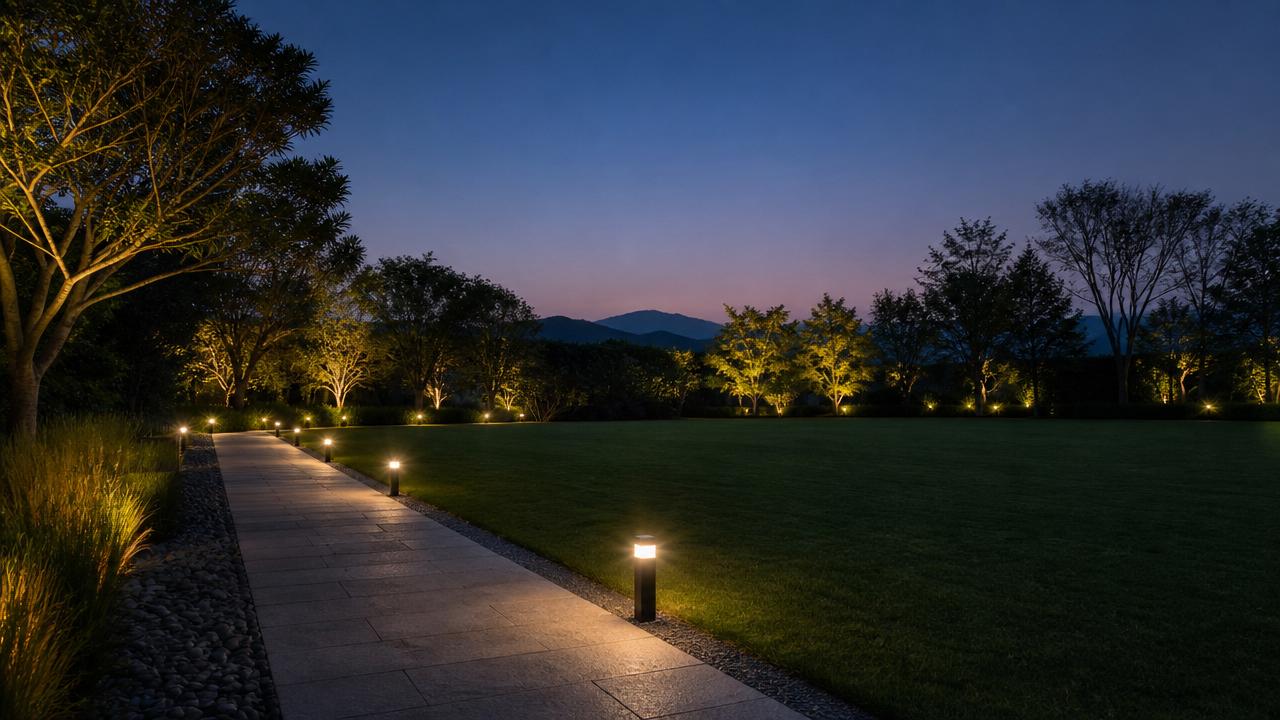
Choosing the right LED Garden&Lawn Lighting for pathways or open greens directly affects safety, visual consistency, maintenance cost, and long-term project performance.
For project managers and engineering leads, the key question is not simply which fixture looks better, but which lighting approach fits circulation patterns, user behavior, and lifecycle requirements.
In most large outdoor developments, pathways and open greens should not be treated as the same lighting task.
Pathways usually require controlled guidance, visual comfort, and dependable uniformity, while open green areas often need selective accenting, boundary definition, or broader ambient coverage.
That is why GLL-FQ planning should start with function first, then fixture layout, control strategy, and maintenance practicality.
When these decisions are made early, projects are easier to deliver, safer to operate, and more consistent over time.
What project managers are really trying to decide
If someone searches for LED Garden&Lawn Lighting for pathways or open greens, the real intent is usually comparative and practical.
They want to know which lighting method is more suitable for a specific outdoor zone, what performance standards matter, and how to avoid over-lighting, under-lighting, or future maintenance problems.
For project leaders, this is rarely a decorative choice alone.
It is a decision tied to user safety, project budget, electrical planning, installation complexity, and whether the finished environment will still perform well after years of exposure.
In public spaces, residential developments, campuses, parks, and mixed-use urban projects, lighting mistakes become visible very quickly.
Poor pathway lighting creates safety concerns and user discomfort, while poorly planned lawn lighting can waste energy and make open spaces feel flat or visually fragmented.
Pathway lighting priorities: safety, orientation, and comfort
For pathways, the first priority is helping people move confidently and safely.
That means lighting should support edge recognition, surface visibility, and direction, rather than creating dramatic brightness with harsh contrast.
In many projects, lower-height garden or lawn fixtures work well because they define the route without overwhelming adjacent landscape elements.
This is especially useful in pedestrian corridors, hotel gardens, parks, community walkways, and public recreational areas.
Project managers should pay close attention to spacing, beam spread, mounting height, and glare control.
A fixture that is too bright or too exposed can reduce comfort, even if measured light levels appear sufficient on paper.
Uniformity often matters more than peak brightness.
Users feel safer when the path reads clearly as a continuous route, with fewer dark pockets and fewer sudden shifts between bright and dim areas.
From a delivery perspective, pathway lighting also benefits from predictable installation logic.
Linear layouts are generally easier to coordinate with paving, drainage, cabling routes, and maintenance access than irregular open-space lighting schemes.
Open green lighting priorities: atmosphere, scale, and selective coverage
Open greens have different demands.
In many cases, these areas do not need blanket illumination across the entire lawn surface, especially when the goal is visual balance and efficient energy use.
Instead, lighting may be used to shape perception of space, define gathering edges, highlight trees or landscape features, or support low-level evening use.
This is where project teams must be careful not to apply pathway logic to lawn areas.
If fixtures are simply repeated across a broad green zone, the result can feel visually cluttered, inefficient, and expensive to maintain.
For open lawns, a layered strategy often works better.
That may include perimeter guidance lighting, feature accent lighting, and only targeted higher-output illumination where activity levels justify it.
In larger civic or commercial landscapes, broader coverage may sometimes be needed.
In such cases, a supporting solution like LED Floodlight can be integrated for plazas, landscapes, or adjacent public zones where wider, more uniform projection is required.
Used selectively, this kind of support can reduce the number of low-level fixtures needed across open space while maintaining visual order.
How to choose between pathway-focused and lawn-focused layouts
The best decision starts with how the outdoor area is actually used.
Project managers should assess whether the primary purpose is movement, short-term gathering, landscape appreciation, or multi-functional public activity.
If people mainly pass through the area, pathway-oriented LED Garden&Lawn Lighting should take priority.
If the space is intended to be viewed, occupied casually, or connected to larger visual compositions, lawn and accent strategies may deserve more emphasis.
It is also important to study the relationship between hardscape and softscape.
Walkways, steps, benches, trees, water features, and open grass all influence how light should be distributed.
Another key factor is operating schedule.
Some pathways require consistent night performance for safety and compliance, while open greens may only need timed, dimmed, or event-based lighting.
This difference strongly affects fixture selection, control zoning, and long-term energy costs.
Finally, consider maintenance access early.
Fixtures installed in exposed lawn areas can be affected by irrigation, landscaping work, and accidental impact, while pathway edge fixtures may be easier to inspect and replace systematically.
What matters most in fixture selection for large-scale projects
For engineering-led procurement, performance specifications matter more than catalog appearance.
Outdoor lighting products should be chosen based on reliability, environmental protection, optical suitability, and compatibility with project controls.
At minimum, project teams should evaluate ingress protection, material durability, driver stability, and expected service life.
In large developments, even a small failure rate can create a significant maintenance burden over time.
Optics are equally important.
Narrow, medium, or wide beam angles can dramatically change the usefulness of a lighting product in pathways, landscape accents, or open-zone coverage.
Color temperature should also match the project character.
Warmer tones often support hospitality, residential, and park settings, while neutral tones may suit civic or mixed-use environments where clarity is a priority.
When complementary higher-output lighting is needed in surrounding zones, technical flexibility becomes valuable.
For example, the TGD-031 configuration offers 6-60W options, CREE or OSRAM chips, DC24V or AC220V input, multiple color temperatures from 2000K to 4000K plus RGB and RGBW, Ra≥80, IP66 protection, beam angles from 3° to 60°, and a lifespan of at least 50,000 hours.
Those specifications are useful in projects that require brighter, more uniform, and longer-lasting illumination with tailored configuration choices.
Cost control is not only about fixture price
One of the most common procurement mistakes is comparing solutions only by unit cost.
For project managers, the more meaningful measure is total project efficiency over the system lifecycle.
A lower-cost fixture that causes uneven lighting, frequent replacement, or difficult integration can create more expense after handover.
That is why layout efficiency, wiring simplicity, control compatibility, and maintenance intervals should be included in early comparisons.
In pathway applications, good spacing discipline may reduce fixture count without sacrificing usability.
In open greens, selective rather than blanket lighting often provides better visual results at lower operating cost.
Smart controls can further improve return on investment.
Dimming schedules, zoning, and scene-based operation help align actual energy use with how the site is occupied throughout the evening.
For contractors and owners managing multiple outdoor areas, integrated planning is usually more effective than selecting products in isolation.
This is especially true in urban environments where roads, plazas, landscaped edges, and open greens connect within one coordinated lighting scheme.
Reducing project risk through better lighting integration
Lighting failures in outdoor projects are often integration failures, not just product failures.
Problems arise when fixture types, controls, installation methods, and site conditions are considered too late.
For this reason, project teams should review lighting together with civil works, landscape design, electrical routing, and operational planning.
Questions to ask early include whether fixture locations conflict with irrigation lines, whether mounting bases are practical, and whether future servicing can be done without disrupting finished landscape areas.
It is also wise to align lighting strategy with the broader project environment.
A pathway may connect to a plaza, roadway edge, or landscaped gathering space, and the transition between these zones should feel intentional.
Experienced suppliers can support this process by helping teams evaluate product fit, configuration options, and system coordination based on real project conditions.
For large-scale developments, this kind of support reduces rework risk and improves consistency from design intent to site delivery.
Final decision: pathways or open greens?
The answer is usually not either-or, but purpose-led prioritization.
If safety, direction, and pedestrian clarity drive the space, pathway-focused LED Garden&Lawn Lighting should lead the design.
If spatial atmosphere, feature visibility, and broader visual composition matter more, open-green lighting should be handled as a layered landscape strategy rather than a repetitive fixture pattern.
For most large projects, the best outcome comes from combining both approaches in the right proportions.
That means using GLL-FQ solutions where low-level guidance and landscape integration are most effective, while supporting wider public or feature-oriented zones with appropriately specified complementary lighting where needed.
For project managers, the real value lies in choosing a system that delivers dependable performance, manageable maintenance, and a clear match between lighting design and actual site use.
When that alignment is achieved, outdoor lighting stops being a procurement item and becomes a reliable part of project success.
◉ MESSAGE
Blog
- What Is an LED Beam Projector Used For in Architectural and Outdoor Lighting?
- LED Beam Projector Buying Guide: Beam Angle, Power, IP Rating, and Control Options
- How to Maintain an LED Beam Projector for Stable Outdoor Performance
- What Safety and Quality Checks Matter Most for LED Beam Projector Selection?
- Is an LED Beam Projector Worth the Investment for Premium Outdoor Lighting Projects?
- Modern Street Lighting | MSL-GH Selection Guide: Wattage, Optics, Pole Height, and Spacing
- Modern Street Lighting | MSL-GH vs Conventional Streetlights: What Changes in Performance?
Message