
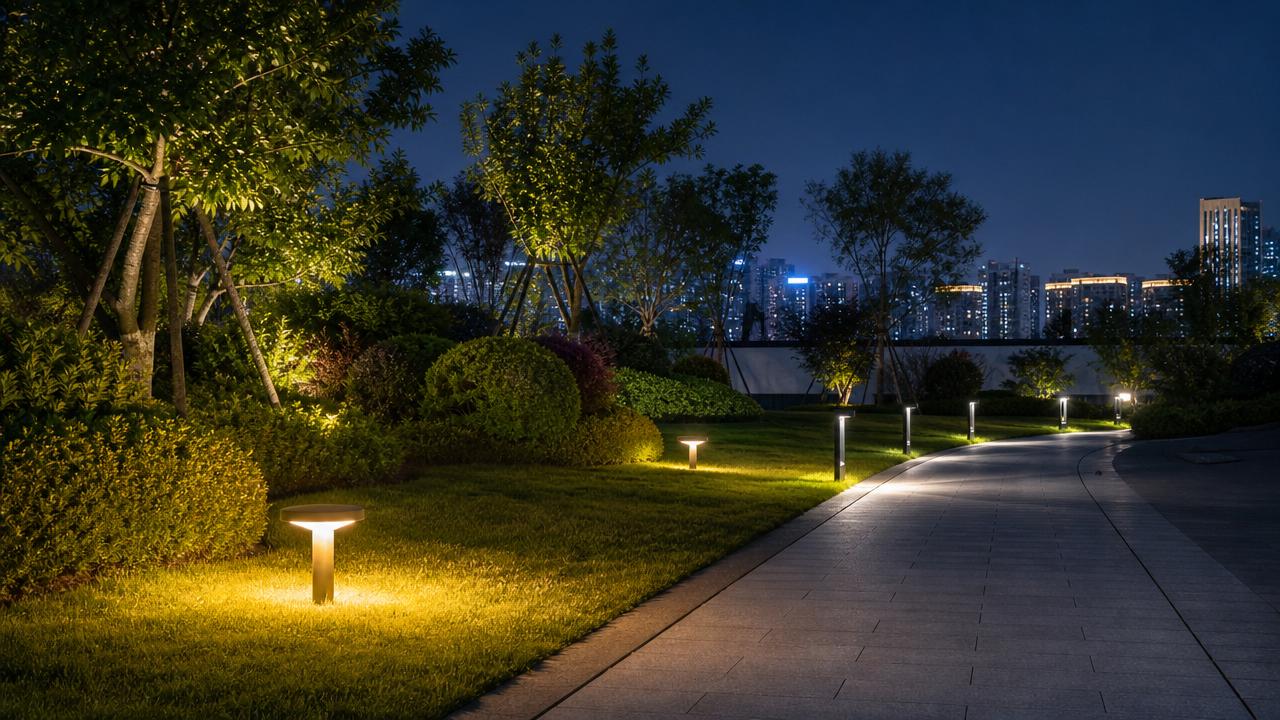
When evaluating outdoor lighting for large-scale projects, understanding the difference between decorative and functional solutions is essential.
LED Garden&Lawn Lighting supports both visual identity and practical performance across public landscapes, roadsides, and urban spaces.
Models such as GLL-FQ can improve safety, navigation, and nighttime consistency while still contributing to a refined landscape appearance.
For project planning, the right distinction affects design quality, maintenance efficiency, smart control compatibility, and long-term value.
Why the decorative versus functional decision matters in outdoor lighting
Not all lawn lighting serves the same purpose, even when fixtures appear similar during daytime installation reviews.
Decorative lighting mainly shapes atmosphere, highlights planting edges, and strengthens the visual character of outdoor environments.
Functional lighting focuses on visibility, route definition, hazard reduction, and stable illumination in frequently used exterior zones.
In many projects, LED Garden&Lawn Lighting must do both, but one priority usually dominates the specification.
That is why early scene judgment is more valuable than selecting fixtures only by appearance or initial wattage.
Scene-based judgment: where decorative lawn lighting works best
Decorative lighting performs best in spaces where mood, identity, and soft visual layering matter more than strong task visibility.
Typical examples include garden borders, hotel landscapes, sculpture surroundings, and leisure lawns with limited night movement.
In these settings, LED Garden&Lawn Lighting should emphasize controlled brightness, color harmony, and reduced glare.
Key indicators of a decorative priority
- Low pedestrian speed and low nighttime traffic
- Strong focus on landscape composition and nighttime ambiance
- Need to highlight textures, plants, or architectural edges
- Preference for warm color temperatures or RGB effects
In decorative scenes, over-lighting can flatten the space and reduce depth, making premium landscaping feel ordinary.
Scene-based judgment: where functional lawn lighting becomes essential
Functional lighting is critical where people must move safely, identify boundaries, and read spatial conditions clearly at night.
This often includes walkways, park connectors, civic lawns, roadside greenbelts, and mixed-use public open spaces.
Here, LED Garden&Lawn Lighting must deliver consistent coverage, durable housing, and dependable operation in changing weather.
GLL-FQ style applications are especially relevant when route clarity and maintenance predictability matter more than visual drama.
Key indicators of a functional priority
- Regular pedestrian circulation after dark
- Potential trip hazards near edges, steps, or uneven surfaces
- Requirement for reliable lumen output over time
- Need for control integration and efficient maintenance access
How application differences change specification choices
The same site may contain decorative and functional zones, but each area should be judged by actual nighttime use.
That affects beam distribution, brightness level, optical shielding, and how the system connects with broader outdoor controls.
Practical adaptation advice for mixed outdoor projects
Most large sites benefit from layered planning rather than using one lighting type across every lawn and landscape section.
- Map pedestrian intensity before choosing fixture spacing.
- Separate visual feature zones from circulation zones.
- Use warmer tones in rest areas and clearer output near paths.
- Check ingress protection, lifespan, and maintenance access early.
- Align LED Garden&Lawn Lighting with central control requirements.
For broader landscape emphasis, targeted floodlighting can complement lawn fixtures without forcing excessive brightness at ground level.
One useful option is LED Floodlight for plazas, stadium edges, and landscape accents.
With 6-60W configurations, IP66 protection, multiple beam angles, and RGB or RGBW choices, it fits varied outdoor lighting layers.
Such support is valuable when decorative lawn lighting needs stronger background depth or when public zones demand more uniform perimeter illumination.
Common misjudgments that reduce project performance
A frequent mistake is judging lawn lighting only by daytime appearance, while ignoring nighttime use intensity and user movement patterns.
Another is assuming decorative fixtures can automatically satisfy functional needs just because they use LED sources.
Poor beam control can create glare, dark patches, or uneven visual rhythm, especially in larger public landscapes.
Projects also underestimate lifecycle issues, including water resistance, driver stability, and replacement coordination across smart systems.
When LED Garden&Lawn Lighting is selected without scene-based evaluation, maintenance costs often rise while actual lighting quality declines.
The next step: evaluate each lawn lighting zone by purpose
The real difference between decorative and functional lawn lighting is not cosmetic. It is operational, spatial, and long-term.
LED Garden&Lawn Lighting should be chosen according to movement patterns, visual goals, environmental exposure, and system-level coordination.
If a zone mainly shapes mood, prioritize aesthetics and layered effects. If it guides people, prioritize clarity, consistency, and durability.
For complex projects, reviewing each outdoor scene separately helps deliver better lighting performance and stronger long-term project results.
◉ MESSAGE
Blog
- What Is an LED Beam Projector Used For in Architectural and Outdoor Lighting?
- LED Beam Projector Buying Guide: Beam Angle, Power, IP Rating, and Control Options
- How to Maintain an LED Beam Projector for Stable Outdoor Performance
- What Safety and Quality Checks Matter Most for LED Beam Projector Selection?
- Is an LED Beam Projector Worth the Investment for Premium Outdoor Lighting Projects?
- Modern Street Lighting | MSL-GH Selection Guide: Wattage, Optics, Pole Height, and Spacing
- Modern Street Lighting | MSL-GH vs Conventional Streetlights: What Changes in Performance?
Message