
When Wind Solar Street Lights Outperform Grid-Connected Road Lighting
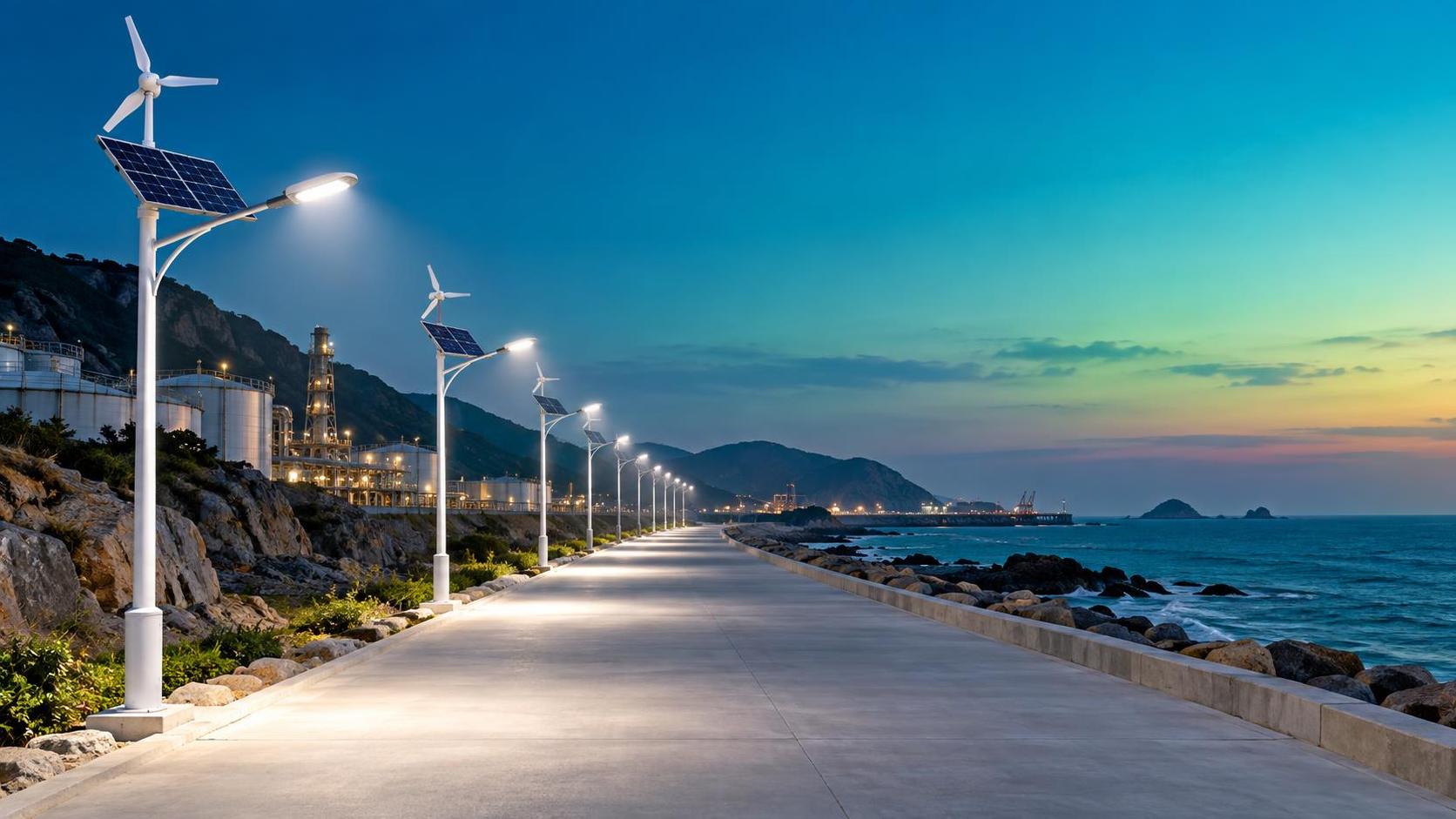
A wind solar street light outperforms grid-connected road lighting only when it removes a real infrastructure constraint rather than simply replacing purchased electricity. The strongest cases are corridors where bringing in utility power requires long cable runs, trenching across difficult ground, new transformers, repeated road closures, or coordination with a grid operator whose connection schedule does not match the construction programme.
Where a stable grid connection is already available at each pole location, conventional LED road lighting is often the lower-risk baseline. It offers predictable energy supply, simpler luminaire sizing, and fewer weather-dependent variables. A hybrid wind-and-solar system becomes the better project choice when its avoided civil works, autonomous operation, and resilience value outweigh the cost and maintenance burden of local generation and energy storage.
Grid extension cost is usually the decisive threshold
The comparison should not begin with the purchase price of a pole, panel, turbine, or luminaire. It should begin with the full installed cost of supplying electricity to the lighting points.
For grid-connected roads, that cost can include cable trenches, ducts, reinstatement, feeder pillars, distribution boards, transformers, utility connection charges, electrical testing, traffic management, and permits. In an urban reconstruction project, opening a newly paved road or crossing existing underground services can be more disruptive than the lighting equipment itself. On remote roads, industrial access routes, coastal infrastructure, parks, border facilities, and temporary development zones, the distance to a suitable power source may make grid extension disproportionately expensive.
A Wind Solar Street Light can avoid much of this network work because generation, battery storage, control, and lighting are installed as a self-contained system. The financial advantage is not that renewable hardware is inherently cheap; it is that the project may no longer need a long, buried electrical distribution network.
This distinction matters in tender evaluation. A bidder comparing only luminaire and pole prices can make an off-grid solution look expensive. A project owner comparing installed, commissioned, and maintained infrastructure over the intended operating period may reach a different conclusion.
Autonomy has value where utility reliability is weak
Grid-connected lighting is dependent on upstream conditions that the lighting contractor cannot control: outages, voltage instability, delayed energisation, feeder faults, and damage to distribution cables. In locations where road visibility is important during power interruptions, a self-powered lighting system can provide operational resilience rather than merely energy savings.
That does not mean every hybrid installation is automatically more reliable. Its reliability shifts from the utility network to local energy management. The battery must retain usable capacity through its service life, the charge controller must protect it against over-discharge, and the renewable inputs must be sufficient for the local weather pattern and lighting load. If these elements are undersized, the system can dim excessively or shut down after a sequence of low-generation days.
Projects with security-sensitive access roads, isolated public assets, emergency routes, or sites awaiting permanent utility service may therefore place a higher value on autonomy. In contrast, a heavily trafficked urban arterial with strict lighting uniformity requirements may still favor grid supply unless the hybrid system has been engineered with a clearly demonstrated energy reserve.
Wind and solar should be treated as complementary resources, not a marketing label
The technical rationale for combining wind and solar is straightforward: solar output is tied to daylight, while wind may contribute at night or during seasons with weaker solar irradiation. But complementarity depends entirely on site conditions. A turbine installed in an enclosed street canyon, behind tall buildings, beside dense tree cover, or in terrain with turbulent airflow may generate far less useful energy than its nominal rating implies.
Wind assessment needs more than a general statement that a region is “windy.” Average wind speed, turbulence, seasonal variation, mounting height, surrounding obstructions, and maintenance access all affect output. Small turbines are particularly sensitive to poor siting because urban turbulence can reduce energy capture while increasing mechanical stress and noise concerns.
Solar assessment has its own constraints. Panel orientation, shade from trees or adjacent structures, dust accumulation, snow cover where relevant, and seasonal daylight all influence charging performance. A road layout can create shading patterns that are not obvious during a brief site visit. A design based on annual average solar availability may also fail to protect winter operation, when lighting hours are longer and solar harvest may be lower.
For this reason, hybrid systems should be sized against the worst credible operating period, not against an attractive annual energy estimate. The relevant question is whether the system can maintain the required lighting schedule after a defined sequence of low-resource days. That design requirement should be explicit in the project specification.
The lighting load must be designed around the energy budget
Off-grid road lighting does not have the same freedom to use electrical power as a grid-connected system. Every watt drawn by the luminaire affects panel size, turbine capacity, battery storage, pole loading, and project cost. Efficient LED optics and intelligent dimming are therefore central to system feasibility.
Rather than operating at full output all night, a road can use a lighting profile that reflects actual risk and traffic conditions. Higher output may be retained during early evening activity, intersections, pedestrian conflict points, or periods requiring enhanced visibility. Lower output can be scheduled during quieter hours, provided the lighting class, safety requirements, and local authority expectations permit it. Motion-responsive control may be suitable for low-traffic paths or access roads, but it is not automatically appropriate for through-roads where abrupt changes in luminance can affect driver perception.
The luminaire choice still matters even when the main decision is between power systems. For a grid-connected section or a hybrid project with demanding photometric requirements, an LED Street Light Luminaire with appropriate optical distribution, dimming compatibility, and IP66 protection can support a lower energy budget without treating reduced wattage as a substitute for sound lighting design. Lumen output alone is not enough; mounting height, spacing, road width, glare control, uniformity, and optical distribution determine whether useful light reaches the roadway.
Battery design is where many lifecycle assumptions fail
The battery is usually the component that makes or breaks long-term off-grid performance. It must store enough energy to bridge nights and low-generation periods, operate within local temperature conditions, and remain protected from deep discharge and inappropriate charging. Battery capacity quoted at factory conditions should not be read as guaranteed usable field capacity throughout the project life.
Decision-makers should ask for the design assumptions behind the battery rather than accepting a single capacity figure. Relevant questions include the planned depth of discharge, expected autonomy, temperature management approach, charging limits, battery replacement strategy, enclosure access, and the control logic used when energy reserves fall below a threshold. A system that preserves battery health by reducing lighting output may be sensible, but the reduced-output mode must still be acceptable for the road’s safety function.
Replacement planning is equally important. A grid-connected LED luminaire with a rated life of 50,000 hours or more does not mean the energy-storage system will require no intervention for the same period. The maintenance budget and contract scope should distinguish between luminaire life, battery service life, turbine inspection needs, and control-system support.
Hybrid poles introduce structural and maintenance obligations
A conventional road-lighting pole carries a luminaire and bracket. A wind-solar pole may additionally support photovoltaic modules, a turbine, batteries, controllers, and communication equipment. This changes wind loading, foundation requirements, lifting procedures, and access needs. The turbine creates moving parts that require inspection for fasteners, bearings, vibration, and blade condition. In coastal or corrosive environments, material selection and protective finishes become particularly significant.
These factors do not rule out hybrid lighting. They simply mean that the project should not treat it as a standard solar pole with an extra accessory attached. Structural calculations, local wind conditions, lightning protection, grounding, ingress protection, and service access need to be addressed as an integrated design.
For grid-connected lighting, the risk profile is different: buried cable faults, electrical distribution failures, and utility dependency tend to be more important. The better option is the one whose maintenance risks can realistically be managed at the site.
Where grid-connected lighting remains the stronger choice
Grid-connected LED lighting generally remains preferable when the electrical network is already present, connection capacity is adequate, power quality is dependable, and the road requires consistently high light output over long nightly operating hours. It is also often the more practical choice where space for panels is limited, wind conditions are unsuitable, or the authority requires centralized electrical infrastructure and uniform control across a dense urban network.
A hybrid solution should not be selected solely to meet a sustainability narrative. If renewable resources are poor, the road carries high safety obligations, and utility power is readily available, local generation can add complexity without delivering a proportionate benefit.
A decision should be based on avoided infrastructure and verified operating conditions
The most credible business case for wind-solar street lighting combines four conditions: costly or delayed grid extension, a site with usable solar and wind resources, a lighting profile that can be intelligently managed, and an owner prepared to maintain distributed energy assets. Remove one of these conditions and the advantage becomes less certain.
Before committing, project teams should require a site-specific energy model, seasonal generation assumptions, battery autonomy calculations, lighting calculations for normal and reduced-output modes, structural documentation, and a lifecycle maintenance plan. They should also confirm applicable local electrical, road-lighting, structural, and product-safety requirements with the relevant authorities.
When these inputs support the design, a Wind Solar Street Light can deliver more than lower grid consumption: it can make lighting feasible where conventional network infrastructure is economically or operationally impractical. When they do not, a well-designed grid-connected LED system remains the more dependable investment.
◉ MESSAGE

Blog
- How to avoid vendor lock-in in a government smart lighting project
- Sizing the communications power budget for smart city solar street lights
- How energy-saving mode affects solar bollard light operating time
- Comparing lead times from LED street light luminaire suppliers in Europe
- What spare parts support should a smart street light exporter offer?
- Where to place a solar garden light in a partially shaded garden
- Which battery alerts matter in remotely monitored solar street lighting?
Message