
What wind data should a wind-solar hybrid street lighting tender require?
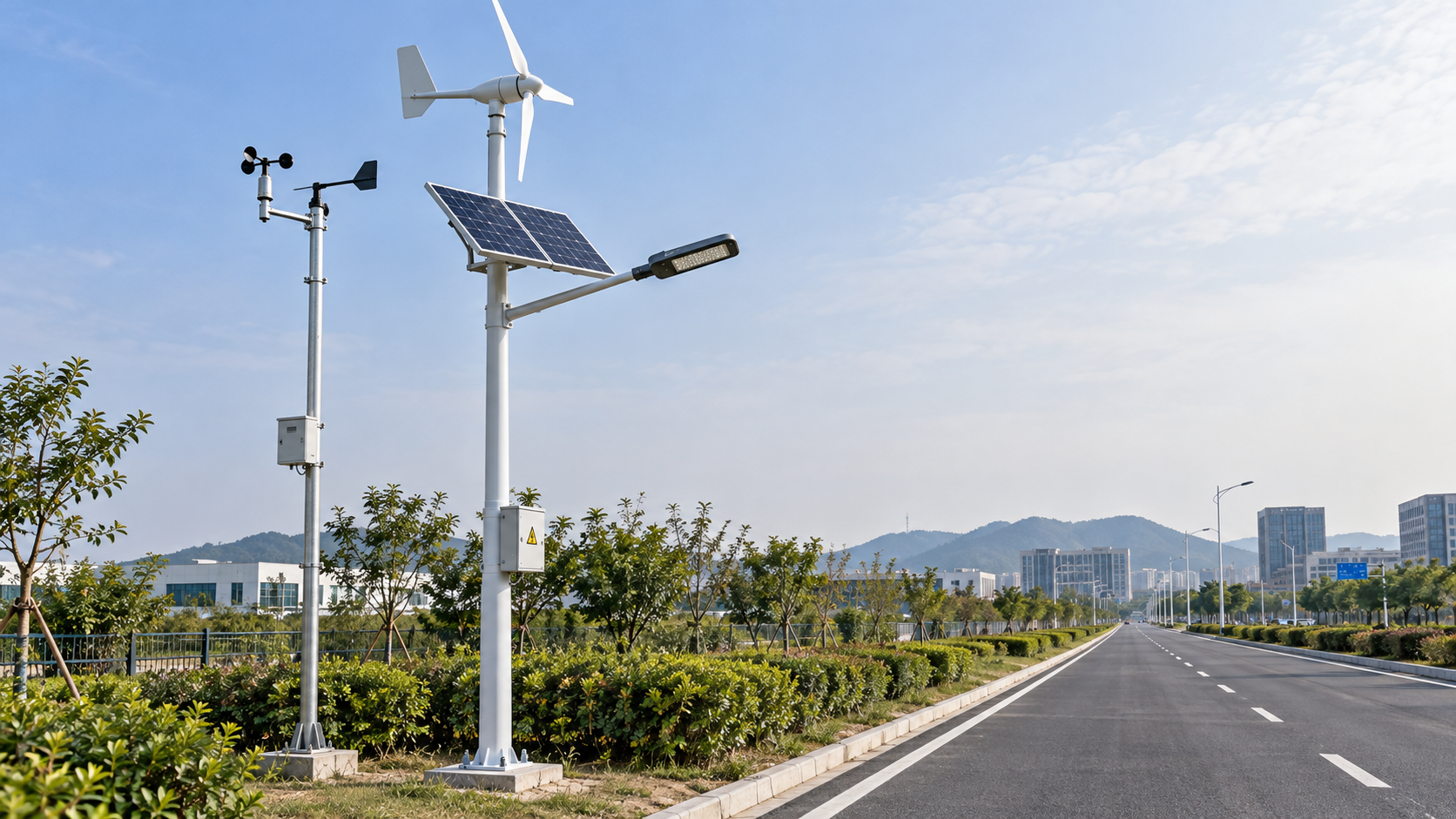
A wind-solar hybrid street lighting tender should require site-representative wind measurements at the proposed turbine hub height, seasonal wind-speed distributions, direction and turbulence records, extreme-wind evidence, and a traceable net-energy calculation. A regional annual average is not enough: two bids can use the same average speed yet predict very different battery charging and nighttime lighting availability.
The procurement risk appears when a low-priced package credits wind generation that the installed turbine cannot reliably deliver. Require bidders to connect their wind evidence to the actual turbine, solar array, battery, and lighting schedule—and disclose uncertainty rather than hiding it inside an annual energy total.
Specify where and how the wind data was collected
Wind measured at an airport, on a rooftop, or above an open field may not represent a turbine beside trees and buildings. At street-lighting heights, nearby obstacles can substantially change speed, direction, and turbulence. Start the tender with a site map showing proposed poles, turbine hub heights, terrain, buildings, vegetation, and other significant obstructions.
For a long corridor or several distinct sites, ask bidders to explain how they grouped locations into wind-exposure zones. One measurement point should not automatically represent every pole. Sheltered sections may need different equipment or no wind contribution in the energy model.
A simple height correction using an unexplained exponent is weak evidence in obstructed streets. Where measurements are taken at another elevation, require the bidder to justify wind shear and account for local sheltering. Mapping products and nearby weather stations can support early screening, but should not silently replace site validation.
Request a seasonal record, not a convenient snapshot
For a measurement-led assessment, specify at least 12 consecutive months as the preferred baseline for capturing seasonality. This is a procurement recommendation, not a universal statutory minimum. One year can still be unusually windy or calm, so require comparison with a suitable longer-term reference and disclosure of the correlation method, reference period, and uncertainty.
When the tender schedule cannot accommodate a full measurement campaign, separate provisional bidding from final design approval. Require bidders to identify the shorter record’s limitations, propose validation, and show performance with reduced or zero wind credit. Do not treat an unverified wind forecast as guaranteed energy.
Request monthly wind statistics and the underlying time series. Ten-minute records are useful for resource assessment, while turbine loading and gust evaluation may require higher-frequency measurements. Specify averaging intervals explicitly: a ten-minute maximum and a short-duration gust are not interchangeable.
The wind statistics that change equipment selection
- Wind-speed frequency distribution: Request measured speed bins and the proportion of time in each bin. An average alone cannot show how often the turbine produces useful power.
- Wind direction: Require a wind rose and direction-dependent obstruction assessment. Winds arriving through buildings may perform differently from winds crossing open terrain.
- Low-wind persistence: Ask for the frequency and duration of consecutive low-generation periods, including those coinciding with weak solar conditions.
- Turbulence intensity: Require the calculation method, averaging interval, and variation with speed and direction. High turbulence can affect yield, fatigue, vibration, and maintenance.
- Air density inputs: Identify temperature, pressure or elevation assumptions, and how the power calculation accounts for them.
A fitted wind distribution can help summarize results, but it should not replace the measured distribution without explanation. Likewise, being above the turbine’s cut-in speed does not mean it delivers rated power—or enough net power to charge the battery after losses.
Keep extreme-wind survival separate from energy yield
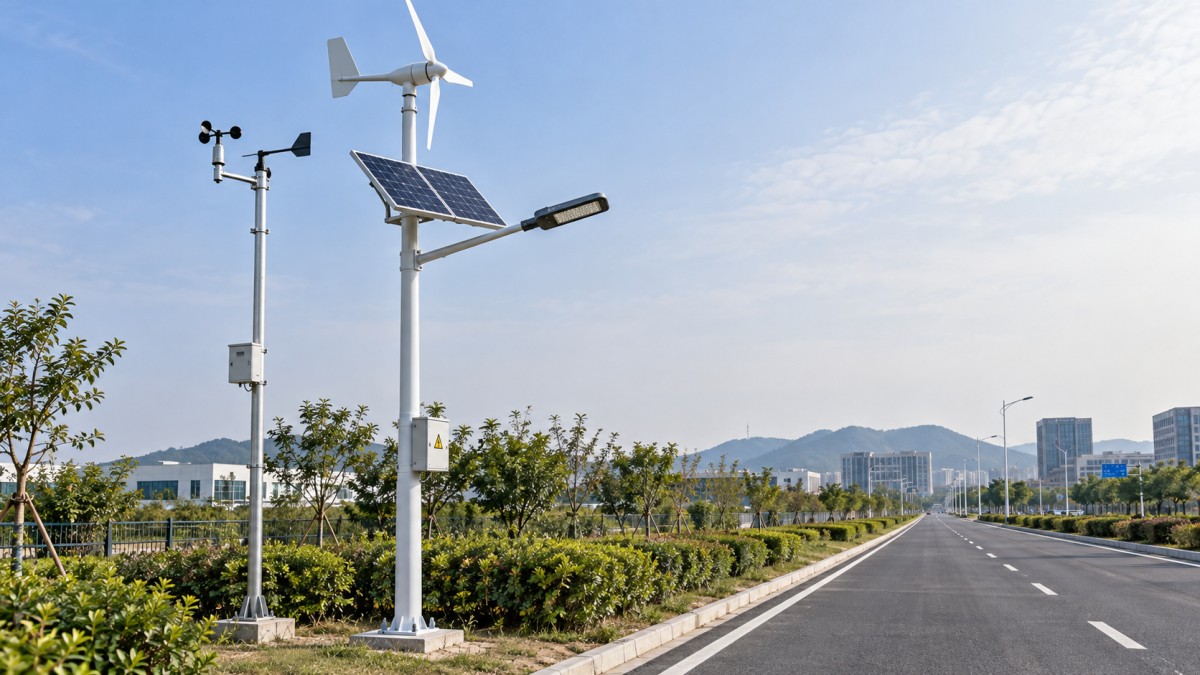
Annual generation calculations do not establish structural safety. Require a site-specific assessment of extreme winds, relevant gust durations, exposure, and the design basis required by applicable local rules. Turbine operating limits, shutdown behavior, braking arrangements, and survival conditions must be documented separately.
The complete assembly needs checking: turbine, mounting bracket, pole, solar panels, connections, and foundation. Adding a rotor introduces dynamic loads that a conventional lighting-pole specification may not address. Ask for engineering verification of the proposed configuration, including fatigue and vibration where relevant.
For example, Smart Street Lighting | SSL-CH lists a 6 m pole, 50–100 W rated power, and wind resistance of ≥150 km/h. These specifications can inform initial selection, but they do not establish turbine compatibility or validate the assembled hybrid system. The tender should require the wind-resistance test or calculation basis and separate verification of any turbine-equipped configuration.
Make bidders convert wind into usable battery energy
Require a documented power curve for the offered turbine, identifying its test basis, configuration, and reference conditions. Marketing claims based only on rated output should not qualify as an energy assessment. The calculation must apply the wind distribution or time series to that curve, then account for site conditions and system losses.
Demand a clear distinction between gross turbine output and energy delivered into storage. Rectifier, controller, wiring, charging, availability, curtailment, and shutdown losses should be shown without double counting. Bidders should also explain performance below useful charging voltage and any limitations imposed by the battery controller.
For bid comparison, issue a common dataset and common modeling assumptions where possible. Let bidders submit alternative assessments separately, with supporting evidence. Otherwise, an optimistic wind model can make an undersized battery appear more economical than a conservative, better-supported design.
Test the difficult nights, not just the annual balance
A positive annual energy balance does not prove nighttime reliability. Wind may arrive when the battery is already full, while a calm, cloudy period can leave it depleted. Require a chronological simulation that aligns wind, solar generation, and lighting demand on consistent timestamps. Hourly modeling is a practical starting point; require finer resolution where control behavior or short events materially affect results.
The load model should include the agreed lighting hours, dimming schedule, controls, communications, and conversion losses. Battery assumptions must cover usable capacity, operating temperature, aging allowance, charge limits, and the minimum permitted state of charge.
- Run the baseline using the same lighting service requirement for every bid.
- Report unmet lighting demand, its duration, and minimum battery state of charge—not only generation totals.
- Stress-test coincident low wind and poor solar conditions, lower-than-expected wind yield, and temporary turbine unavailability.
- Show whether any apparent reliability improvement depends on dimming below the contracted lighting requirement.
Use the evidence to control cost and acceptance
Compare hybrid bids against a solar-only baseline providing the same lighting service. Include the turbine, structural changes, measurement work, inspections, maintenance access, replacement components, and battery implications. Wind is financially useful only when its incremental usable energy justifies those costs; extra annual generation that is mostly curtailed may offer little value.
Finally, define acceptance evidence before award: delivered configuration, calculation files, structural documentation, commissioning checks, and operational monitoring. Short commissioning tests cannot prove annual yield. Where performance guarantees are requested, specify how measured wind conditions, equipment availability, battery state, and lighting output will be recorded and reconciled. Reject unsupported wind credit or price it as an unverified option rather than allowing it to reduce the required storage capacity.
◉ MESSAGE

Blog
- How to avoid vendor lock-in in a government smart lighting project
- Sizing the communications power budget for smart city solar street lights
- How energy-saving mode affects solar bollard light operating time
- Comparing lead times from LED street light luminaire suppliers in Europe
- What spare parts support should a smart street light exporter offer?
- Where to place a solar garden light in a partially shaded garden
- Which battery alerts matter in remotely monitored solar street lighting?
Message