
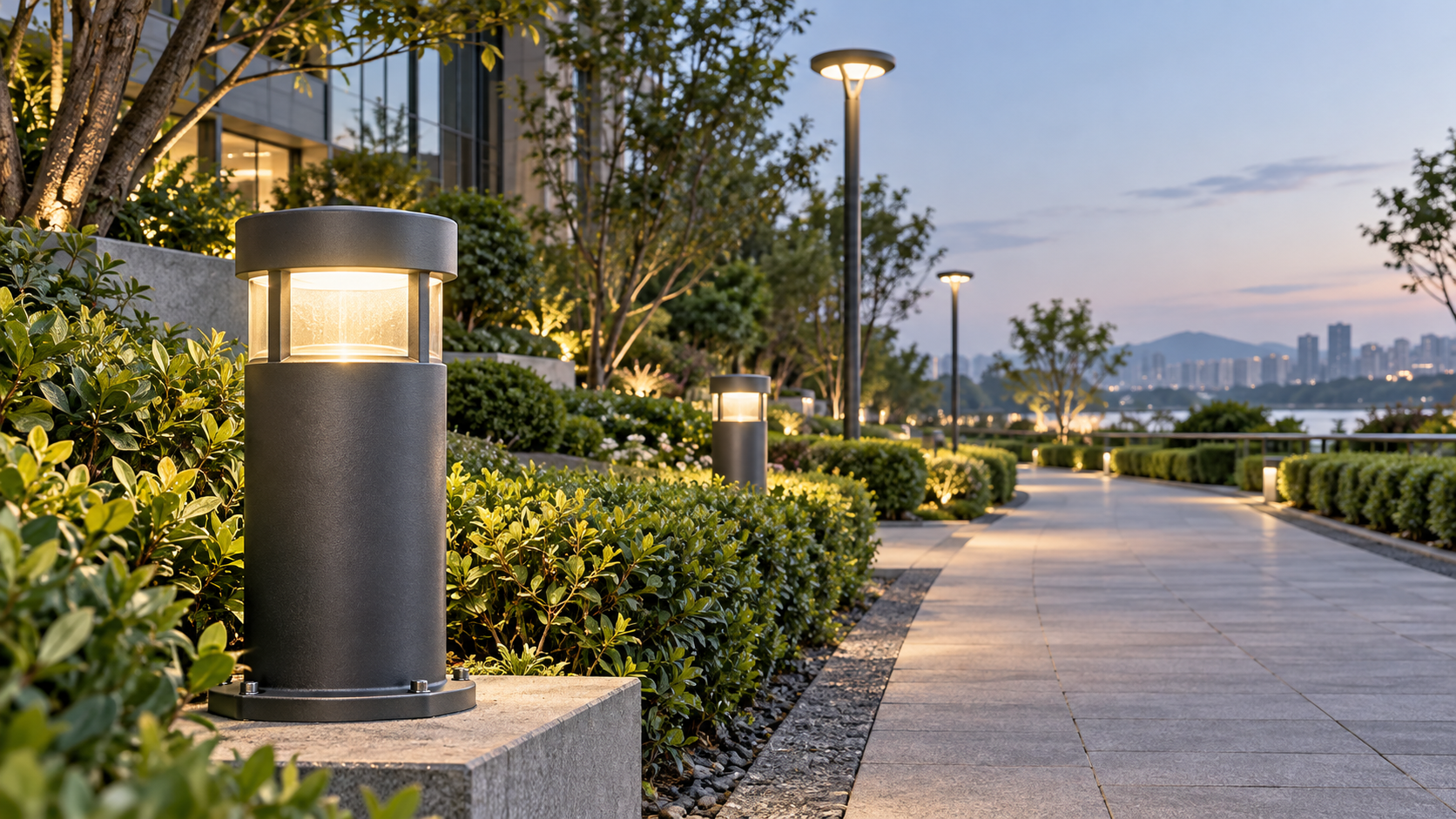
What impact rating should commercial LED garden lighting have?
For most publicly accessible commercial gardens, IK08 is a practical starting specification. Consider IK10 where deliberate damage, frequent contact, or costly maintenance increases exposure.
For quality control and safety teams, specifying LED Garden&Lawn Lighting commercial grade means looking beyond brightness and weather resistance to foreseeable mechanical impacts.
The appropriate rating depends on installation height, public access, maintenance activity, and vandalism risk. Neither IK08 nor IK10 represents a universal minimum for every project.
This guide explains how to assess ratings under IEC 62262, review test documentation, and match fixture durability to site conditions and long-term maintenance requirements.
Choose IK08 or IK10 according to actual exposure
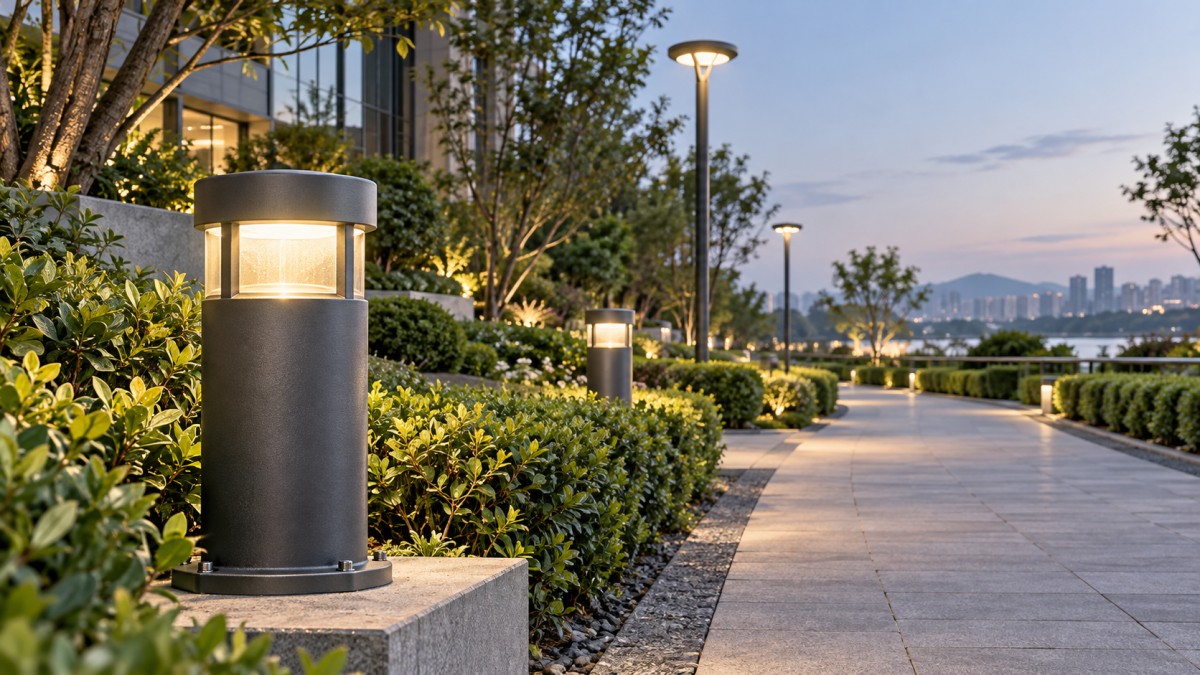
Start by mapping where people, tools, and maintenance equipment can contact the luminaire. Then assign impact requirements to each location instead of specifying uniformly.
An elevated luminaire in a supervised courtyard faces different hazards from an accessible fixture beside a busy public path, playground, or late-night gathering area.
These are selection guidelines, not requirements imposed universally by IEC 62262. Applicable regulations, tender specifications, and owner standards may establish different minimum requirements locally.
For accessible bollards near groundskeeping routes, consider equipment contact separately. Even IK10 does not establish resistance to mower collisions, vehicle strikes, or repeated abuse.
Where impact consequences are severe, combine a suitable enclosure rating with protected positioning, barriers, or revised maintenance routes. Increasing the rating alone may be insufficient.
Understand what an IK rating actually proves
IEC 62262 classifies the protection provided by electrical equipment enclosures against external mechanical impacts. The rating expresses standardized impact energy rather than overall product durability.
Although IK10 represents four times the impact energy of IK08, it does not mean four times the service life or immunity to vandalism damage.
Sharp objects, repeated blows, unusual impact angles, and vehicle contact may create conditions outside the reported test. Avoid describing any IK-rated fixture as vandal-proof.
Likewise, a metal housing does not establish an IK rating. Lenses, covers, joints, and fastening arrangements influence how the tested enclosure withstands an impact.
IK and IP ratings address different hazards. An IP67 declaration concerns dust and water ingress under specified conditions; it does not demonstrate mechanical impact resistance.
Check whether the evidence covers the supplied fixture
A catalogue entry stating “IK10” should trigger document review, especially where fixture failure could expose electrical components, release fragments, or disrupt a busy public area.
Request a test report identifying the standard, laboratory, tested model, and relevant configuration. Confirm that the report corresponds to the product offered for supply.
Check whether different lenses, housing materials, sizes, or mounting options affect applicability. Evidence for one version should not automatically be accepted for every variant.
- Match model numbers, drawings, photographs, and material descriptions to the approved submittal.
- Review tested surfaces, impact locations, mounting arrangements, and any exclusions.
- Check results and acceptance criteria, including relevant safety and enclosure integrity assessments.
- Confirm laboratory competence and any accreditation required by the contract.
- Obtain written clarification when the report covers only selected components.
A report covering only the metal body may leave the diffuser unverified. That gap matters when the diffuser is the most accessible or vulnerable surface.
Do not assume the rating proves continued sealing after any field impact. If post-impact ingress protection matters, require evidence addressing that condition and test sequence.
For safety approval, distinguish cosmetic damage from unacceptable deterioration. Review accessible live parts, retained covers, secure mounting, and other applicable luminaire safety requirements explicitly.
Assess the pole, mounting, and enclosure separately
A strong enclosure cannot compensate for loose anchors, inadequate foundations, or unsuitable brackets. These components require their own design checks and installation acceptance criteria.
For pole-mounted lighting, evaluate accessible access doors and lower pole sections independently from elevated luminaires. Different components can experience very different types of impact.
Wind resistance also requires separate evidence. An IK rating does not verify structural performance under wind loading, foundation adequacy, or resistance to corrosion over time.
At exposed sites, ask the project engineer to assess mounting height, bracket geometry, local wind conditions, and foundation design alongside the luminaire selection process.
Apply the same checks when evaluating a product
For gardens, parks, and commercial landscapes, LED Garden&Lawn Lighting | GLL-TY provides a relevant example of why weather protection and impact resistance need separate verification.
Its supplied specifications list IP67 protection, rated power of 45–75 W, and installation heights of 3.5–4.5 m. They do not state an IK rating.
Accordingly, quality teams should request impact test documentation before approving it for a project requiring IK08 or IK10. IP67 cannot fill that evidence gap.
The listed Q235 pole construction, 3–4 mm thickness, hot-dip galvanizing, and powder coating inform structural and corrosion reviews, but do not independently establish impact performance.
Lishida Smart Lighting supports contractors and project owners with lighting products, smart controls, and project solutions. Use that support to clarify configuration and documentation.
For this selection, prioritize evidence matching the proposed fixture and site conditions. Confirm replacement component availability and maintenance access before final approval and procurement.
Make impact resistance part of project acceptance
Translate the risk assessment into a clear purchase specification. State the required IK level, applicable standard, covered components, and documents needed before shipment approval.
For example, a project may require IK08 for elevated garden luminaires and IK10 for accessible fixtures in locations with documented damage or greater exposure.
Identify which supplied configurations are approved, and require review of substitutions affecting enclosure performance. Changes to lenses, fasteners, or housing materials can undermine previous evidence.
- Before ordering, approve the model-specific report and resolve exclusions.
- During incoming inspection, compare labels, materials, covers, and fasteners against approved samples.
- After installation, check anchors, mounting security, access doors, and visible damage.
- During operation, record impact incidents and inspect affected fixtures promptly.
Incoming inspection should confirm conformity with approved documentation. Avoid improvised hammer tests, which lack controlled conditions and may damage products without producing meaningful acceptance evidence.
After a significant impact, follow the manufacturer’s isolation and inspection instructions. Continued illumination alone does not establish electrical safety, secure retention, or maintained sealing.
Specify the rating you can justify and verify
IK08 is a reasonable starting point for many commercial garden lighting projects. IK10 deserves consideration where accessibility, previous damage, or failure consequences justify stronger protection.
The sound decision combines site assessment, model-specific test evidence, suitable installation, and maintenance planning. A higher catalogue rating cannot replace any of these checks.
For quality and safety teams, approve a documented configuration that matches foreseeable hazards. This creates a defensible specification and helps reduce avoidable failures after handover.
