
Is IP65 enough for LED lighting integrated into urban furniture?
Is IP65 enough for LED lighting integrated into urban furniture?
Is an IP65 rating enough to protect LEDs built into benches, bollards, and other urban furniture? For quality control and safety teams, the answer depends on more than dust and water ingress. LED urban furniture lighting with IP65 rating may suit many outdoor locations, but pressure washing, standing water, impact, corrosion, and installation details can introduce risks the rating alone does not address. This guide explains what IP65 covers, where additional protection may be needed, and which checks help contractors and project owners specify safer, more reliable lighting for demanding public spaces.
The practical answer: IP65 can be adequate for exposed, well-drained installations, provided the complete assembly maintains that protection. It is not enough evidence by itself for recessed fittings, flood-prone locations, or furniture routinely cleaned with high-pressure equipment.
What IP65 actually establishes
Under IEC 60529, the first digit, 6, indicates a dust-tight enclosure. The second digit, 5, indicates protection against water jets under specified test conditions, without harmful effects. It does not mean the enclosure is hermetically sealed, suitable for submersion, or protected against every cleaning method.
The distinction matters because an ingress test is controlled. It does not reproduce years of sunlight, gasket compression, vandalism, detergent exposure, and repeated maintenance. Nor does an IP marking establish electrical safety certification for the complete luminaire.
Ask which enclosure was tested. A sealed LED module may be IP65 while its driver, connector, or terminal compartment has a different rating. Once installed inside a bench, the protected boundary must remain clear: which parts can get wet, and which must stay dry?
The installation detail usually decides the answer
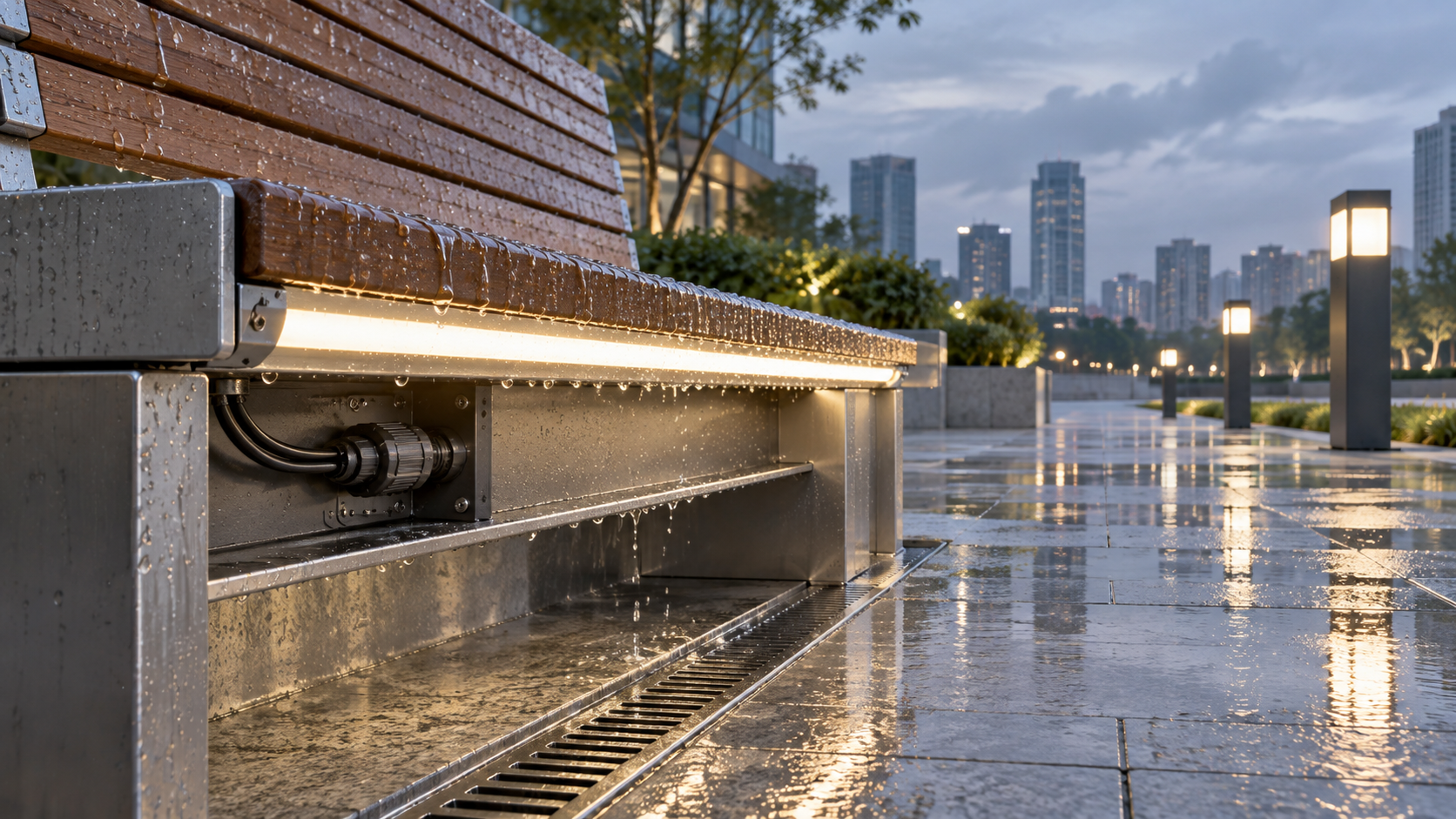
Consider a light mounted beneath a slatted bench. Rain can pass through the seat, follow a support bracket, and reach a cable entry from behind. If the module has been tested only in its intended mounting position, rotating it or altering its fixing arrangement needs review. An IP65 label cannot compensate for a missing gland seal or an enclosure modified on site.
A recessed light in a planter edge presents another problem. Soil, leaves, and litter may obstruct drainage, turning an apparently sheltered recess into a small reservoir. Persistent standing water is outside the protection demonstrated by IPX5 testing. Improving drainage may be more effective than simply specifying a higher-rated module.
Detail drawings should show the water path, not just the luminaire position: drainage outlets, cable approaches, drip loops where appropriate, connector locations, and access for maintenance. Avoid drainage holes that open directly into a compartment intended to remain sealed.
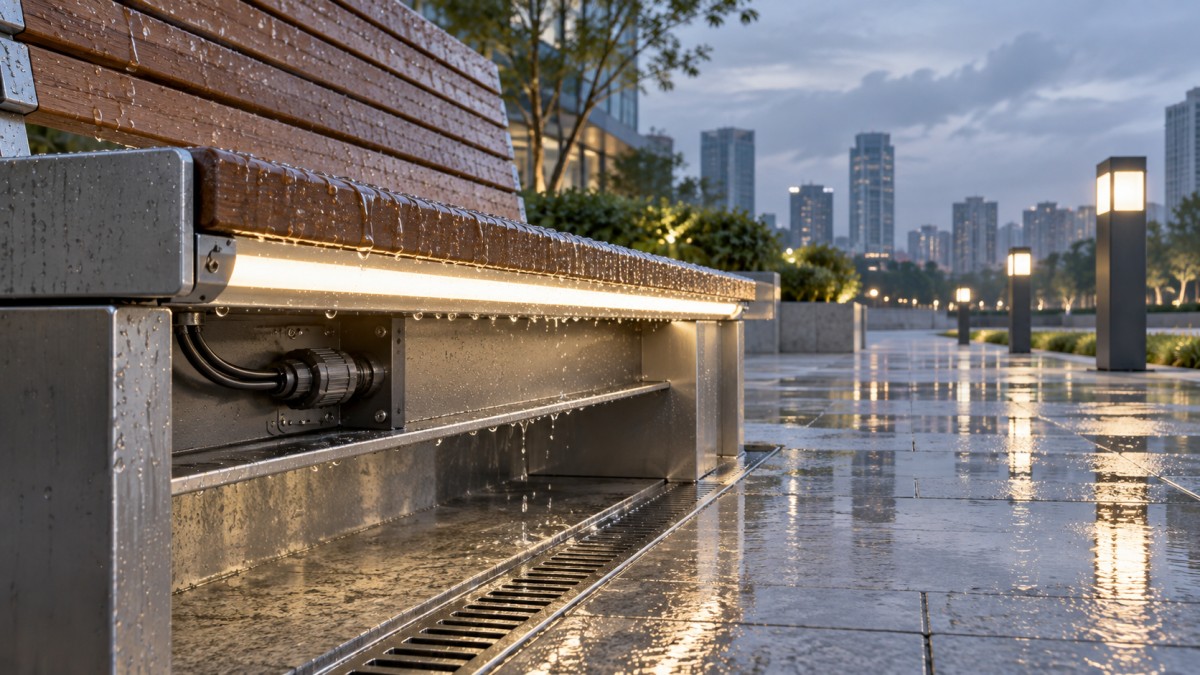
A useful pre-installation review follows water from the top of the furniture to its lowest point. If it collects around a joint or electrical connection, resolve that detail before approving production.
When a higher rating helps—and when it does not
Choose additional protection against the actual exposure, rather than treating the largest IP number as automatically best.
- More severe water jets: IP66 may be relevant, but ordinary jet testing still does not establish suitability for close-range, hot, high-pressure cleaning. Confirm the cleaning limits with the manufacturer.
- Temporary immersion: IP67 addresses temporary immersion under prescribed conditions. It does not automatically demonstrate compliance with IP65 or IP66 jet tests; request evidence for both exposures where necessary.
- Longer or deeper immersion: IP68 requires checking the manufacturer's declared test conditions. It is not an unrestricted underwater-use claim.
For park projects, the surrounding lighting may need a different specification from furniture-integrated LEDs. For example, Lishida’s LED Garden&Lawn Lighting | GLL-LGYC is listed as an IP67 garden and landscape lighting product with a 3–4 m pole height. It is not a substitute for a bench-mounted module. Its relevance is at scheme level: different mounting positions create different exposure and maintenance requirements. The declared IP67 rating should still be checked against the supplied configuration and supporting test documentation.
Public-space safety extends beyond water ingress
Bollards may be struck by maintenance equipment. Bench lighting can be kicked or deliberately damaged. Mechanical impact resistance is assessed separately from IP protection; where an IK rating is specified, review evidence against IEC 62262 and confirm which enclosure surfaces it covers. A damaged lens or distorted housing can compromise an otherwise satisfactory seal.
Corrosion also needs its own assessment. Coastal salts, de-icing chemicals, fertilizer, and cleaning agents can attack housings, fasteners, and interfaces between dissimilar metals. Neither IP65 nor IP67 proves corrosion resistance. Material grade, coating details, isolation measures, and exposure-specific evidence matter more than a generic “weatherproof” description.
For electrical safety, establish the applicable luminaire requirements, commonly including IEC 60598-1 and the relevant particular part or local equivalent. Review protective earthing where required, insulation, accessible wiring, cable strain relief, and protective devices under local installation rules. Extra-low-voltage lighting can reduce certain shock risks, but the power supply, circuit design, and connections still require assessment.
Do not overlook heat. Integrating LEDs into a narrow cavity can restrict heat dissipation, while nearby seating surfaces may be touched for extended periods. Check thermal performance and accessible surface temperatures in the intended assembly—not only in open-air product tests.
What to verify before release
A useful approval package connects the declared rating to the installed equipment. Request the relevant test report, model identification, mounting instructions, sealing details, cable diameter range, and maintenance restrictions. Confirm that the tested configuration matches the ordered driver, connectors, covers, and cable entries.
At incoming inspection and installation handover, focus on details likely to invalidate protection:
- Gaskets seated correctly, without contamination, damage, or trapped wires.
- Glands matched to cable diameter and tightened to the specified requirements.
- Unused openings sealed with suitable rated components.
- Connectors kept out of water-collecting pockets and protected as specified.
- Drainage and service access preserved after the furniture is fixed in place.
Where project risk warrants it, agree on representative assembly testing before volume production. An improvised hose-down on site is not equivalent to an IEC ingress test and should not replace documented verification.
Lishida Smart Lighting’s integrated support for products, smart controls, and large-scale project delivery provides a useful coordination point for these checks. The important task is keeping the luminaire, furniture fabrication, electrical installation, and maintenance requirements aligned—including any added control cables or access openings.
Approve LED urban furniture lighting with IP65 rating when exposure, drainage, assembly evidence, and maintenance practices support that choice. If water can pool, cleaners use pressure washers, or the enclosure is modified during installation, resolve those conditions explicitly. A higher rating may be part of the answer; a defensible installation detail is always necessary.
◉ MESSAGE

Blog
- How to avoid vendor lock-in in a government smart lighting project
- Sizing the communications power budget for smart city solar street lights
- How energy-saving mode affects solar bollard light operating time
- Comparing lead times from LED street light luminaire suppliers in Europe
- What spare parts support should a smart street light exporter offer?
- Where to place a solar garden light in a partially shaded garden
- Which battery alerts matter in remotely monitored solar street lighting?
Message