
What causes LED street light drivers to fail early in hot climates
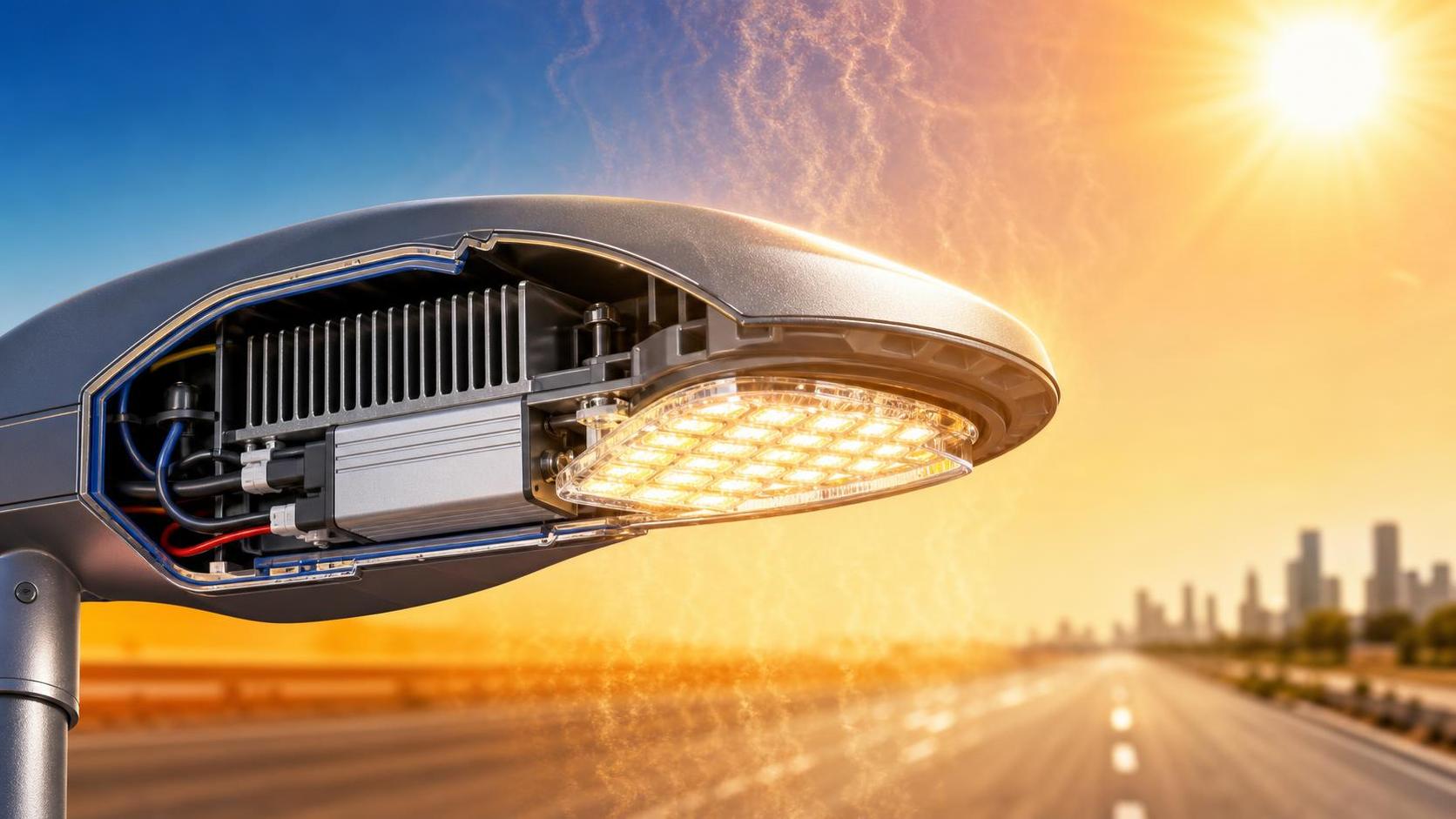
In hot climates, an LED street light driver often fails long before the LEDs themselves show serious lumen depreciation. For maintenance teams, that mismatch creates a frustrating pattern: the housing still looks intact, the light source still has theoretical life left, but the fixture is dark, unstable, or cycling on and off. In practice, early driver failure is rarely caused by one single defect. It usually comes from a combination of heat, electrical stress, installation conditions, and design choices that were acceptable on paper but not robust enough for real outdoor exposure.
The important point is that “hot climate” does not only mean high daytime ambient temperature. Driver stress rises when high solar loading, poor airflow, enclosed luminaire structure, unstable grid conditions, long operating hours, and inconsistent installation quality all happen together. That is why the same LED street light model may perform reasonably in a mild coastal city but show repeated driver failures in arid inland roads, tropical urban corridors, or high-traffic heat islands.
Heat is the main trigger, but not always in the way people assume
Most field teams know that heat shortens electronics life. What is often underestimated is where the damaging temperature actually comes from. Ambient temperature matters, but internal temperature rise is usually the more decisive factor. A driver mounted inside a compact luminaire can run far hotter than the surrounding air because it is affected by heat from the LED board, solar radiation absorbed by the housing, and limited thermal escape paths.
Electrolytic capacitors are especially vulnerable. Their service life drops rapidly as operating temperature rises. In many failed drivers collected from hot-region road projects, the weak point is not the switching topology itself but capacitor drying, ESR increase, and the resulting ripple and instability. Once that begins, other components are stressed more heavily, accelerating total failure.
This is why maintenance teams should be cautious when a supplier highlights LED chip life but gives limited visibility into driver thermal design. A luminaire may claim 50,000 hours or more, yet the actual driver environment may never support that under high-heat operation.
Poor luminaire-driver thermal matching causes hidden overload
One common mistake in project delivery is treating the driver as a replaceable standard part without checking whether the whole luminaire structure supports its thermal limits. In hot climates, the relationship between housing design and driver reliability becomes critical. A driver with acceptable bench performance may still fail early if installed in a fixture with poor internal airflow, insufficient separation from the LED module, or heat accumulation near the power compartment.
For example, higher-power roadway luminaires in the 200W to 350W range naturally generate more internal heat. If the luminaire body is not designed to isolate or dissipate that heat effectively, the driver sees prolonged exposure to elevated case temperature every night. The result is not always immediate burnout; more often it appears first as dimming instability, delayed startup, intermittent shutdown, or random outages after several months of summer operation.
In this area, fixture design matters as much as driver brand. A road project using a well-matched luminaire platform—such as a properly engineered LED Street Light Luminaire with IP66 protection, wide power options, and dimming compatibility—has a better chance of controlling internal stress than a system assembled from individually acceptable but poorly integrated parts.
Voltage instability and surge exposure are worse in hot regions than many specifications suggest
Hot-climate projects often overlap with grid conditions that are less stable: expanding urban districts, remote highways, mixed industrial loads, or areas with frequent storm activity. Maintenance personnel may see the failed driver and assume temperature was the only issue, but electrical stress often does equal damage.
Three field conditions show up repeatedly:
- repeated surge exposure from lightning or switching events;
- overvoltage or undervoltage outside the driver’s comfortable operating window;
- neutral instability or poor earthing that causes abnormal stress on the input stage.
A driver may survive occasional surge events under laboratory conditions, yet fail early in service when thermal aging has already weakened capacitors, MOVs, or input protection components. Heat and surge do not act separately. Heat reduces component margin; surge consumes what margin remains.
When failure clusters happen after seasonal storms or after new loads are added to a feeder, teams should not limit investigation to the fixture itself. Checking feeder quality, grounding continuity, and surge protection strategy at pole and distribution level often explains why replacement drivers continue to fail in the same zone.
Ingress is not only about water; contamination also raises thermal and electrical risk
In many hot regions, dust, salt mist, and airborne pollutants are as damaging as rain. A luminaire can have a nominal protection rating and still experience long-term contamination if seals age, cable glands are poorly tightened, or maintenance access points are not reassembled correctly after service.
Fine dust accumulation can impair heat dissipation. Moisture condensation, especially in coastal hot climates with large day-night temperature swings, can attack solder joints, driver coatings, and connector interfaces. Salt contamination is particularly aggressive because it increases corrosion and leakage paths. The field symptom may appear as a “driver failure,” but the root cause is often corrosion-induced breakdown or gradual insulation degradation.
This is why repeated failure analysis should include opening returned units under controlled inspection, not just swapping parts on site. Burn marks, swollen capacitors, corroded terminals, brittle potting, and discoloration tell different stories, and each points to a different corrective action.
Installation quality often decides whether a good driver survives the summer
After-sales teams know that factory quality is only part of the picture. In hot-climate projects, installation errors that seem minor in cool weather can become major reliability problems once summer temperatures arrive.
Typical examples include:
- loose AC connections that create localized heating;
- driver replacement with incompatible current or dimming settings;
- crushed or sharply bent cables that weaken insulation;
- incorrect sealing after maintenance;
- mounting orientation that traps heat or water;
- using non-original drivers with similar wattage but different thermal derating behavior.
One frequent field error is replacing a failed driver based only on output wattage and voltage, without verifying drive current, surge immunity, dimming protocol, and allowable case temperature. The light may turn on after replacement, but the new driver may operate closer to its limit than the original design intended. That usually leads to repeat failures and confusion over whether the problem is in the batch, the site, or the maintenance process.
Dimming and control systems can create unexpected driver stress
Smart lighting projects add another layer of complexity. PWM, PLC, and 0-10V controls improve energy management, but only if the driver, control node, and site wiring are properly matched. In some outdoor systems, nuisance failures come not from high ambient temperature alone but from poor control compatibility that causes unstable dimming behavior, repeated switching, or abnormal standby stress.
In hot climates, those control-related inefficiencies matter more because the driver has less thermal headroom. A unit operating at high internal temperature while handling noisy control signals or frequent dimming transitions may degrade faster than expected. When maintenance teams investigate early failure, they should review not only power quality but also control logs, dimming schedules, and whether firmware or node configuration changed before the failures increased.
Driver derating is often ignored during procurement and later paid for in maintenance
Many specifications focus on lumen output, efficacy, and ingress rating, while driver derating curves receive little attention. That is a problem in regions where nighttime ambient temperature may remain high for long periods. A driver that can technically power the fixture at rated output may still require output derating at elevated temperature to maintain long-term reliability.
From a maintenance perspective, this matters more than headline efficiency. A slightly more conservative electrical design often produces fewer interventions over the project life. For large roads, highways, and smart city deployments, fixtures in the 50W–350W range should be reviewed not only for optical performance but also for how the driver is thermally managed at expected summer operating conditions.
This is one reason integrated platforms tend to outperform loosely matched assemblies. A luminaire specified around realistic outdoor conditions—using established LED sources, suitable input range such as AC176-264V, and validated dimming interfaces—reduces the chance that after-sales teams become the last line of thermal design correction.
What maintenance teams should check before blaming the driver alone
When failures are recurring, the fastest path is not simply replacing units one by one. A structured check usually reveals patterns:
- Compare failure location: isolated poles or entire feeder sections.
- Review seasonality: first summer peak, storm periods, or year-round random failure.
- Inspect failed parts physically for heat, surge, corrosion, or moisture signatures.
- Measure input voltage stability and grounding condition on site.
- Verify actual driver case temperature under night operation, not just ambient temperature.
- Confirm replacement driver compatibility with original current, control, and protection requirements.
- Check whether luminaire sealing and cable entry were compromised during installation or maintenance.
These checks are more useful than relying on a generic failure label. “Driver damaged” is an outcome, not a root cause.
Reducing early failures requires design decisions upstream, not only better repair response
For hot-climate outdoor lighting, the long-term solution is rarely a single “higher quality driver” substitution. Reliability improves when thermal management, surge protection, optical power level, housing design, and control compatibility are treated as one system. Maintenance data should feed back into procurement and design review. If one region repeatedly shows the same failure mode, that is operational evidence that the original project assumptions were too optimistic.
In replacement or new-build projects, it is worth prioritizing luminaires designed for real outdoor stress rather than laboratory minimums. A model used in roads, highways, and smart city applications should be judged by how it handles heat, sealing, electrical fluctuation, and serviceability together. Products such as the LD044 configuration of the LED Street Light Luminaire, with broad power coverage, IP66 enclosure, and multiple dimming options, fit that discussion only if the project team also verifies driver thermal margin and site electrical conditions.
For after-sales maintenance teams, the practical lesson is straightforward: early driver failure in hot climates is usually systemic, not accidental. If the same site keeps consuming drivers, the real task is not faster replacement. It is finding which combination of heat buildup, electrical stress, sealing weakness, control mismatch, or installation error is repeatedly pushing the driver beyond its safe operating margin.
◉ MESSAGE
Blog
- LED Street Luminaire Specifications That Matter for Roadway Projects
- What to Evaluate When Selecting a Smart Street Lamp Manufacturer
- How to Prepare a Compliant Solar Lighting Bid for Public Infrastructure Projects
- LED Street Lighting Solutions for Urban and Municipal Roads
- LED Street Light Installation Guide for Road Projects
- LED Street Light Lifespan: How Long Do LED Road Lights Last?
- LED Street Light IP Rating: What Should Buyers Choose?
Message