
What affects the lifespan of an LED street light in coastal areas
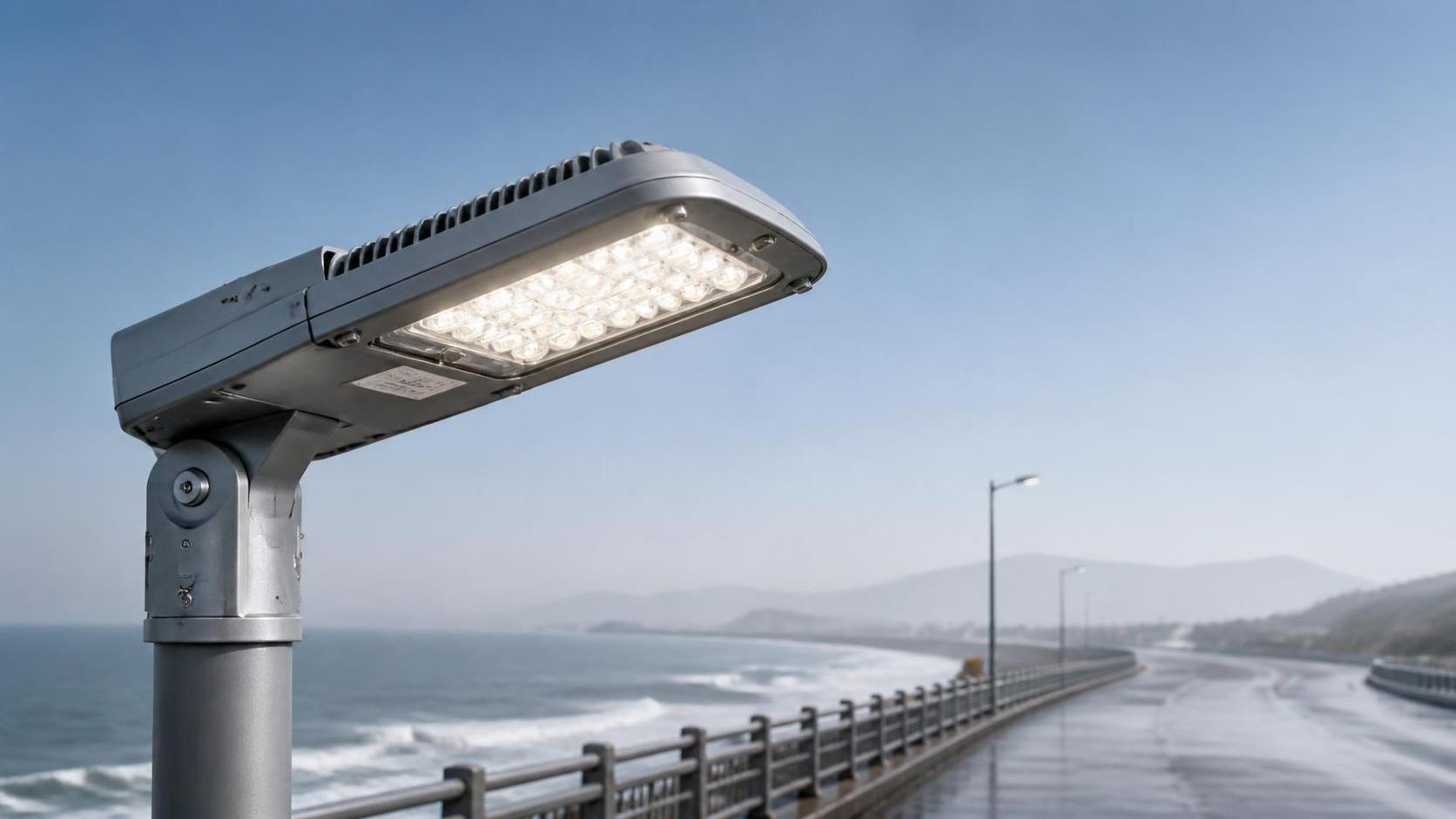
What really determines LED street light lifespan near the coast
When an LED street light is specified for a coastal road or public space, the rated LED life on the datasheet is only one part of the story. In practice, the service life of the whole luminaire is shaped by corrosion, moisture ingress, structural loading, thermal conditions, driver quality, and how well the system is matched to the site. This is why two fixtures with similar wattage and similar LED chips can perform very differently after a few years by the sea.
Project teams usually feel this difference not on day one, but later: screws seize, paint blisters, driver compartments show condensation, optical covers haze, and maintenance intervals become shorter than expected. For large-scale outdoor lighting works, those issues matter as much as initial light output.
Salt spray is usually the first enemy, not the LED chip
In coastal areas, airborne salt accelerates corrosion on metal housings, poles, brackets, fasteners, and cable connections. The LED chip itself may still be capable of long operation, but the surrounding mechanical and electrical parts often age faster. This is where many lifespan assumptions become too optimistic.
Material choice matters. Aluminum housings, galvanized steel poles, coating thickness, and the quality of powder coating all affect how well the fixture resists corrosion over time. Fasteners are often overlooked. If the housing is robust but bolts, hinges, or clips are not adequately protected, maintenance becomes difficult and water ingress risk increases during servicing.
For poles and landscape lighting components in exposed sites, surface treatment can be just as important as lumen output. A product such as LED Garden&Lawn Lighting | GLL-TY, which uses hot-dip galvanizing and powder coating on Q235 steel, reflects the kind of anti-corrosion thinking that is often necessary in marine-adjacent environments. Even though garden and lawn applications differ from roadway lighting, the same durability logic applies.
Ingress protection is important, but it does not solve everything
A high IP rating is essential for outdoor lighting, especially where wind-driven rain and salt-laden humidity are common. But IP67 or similar protection should not be read as a blanket guarantee of long life. The real question is whether the sealing design remains stable after years of UV exposure, temperature cycling, vibration, and repeated maintenance.
Coastal projects often face a familiar problem: a luminaire passes factory tests, but on site it experiences condensation because the internal pressure changes with heat and cooling. If the fixture cannot breathe properly, moisture may accumulate inside even when the enclosure is nominally well sealed. Over time, that affects drivers, connectors, and optics. This is why drainage paths, gasket quality, and compartment design deserve closer review during technical evaluation.
Heat management still matters, even by the sea
People sometimes assume that a coastal environment is naturally cooler and therefore easier on LEDs. That is not always true. High ambient temperature, strong solar radiation, enclosed fixture design, and dirt or salt buildup on heat-dissipating surfaces can still push junction temperatures upward. And once thermal performance drops, lumen depreciation and driver stress tend to follow.
For an LED street light, the driver is often the limiting component before the LED package reaches its theoretical lifetime. A good thermal path from LED board to housing helps, but the driver compartment also needs attention. If heat is trapped in a small sealed space, the driver may age faster than expected. In project reviews, it is worth checking not only LED brand and power, but also how the luminaire manages heat under local summer conditions.
Wind exposure and structural design affect lifespan more than many buyers expect
Coastal roads, bridges, ports, and open public spaces often have stronger and more continuous wind loads. This affects pole stability, bracket fatigue, vibration at joints, and even internal wiring over time. A fixture can remain electrically functional but develop mounting problems, loosened hardware, or cracked seals because the structural design was not suitable for the site.
This is one reason project managers should look at the complete installation system rather than the luminaire alone. Pole height, wall thickness, base plate design, anchor bolts, and wind resistance all interact. In lower-height landscape or pedestrian-zone applications, for example, products built with clear wind resistance targets can reduce risk in exposed locations. The GLL-TY series is specified with wind resistance of at least 150 km/h, which is a useful reminder that long life outdoors is always a system issue, not just an LED issue.
Power quality and control strategy can shorten or extend service life
In many municipal or large mixed-use developments, the electrical environment is not perfectly stable. Voltage fluctuation, surge exposure, poor grounding, and switching frequency from smart control systems all influence driver lifespan. Coastal areas with storms or complex infrastructure may be especially demanding in this respect.
Smart lighting controls can reduce energy use and maintenance visibility gaps, but only when the luminaire, driver, and control architecture are properly matched. Dimming profiles, communication modules, and surge protection should be considered together. If not, the project may gain control functionality while introducing extra failure points. Teams handling large-scale delivery usually learn this quickly: integration quality is part of reliability.
That is also why integrated support matters in real projects. Lishida Smart Lighting works with contractors and project owners across roads, public spaces, and complex urban environments, where product selection, smart controls, and long-term system compatibility cannot be treated separately. The challenge is rarely one component in isolation; it is whether the full lighting scheme remains stable after installation.
Maintenance access and installation quality are often the hidden variables
A well-designed LED street light can still lose years of service life if installation is rushed. Damaged cable glands, poor sealing after wiring, mixed-metal contact without protection, and improper torque on fasteners all show up later as corrosion or water problems. In coastal jobs, these are not minor workmanship issues. They are lifespan issues.
Ease of maintenance also matters. If luminaires are hard to open, hard to reseal, or mounted on systems with difficult anchor alignment, field teams are more likely to compromise during servicing. Features such as practical base plate options and accessible hardware can reduce those risks. In landscape areas like parks or commercial grounds, LED Garden&Lawn Lighting | GLL-TY uses square or round base plate options for easier anchor bolt installation, which is a small detail but the kind that tends to matter on site.
What to check before approving a coastal lighting specification
A practical review usually includes these points:
- Housing, pole, and fastener corrosion protection, not just fixture wattage and efficacy
- Sealing design, gasket durability, and moisture management inside the luminaire
- Thermal design for both LED module and driver under local ambient conditions
- Wind resistance and structural suitability for open coastal exposure
- Surge protection, grounding, and compatibility with dimming or smart control systems
- Installation details and future maintenance accessibility
If one lesson repeats across coastal outdoor lighting, it is this: the lifespan of an LED street light is decided by the weakest part of the system, not the strongest line on the brochure. A fixture rated for long LED hours can still become a short-life asset if corrosion protection, sealing, thermal management, or installation quality are treated as secondary. For coastal projects, that is where careful selection pays off—usually not in the first month, but in years three, five, and beyond.
◉ MESSAGE
Blog
- LED Street Luminaire Specifications That Matter for Roadway Projects
- What to Evaluate When Selecting a Smart Street Lamp Manufacturer
- How to Prepare a Compliant Solar Lighting Bid for Public Infrastructure Projects
- LED Street Lighting Solutions for Urban and Municipal Roads
- LED Street Light Installation Guide for Road Projects
- LED Street Light Lifespan: How Long Do LED Road Lights Last?
- LED Street Light IP Rating: What Should Buyers Choose?
Message