
Solar Wall Light Buying Guide: Battery, Sensor, and Weatherproof Ratings
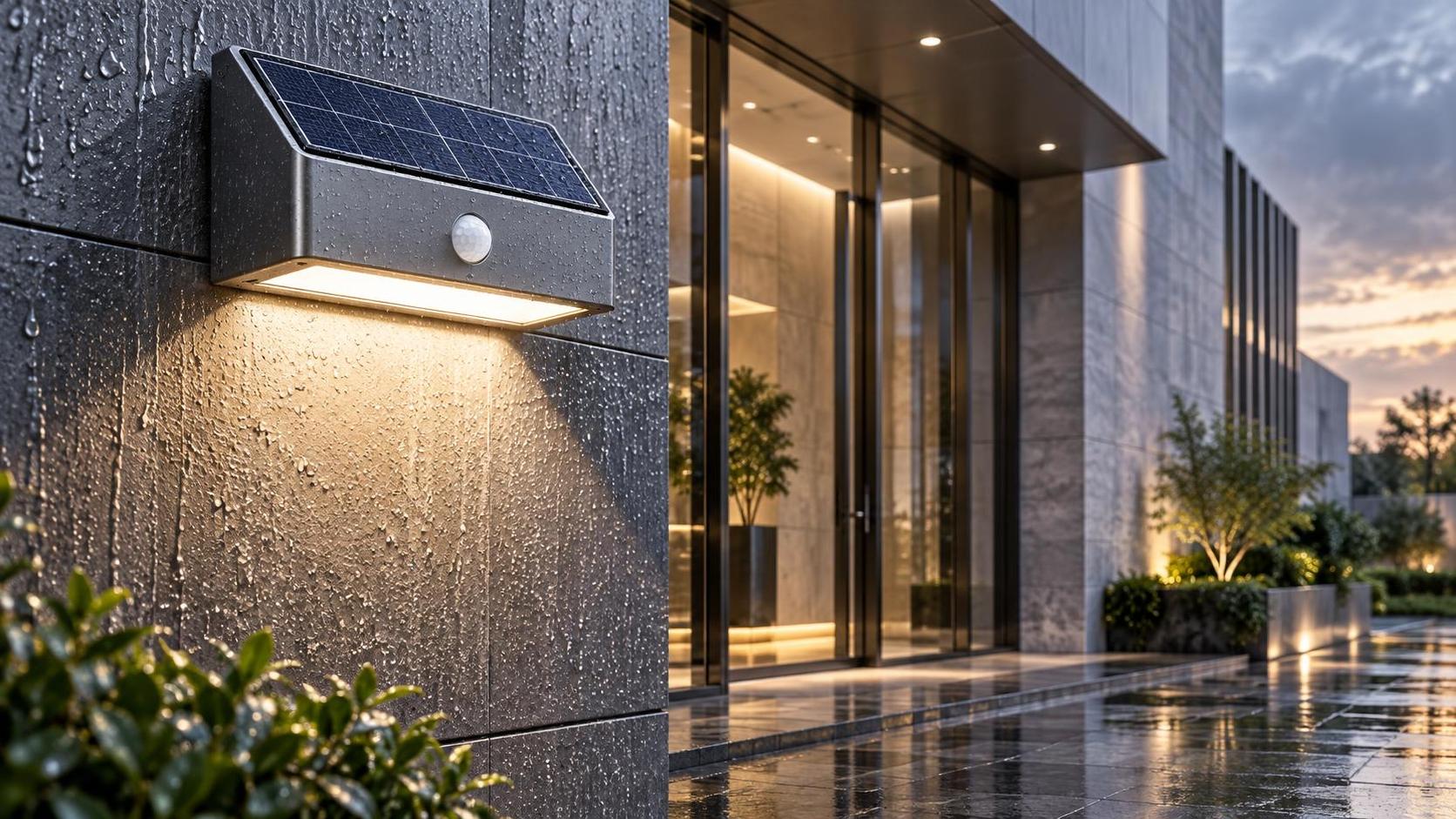
A solar wall light should be specified as a small off-grid lighting system rather than a decorative fixture with a panel attached. Its light output after several cloudy days, ability to detect movement at the intended distance, and resistance to water intrusion are determined by connected components. A high lumen claim or a large-looking solar panel does not establish reliable performance on an entrance wall, perimeter route, public washroom block, or service building.
Begin with the site conditions that affect energy collection and sensor operation: wall orientation, seasonal shading, nearby trees, reflected light, local overnight temperatures, traffic pattern, and cleaning access. A unit mounted beneath a deep canopy may remain protected from rain yet receive too little direct sun. A fixture facing a busy roadway may see enough ambient light to delay dusk activation, while one beside a reflective white wall may produce a narrower useful detection zone than its data sheet suggests.
Read Battery Capacity as Usable Energy
Battery capacity expressed in ampere-hours is incomplete without battery voltage. Electrical energy is measured in watt-hours: voltage multiplied by ampere-hours. A 12Ah battery at one voltage does not store the same energy as a 12Ah battery at another voltage. The relevant comparison is usable battery energy after the controller's low-voltage cutoff, battery protection reserve, conversion losses, and the reduction in capacity caused by low temperatures.
Match that usable energy to the actual lighting profile. A wall light running at full output for a short arrival period and then dimming consumes energy very differently from one held at a fixed output throughout the night. Request the power draw for each mode, including standby consumption by the controller and sensor. If the stated LED power is the maximum rating, it should not be treated as the nightly average load.
Lithium battery chemistry is often selected for compact size and cycling performance, but the battery enclosure and battery-management design still matter. Cells exposed to repeated high enclosure temperatures can age faster; cold weather can limit charging and discharge behavior. Ask whether the battery is replaceable, where it sits relative to the LED heat source, and whether the design prevents charging outside the battery's permitted temperature range. A sealed unit with no service path can turn a battery replacement into replacement of the entire fixture.
Autonomy Must Reflect the Lighting Schedule
Autonomy is the number of nights the stored energy can support the defined operating schedule without meaningful solar charging. It has no value unless the schedule is stated. “Three-night autonomy” could describe a low-output standby mode, not three full nights at maximum brightness. For a passageway where safety depends on predictable illumination, define the minimum acceptable output, nightly operating hours, dimming intervals, and the expected low-sun period before comparing battery options.
Solar input must also be considered as a system. Panel wattage alone does not account for panel orientation, dirt accumulation, partial shading, cell temperature, controller efficiency, or the fact that a wall-mounted panel is often not tilted at its ideal solar angle. A separate panel may improve collection but introduces cable routing, connector sealing, and mechanical fixing requirements. An integrated panel reduces installation work but should be assessed against the actual wall geometry and exposure.
Sensor Specifications Need Site Context
Most solar wall lights use a passive infrared sensor, commonly called PIR, to identify heat movement across its detection zones. PIR does not detect every type of movement equally. It responds best when a person crosses the sensor's field; movement directly toward the fixture can be detected later. This distinction is important at gates, corridors, ramps, and narrow side passages.
Quoted detection distance should be treated as a test condition rather than a guaranteed field radius. Mounting height, approach angle, ambient temperature, wall texture, obstructions, and lens aiming all change performance. In hot climates, the temperature contrast between a person and the surroundings is smaller, which can reduce PIR response. Metal gates, parked vehicles, planting, and projecting signs can create blind areas even when the nominal range appears sufficient.
- Detection zone: Request a diagram showing horizontal coverage, vertical coverage, and the mounting height used for the test.
- Hold time: A short delay saves energy but may allow the light to dim while someone is still in a slow-moving queue or on a ramp.
- Background level: Confirm the brightness of the dim mode and the triggered mode. “Sensor light” does not by itself indicate whether the area remains visibly lit before activation.
- Override behavior: Establish whether the fixture can be set to a fixed schedule, a permanent low-output mode, or a timed full-output mode when sensor operation is unsuitable.
False triggering and missed activation are different faults and should not be solved with the same adjustment. False triggering can result from traffic, animals, moving foliage, or a sensor pointed toward a heat-emitting surface. Missed activation is more often linked to approach direction, masking by physical objects, insufficient temperature contrast, or excessive mounting height. Reducing sensitivity may cure nuisance switching while making an access route less usable.
Photocell behavior deserves similar attention. The daylight sensor should be located where it reads representative ambient light, not LED spill from its own fixture or a nearby luminaire. If the product combines a photocell and motion sensor, obtain the control sequence: when the fixture enters night mode, what motion does at each battery state, and whether low battery changes the lighting profile without a visible fault indication.
Weatherproof Ratings Protect Specific Things
An IP rating distinguishes protection against solids and water ingress, but it does not describe every outdoor durability issue. The first digit concerns access by solid objects and dust; the second concerns water exposure. A rating suitable for rain does not automatically establish resistance to pressure washing, salt-laden air, prolonged condensation, ultraviolet exposure, or impact from public-space use.
Water often enters through joints rather than broad housing surfaces. Inspect the cable gland, rear mounting plate, sensor lens interface, panel frame, battery hatch, and any unused openings. A fixture installed on an uneven masonry wall can distort a rear gasket and form a water path. Where conduits enter from above, use a drip loop and avoid creating a route that channels water directly into a cable entry.
Corrosion is a separate selection issue. Powder-coated aluminum can perform well when pretreatment, coating continuity, and hardware selection are appropriate, but scratches, exposed drilled holes, and incompatible fasteners create localized weakness. Coastal exposure also calls for attention to stainless fastener grade and the isolation of dissimilar metals. A nominally weatherproof enclosure can still become difficult to remove after years of corrosion at the mounting points.
Resolve Conflicts Between the Wall Light and the Site
Installation height changes both illumination and control performance. Raising the fixture broadens the lighted footprint but reduces vertical illumination near doors and can move the sensor above the relevant movement path. Lower installation improves facial recognition near an entrance but may introduce glare, tampering risk, or reflected light into adjacent windows. Before finalizing a fixture, map the required task area rather than judging brightness from the illuminated wall surface.
For remote routes with poor solar availability, the energy problem may exceed what a wall-mounted panel and battery can reasonably cover. Hybrid generation is relevant in exposed high-wind locations, but its mechanical and maintenance requirements differ from a compact wall light. The MPPT hybrid controller, lithium battery range, and wind-plus-solar configuration described for Wind-Solar Hybrid Street Lighting | SHL-007 illustrate why low-sun resilience must be evaluated at the power-system level instead of inferred from a fixture's solar label.
Ask for a wiring diagram, battery and controller location, charging logic, sensor mode table, ingress-protection scope, and installation instructions before approving a model. These documents expose mismatches early: a panel placed in shade, a sensor aimed across the wrong travel path, a rating that excludes the cable connection, or a battery schedule that cannot support the required light profile. The strongest selection is one whose stored energy, detection behavior, enclosure construction, and mounting details all fit the same site conditions.
◉ MESSAGE

Blog
- How to avoid vendor lock-in in a government smart lighting project
- Sizing the communications power budget for smart city solar street lights
- How energy-saving mode affects solar bollard light operating time
- Comparing lead times from LED street light luminaire suppliers in Europe
- What spare parts support should a smart street light exporter offer?
- Where to place a solar garden light in a partially shaded garden
- Which battery alerts matter in remotely monitored solar street lighting?
Message