
High-Power LED Floodlight Selection for Large-Area Industrial Yards
High-Power LED Floodlight Selection for Large-Area Industrial Yards
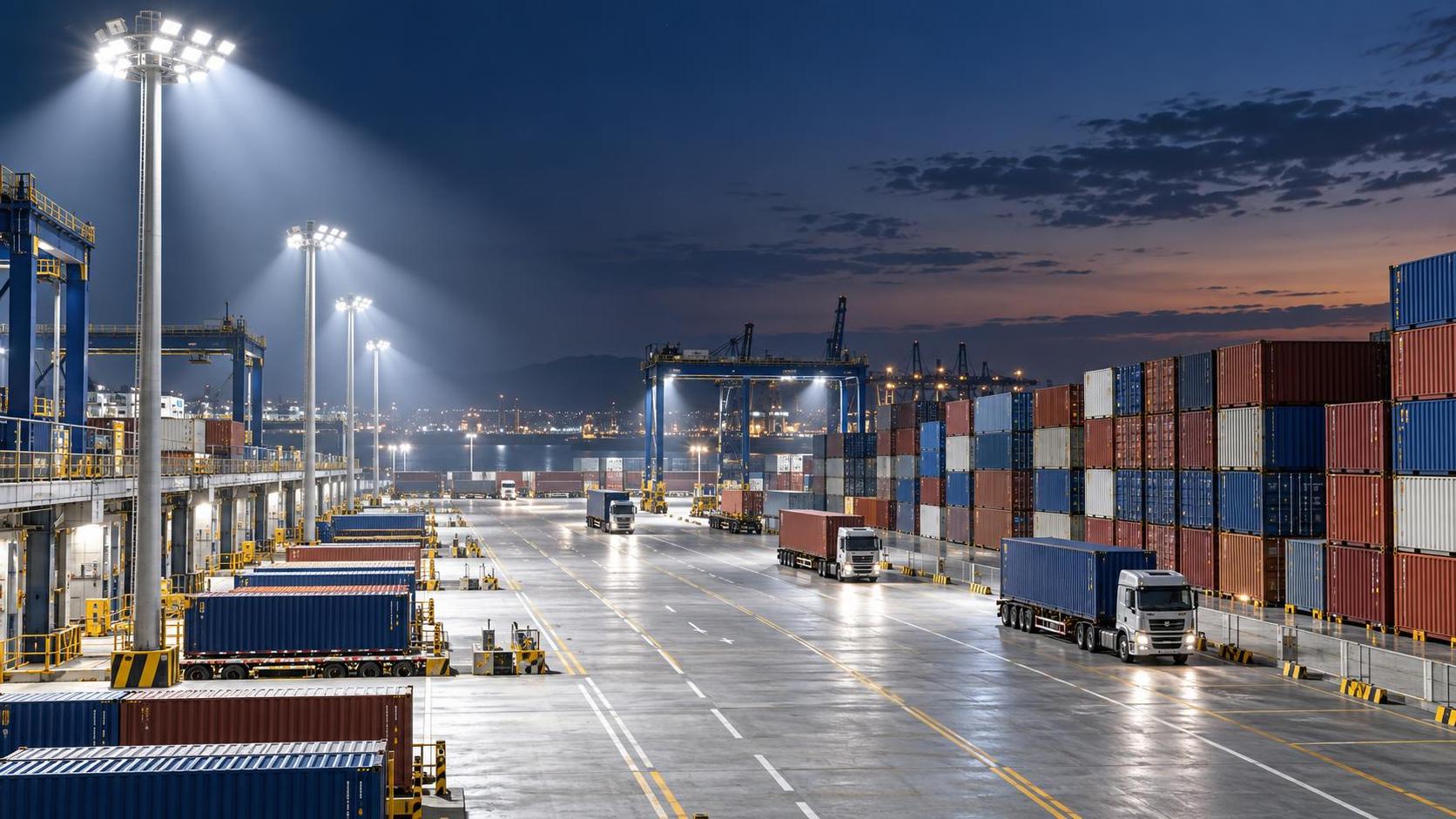
Selecting a high power LED floodlight for a large industrial yard is not a matter of finding the biggest wattage on a catalogue page. A container yard, logistics hub, steel stockyard, loading apron, or manufacturing compound has moving vehicles, uneven activity zones, tall equipment, and changing operating hours. The lighting system has to support real work: drivers need to identify routes, operators need to read labels, security staff need clear camera coverage, and maintenance teams need access without repeatedly hiring lifts or closing lanes.
The most expensive mistake is usually made before installation: treating the yard as one uniform open area. It rarely is. A floodlight layout that looks bright from the gate can still leave loading bays, turning zones, rack edges, and pedestrian crossings poorly lit. Good selection starts with the site plan and work patterns, then moves to luminaire output, optics, poles, controls, and maintenance access.
Start with the Tasks Happening After Dark
Before comparing fixtures, divide the yard into operational zones. Vehicle circulation lanes, container stacking areas, loading docks, security perimeters, pedestrian routes, and emergency access roads do not need the same lighting distribution. A broad flood beam may be appropriate for an open storage area, while a narrower or asymmetric optic may better serve a truck lane or a high-mast position near a boundary.
Project teams should also ask what changes through the night. A logistics yard may have intense activity around dispatch windows but much lower traffic later. A plant may require full brightness around loading points while leaving low-occupancy storage zones at reduced output. This affects not only the required light level, but also whether dimming, scheduling, motion sensing, or centralized control is worth including from the beginning.
Do not rely on nominal lumen output alone. Useful light on the working plane depends on mounting height, beam angle, tilt, pole spacing, obstructions, surface reflectance, and maintenance factor. A lighting calculation based on the actual layout is far more valuable than a simple “watts per square metre” estimate. It reveals where light overlaps excessively and where dark pockets may remain.
Wattage Is a Result, Not the Starting Point
A high power LED floodlight is often selected for mounting heights that smaller luminaires cannot serve efficiently. Yet higher wattage does not automatically create a better yard. If the optic is too wide at a tall mounting height, light can spill beyond the site boundary and reduce useful illumination where it is needed. If the beam is too narrow, the centre may be bright while the space between poles feels uncomfortable or unsafe.
When reviewing proposals, compare the photometric file, beam distribution, and target illuminance grid rather than only fixture wattage. The right question is: how many fixtures, at what height and aiming angle, produce the required average illumination and acceptable uniformity in each task area? This makes it easier to assess competing designs fairly, especially when different suppliers use different LED packages and claimed efficacy figures.
Over-lighting can create its own operational problems. Strong reflected light from wet concrete, painted trailers, metal stock, or vehicle roofs can make it harder for drivers to judge depth. It also increases energy demand and may raise complaints from neighboring properties. A practical design aims for usable visibility, not visual drama.
Mounting Height, Pole Design, and Aiming Must Be Considered Together
Floodlights are only one part of the system. Pole height and location influence uniformity, glare, installation cost, and future service work. Taller poles can cover more ground with fewer mounting points, but they require suitable optics, structural assessment, and safe maintenance planning. Lower poles can improve directional control in confined zones, although more poles and cabling may be needed.
Wind exposure deserves early attention. Large luminaires, brackets, and high masts create load that cannot be evaluated separately from the foundation and pole. Coastal yards, open industrial parks, and exposed transport terminals need a coordinated review of local wind conditions, mounting hardware, corrosion protection, and access door arrangement. A robust floodlight installed on an unsuitable support structure is still a project risk.
Aim fixtures during commissioning, not only on drawings. Small adjustments can reduce glare toward drivers, neighboring roads, control rooms, or CCTV cameras. Where a yard includes entry landscaping or pedestrian approaches, lower-level lighting may complement the high-mast system rather than forcing floodlights to cover every edge. For example, LED Garden&Lawn Lighting | GLL-TY is designed for gardens, parks, and commercial landscapes, with a 3.5–4.5 m pole option. It is not a replacement for industrial floodlighting, but the distinction matters: low-level route lighting can improve wayfinding and visual comfort while high-power units remain focused on operational areas.
Control Glare Before It Becomes a Site Complaint
Glare is frequently underestimated because it is difficult to judge from a daytime site visit. In operation, it can affect forklift drivers, truck operators, security guards, and workers moving between bright exterior zones and darker interiors. It may also reduce the effectiveness of surveillance cameras if a fixture is aimed directly into the field of view.
Look for practical glare-control options: appropriate optical distribution, shielding where needed, controlled tilt angles, and sensible pole placement. Simply angling every floodlight outward to increase coverage is a common shortcut, but it can send light upward, create spill, and put the brightest source directly in someone’s line of sight. A slightly revised layout is often better than trying to solve an optical problem with more wattage.
Colour temperature and colour rendering also affect how the yard feels and functions. The appropriate choice depends on the activities taking place, camera requirements, local expectations, and operator preference. Where workers must distinguish colored labels, markings, or safety signage, the quality of light deserves discussion alongside illuminance targets.
Check Reliability at the System Level
Industrial yards expose luminaires to heat, dust, vibration, rain, salt air in some locations, and electrical disturbances. An IP rating is useful, but it is not the whole reliability story. Ask about housing material, thermal design, driver arrangement, surge protection, cable entry, gasket quality, bracket strength, and the replacement process for drivers or LED modules where applicable.
Operating temperature range should match the local environment, especially in regions with hot summers, freezing winters, or large day-night swings. Corrosion protection should be assessed with the pole, fasteners, and brackets included. A galvanized and powder-coated support may be appropriate for many outdoor applications, but the selected finish and hardware should still match the site atmosphere and planned service interval.
For large projects, consistency across batches matters as much as the sample fixture. Contractors need confidence that optics, drivers, mounting dimensions, and control interfaces will remain manageable when a project expands or spare units are ordered later. This is where suppliers with manufacturing capability and engineering support can reduce unnecessary variation between design intent and site delivery.
Build Controls Around Operations, Not Around Features
Smart controls can reduce wasted energy and simplify fault monitoring, but only if the operating logic is clear. A basic time schedule may suit a stable production yard. A distribution centre with variable shifts may benefit from zone-based dimming and centralized monitoring. Emergency routes, gates, and surveillance areas usually need different rules from low-traffic storage zones.
Avoid specifying a sophisticated platform without deciding who will manage it after handover. Confirm whether the project needs local override switches, remote access, fault alerts, energy reporting, or integration with an existing building or site management system. The control architecture should also allow safe manual operation if communications fail.
A More Reliable Procurement Review
Before approving a floodlighting package, review the lighting calculation against the latest yard layout, including future racks, buildings, and vehicle routes. Confirm mounting heights, aiming positions, electrical capacity, control zoning, pole foundations, and maintenance access. Request documentation that allows the technical team to compare fixtures on a like-for-like basis rather than relying on headline wattage or quoted lifetime alone.
For complex outdoor works, product selection, controls, and installation details should be coordinated early. Lishida Smart Lighting supports contractors and project owners with lighting products, smart control systems, and project-based engineering support for large-scale outdoor environments. That kind of coordination is especially useful when the floodlight layout must work alongside roads, public-facing edges, pedestrian spaces, and industrial operations.
The strongest choice is not necessarily the highest-output fixture. It is the floodlight system that delivers clear working visibility, controlled glare, practical maintenance, and dependable performance within the realities of the site. If the design cannot explain how it handles those four points, it is not ready for procurement.
◉ MESSAGE

Blog
- How to avoid vendor lock-in in a government smart lighting project
- Sizing the communications power budget for smart city solar street lights
- How energy-saving mode affects solar bollard light operating time
- Comparing lead times from LED street light luminaire suppliers in Europe
- What spare parts support should a smart street light exporter offer?
- Where to place a solar garden light in a partially shaded garden
- Which battery alerts matter in remotely monitored solar street lighting?
Message