
Industrial LED Lighting Retrofit: Reducing Energy Use Without Dark Zones
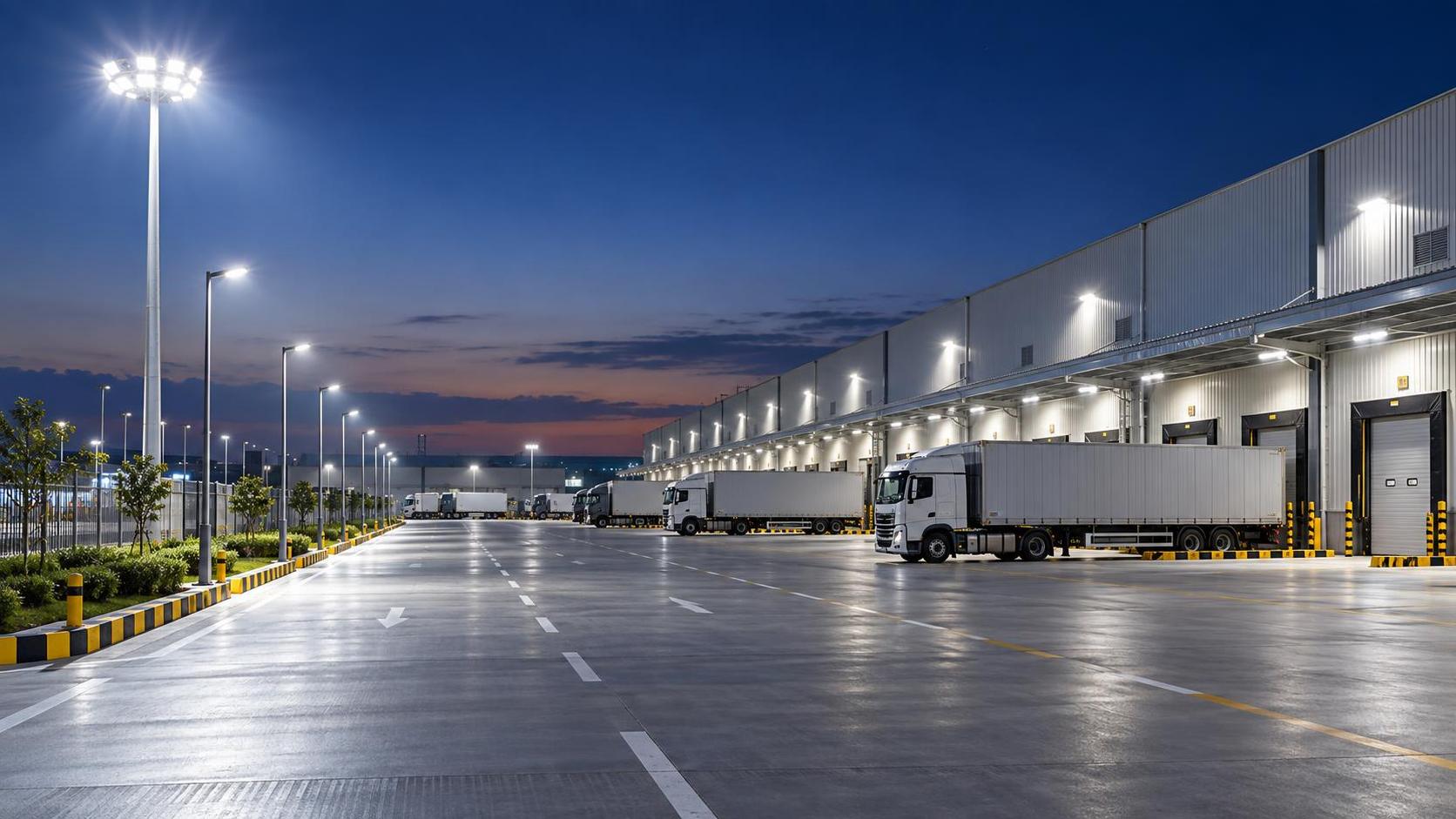
Industrial LED Lighting Retrofit: Reducing Energy Use Without Dark Zones
Industrial LED lighting retrofit projects are often approved on the promise of lower electricity consumption. That is valid, but it is not the whole job. In an active factory yard, logistics hub, municipal road corridor, or large public facility, lighting also governs vehicle movement, pedestrian safety, security coverage, loading accuracy, and night-time operations. A retrofit that cuts wattage but leaves patchy illumination near gates, storage lanes, intersections, or building edges creates a different kind of cost.
The practical goal is not simply to replace an old high-wattage fitting with a lower-wattage LED unit. It is to deliver the required visibility across the working area while using light only where it is useful. That requires a lighting plan based on site conditions, mounting geometry, luminaire optics, control strategy, and maintenance access—not catalogue wattage alone.
Why “Same Wattage Replacement” Creates Uneven Lighting
Older HID and metal-halide installations frequently have wide light distribution, gradual lumen depreciation, and a layout designed around the performance of those legacy sources. When LED fixtures are installed one-for-one without reviewing beam angles and mounting positions, the result can be misleading: the area directly beneath each pole appears bright, while the spaces between poles become visibly darker.
This is especially common in open yards. A wide road may need consistent forward visibility for drivers, but a floodlight selected only for peak output can create intense pools of light and poor transition zones. At loading docks, shadows from trailers, racking, canopies, and parked equipment can make the issue worse. In high-mast applications, a small change in optical distribution has a large effect on where usable light actually lands.
The better starting point is to identify task areas and risk areas. Vehicle turning points, gatehouses, pedestrian crossings, dock faces, emergency routes, and perimeter boundaries should be considered separately from low-traffic storage space. Uniformity matters because the eye needs time to adapt when moving from bright to dark areas. Good industrial LED lighting should reduce those abrupt changes rather than merely increase the brightest point on the site.
Audit the Existing Site Before Selecting Fixtures
A credible retrofit begins with field information. This does not always require a complex engineering study, but it does require more than a fixture count. Teams should document pole heights, bracket lengths, spacing, road widths, obstructions, existing circuit groups, available voltage, and the condition of poles and wiring. A luminaire that performs well at 8 metres may not deliver the desired coverage from a 15-metre mast.
Existing light levels should be measured at representative locations where possible, including the areas that operators complain about. The complaints are often useful. “The gate is too dark” may actually mean glare from a nearby fixture is reducing contrast. “The loading area needs more light” may point to shadowing from a canopy rather than insufficient overall output.
For outdoor projects, the audit should also note dust, salt air, rain exposure, vibration, ambient heat, and the likelihood of vehicle impact. These factors influence housing construction, sealing, surge protection, thermal management, and mounting method. Saving energy in year one is less meaningful if fittings fail early or require difficult access equipment for routine replacement.
Use Optics and Layout to Control Dark Zones
The luminaire’s optical distribution is usually more important than its nominal wattage. Narrow distributions can project light farther along a roadway or into a deep yard. Wider distributions may suit broad apron areas, pedestrian zones, or parking layouts. Asymmetric optics are often valuable where light must be pushed toward the roadway or work area while limiting spill behind the pole.
In practice, the best layout may include several fixture types rather than one universal product. High-output floodlights can cover large yard zones, while lower-mounted luminaires handle entrances, walkways, dock edges, and service doors. This layered approach makes it easier to maintain useful light at ground level without overlighting the entire site.
- Check illumination at the edge of the coverage area, not only directly under poles.
- Review vertical visibility where drivers must see people, signage, barriers, or dock numbers.
- Control glare near approach roads, security stations, and building windows.
- Allow for future changes such as added racking, landscaping, new loading lanes, or expanded parking.
Lighting calculations and on-site aiming are both necessary. A calculation can show whether the design is likely to meet the required coverage, but field commissioning confirms whether poles are plumb, fixtures are aimed correctly, and real obstructions are affecting the result. Outdoor light is not installed in a perfect digital model.
Controls Deliver Savings Without Sacrificing Operations
LED efficiency creates the baseline energy reduction; controls determine whether that reduction holds during everyday operation. Many sites do not need full brightness in every area throughout the night. A parking area, perimeter road, or low-activity storage yard may operate safely at a reduced level after normal working hours, then return to full output when a vehicle or person enters.
The important distinction is between dimming and switching off. Turning large outdoor zones completely off may save power, but it can introduce safety and security concerns. Scheduled dimming, photocell response, occupancy detection, and centralized monitoring are usually more practical where operating patterns vary. Controls should be grouped according to how the site is used, not simply according to the circuits inherited from the old installation.
For large schemes, smart controls also make faults easier to identify. A maintenance team can respond to an isolated outage before it becomes a visible dark zone. However, the control system needs to be matched to local communications conditions, ownership responsibilities, and the facility’s ability to maintain it. A sophisticated platform is not automatically the right choice for a site that needs simple, dependable scheduling.
Consider the Wider Night-Time Environment
Some outdoor industrial and urban projects include more than functional lighting. Building façades, landscape features, public squares, and event areas may require visual elements that are separate from road and work-zone illumination. Keeping these systems distinct helps avoid a common mistake: trying to make decorative lighting perform a safety task, or using functional floodlighting where controlled visual presentation is needed.
For a planned outdoor display or architectural presentation, a dedicated solution such as the Laser Engineering Projector can be considered alongside the lighting scheme rather than in place of it. The JGTYD-011 provides 8000 ISO lumens, WUXGA resolution with 4K compatibility, flexible lens shift, and interfaces including HDMI, LAN, RS232, and HDBaseT. Its laser source is specified for 20,000 hours in ECO mode. These details may be relevant where a building, landscape, or stage environment needs controlled projected visuals, but the installation still requires a separate assessment of viewing distance, ambient light, weather exposure, and mounting security.
Execution Determines Whether the Design Performs
Retrofit projects are often constrained by operating hours. A distribution yard cannot always close for pole work, and a public road may have limited access windows. Product selection therefore needs to account for installation practicality: fixture weight, mounting compatibility, cable entry, connector arrangement, aiming adjustment, and whether existing brackets can be retained safely.
This is where integrated project support can prevent avoidable delays. Lishida Smart Lighting works with contractors and project owners on large-scale outdoor lighting requirements spanning roads, public spaces, and complex urban environments. The value is not just in supplying luminaires; it is in coordinating lighting products, smart control systems, technical selection, and project-specific delivery details. Experience with large installations often reveals problems early, such as incompatible mounting interfaces, poorly divided control zones, or a maintenance plan that was never considered during design.
Before handover, test the site under actual night conditions. Confirm switching schedules, dimming behavior, aiming angles, glare points, emergency routes, and coverage around entrances and boundaries. Keep records of fixture locations, drivers, control addresses, and replacement specifications. Those records become valuable when the facility changes hands or expands years later.
A sound industrial LED lighting retrofit is not defined by the lowest fixture wattage or the highest lumen figure. It is defined by whether people can work, drive, load, inspect, and move safely across the full site while the system uses energy intelligently. Start with the dark zones, model the real operating conditions, and make commissioning part of the project scope rather than an afterthought.
◉ MESSAGE

Blog
- How to avoid vendor lock-in in a government smart lighting project
- Sizing the communications power budget for smart city solar street lights
- How energy-saving mode affects solar bollard light operating time
- Comparing lead times from LED street light luminaire suppliers in Europe
- What spare parts support should a smart street light exporter offer?
- Where to place a solar garden light in a partially shaded garden
- Which battery alerts matter in remotely monitored solar street lighting?
Message