
Solar Street Lighting for Urban Renewal: Design Priorities for Municipalities
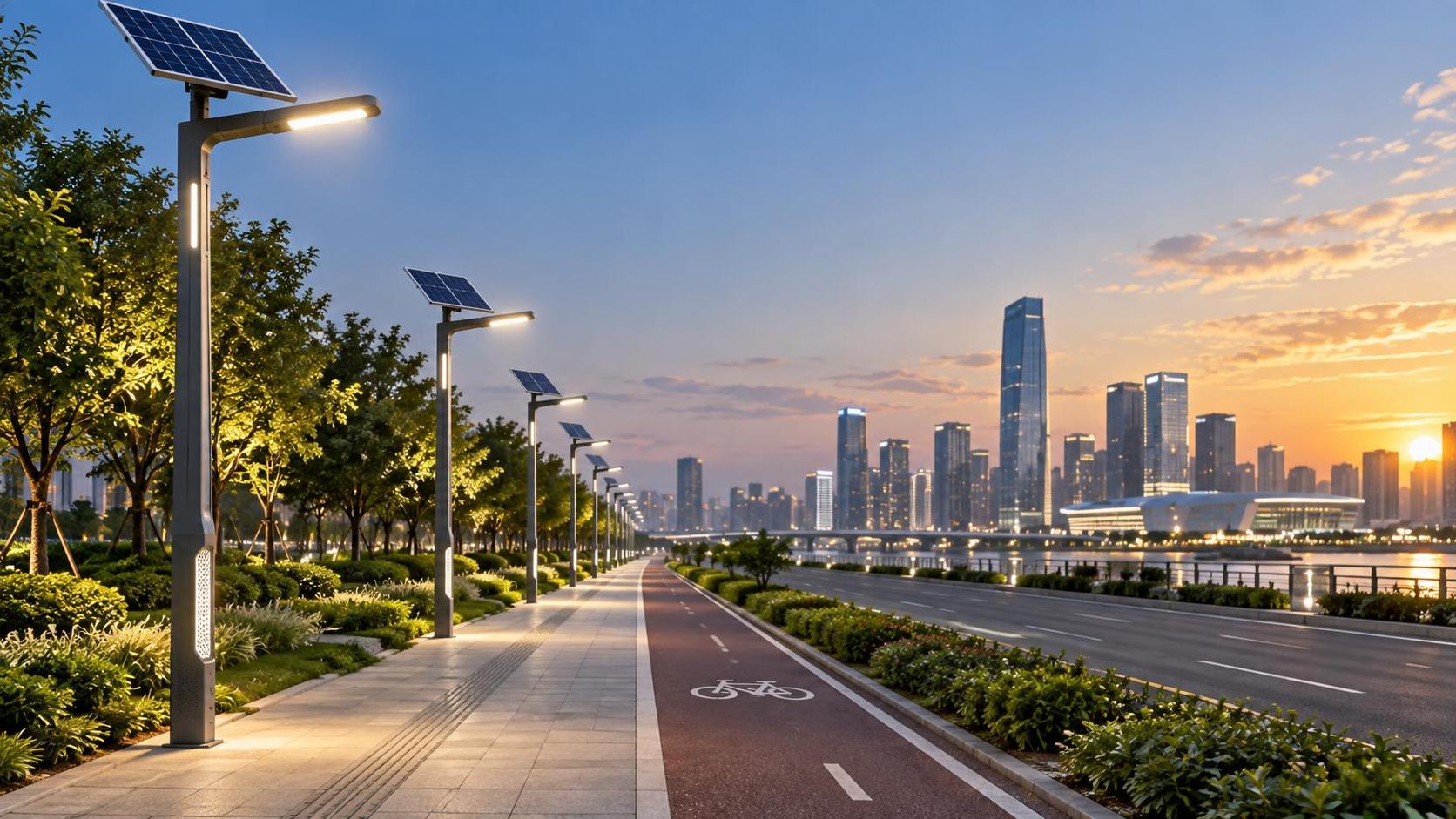
Solar powered street lighting for urban renewal projects should be planned as an infrastructure system, not purchased as a row of standalone fixtures. A solar luminaire can reduce trenching and grid dependence, but it will only deliver reliable public lighting when the site conditions, lighting task, energy storage, controls, and maintenance approach are designed together.
For municipalities upgrading aging streets, parks, waterfronts, pedestrian corridors, and mixed-use districts, the practical question is not simply whether solar lighting is viable. It is where it is the right fit, what level of autonomy the site needs, and which design decisions will prevent dark periods, poor visibility, or difficult maintenance after handover.
Start with the lighting task, not the fixture wattage
Urban renewal sites often combine several nighttime activities within a small area: vehicles moving through a road, pedestrians crossing at junctions, residents using a path, and visitors gathering near shops or public amenities. These spaces should not automatically receive the same pole spacing, mounting height, beam distribution, or control schedule.
Roadways need consistent forward visibility and controlled glare. Pedestrian routes need facial recognition and visual comfort at walking speed. Parks and plazas benefit from lower, more carefully directed light that supports wayfinding without flooding nearby homes. A single high-output fixture selected only by wattage can leave some zones overlit while creating weak coverage between poles.
Before selecting equipment, map the site by function: traffic lanes, crossings, entrances, transit stops, stairs, cycle paths, gathering areas, and low-use peripheral zones. This reveals where continuous lighting is necessary and where adaptive dimming is appropriate. It also prevents a common procurement mistake: applying one solar street light specification across spaces with fundamentally different risks.
Solar availability determines whether the scheme is dependable
The photovoltaic panel needs usable daylight, not merely an outdoor location. Mature trees, new high-rise construction, elevated roads, signs, building overhangs, and seasonal shading can significantly reduce charging time. These conditions are especially relevant in renewal work, where the public realm may change after lighting has been specified.
A proper solar assessment should consider the installed orientation, shading across the day, likely future obstruction, and the period when available sunlight is weakest. It should also account for local weather patterns rather than assuming that a bright-day energy calculation represents year-round operation.
Where shading is persistent, solar lighting may still work in selected locations, but a fully independent system may not be the best answer. Grid-connected LED lighting, a hybrid arrangement, or relocation of poles can be more reliable. Solar is particularly valuable where cable excavation would disrupt finished surfaces, mature landscaping, buried utilities, heritage fabric, or active public areas. It is less suitable when the location cannot provide predictable charging or when the required operating load is high every night without enough energy recovery.
Size the energy system around the operating profile
A solar street light is an energy balance. The panel collects energy, the battery stores it, the LED consumes it, and the controller decides how that stored energy is used through the night. If any one of those elements is undersized or poorly matched, the fixture may appear adequate during commissioning but lose performance during extended low-sun periods.
Municipal specifications should define the intended lighting schedule before comparing models. Ask whether the site requires full output all night, a reduced level after evening activity declines, motion-triggered brightening, or a programmed curfew. A path beside a late-night transit route has a different operating profile from a landscaped promenade with limited overnight use.
Battery autonomy should be treated as a resilience requirement, not a brochure feature. The design needs enough stored energy for the expected lighting duty during periods of reduced solar input. It should also account for battery performance over time, not only the condition of a new installation. Clear system documentation is valuable here: it should state the intended operating modes, dimming logic, battery service approach, and what happens when stored energy reaches a low level.
Use controls to protect both safety and battery capacity
Smart control is often more useful than simply increasing panel or battery size. A programmed dimming schedule can reserve energy for the late-night hours when safety lighting is still needed. Motion sensing can raise output when people, bicycles, or vehicles enter a lower-use zone, then return the fixture to a more economical level.
The control strategy must match how the space is actually used. Aggressive dimming on a busy footpath can make the environment feel unsafe. Constant high output on a quiet service road can consume stored energy without improving the public experience. The best approach is usually zone-based: define the minimum acceptable light level for each activity area, then assign operating schedules and sensor behavior accordingly.
For larger schemes, remote monitoring adds operational value. Fault alerts, battery status, lighting status, and control adjustments help maintenance teams identify issues before residents report a dark location. However, connected controls should be specified with the same care as the luminaires: communications coverage, commissioning process, user access, data ownership, and long-term support all affect whether the system remains manageable.
Specify for public exposure, not showroom conditions
Urban equipment faces vibration, moisture, dust, heat, corrosion, accidental impact, and sometimes deliberate damage. Housing quality, mounting design, seals, cable protection, battery enclosure access, and surge protection can matter as much as the LED module itself. A durable luminaire should be serviceable without turning a routine battery or controller replacement into a pole replacement.
It is also important to distinguish between a stated ingress-protection rating and the whole installation’s resistance to water and wear. Cable entries, connectors, mounting interfaces, and panel fixings need appropriate attention during installation. Poor workmanship at these points can undermine otherwise suitable equipment.
Standardization helps municipal maintenance teams. Using a manageable number of pole, controller, battery, and fixture configurations makes it easier to hold spares, train technicians, and diagnose faults. Standardization should not mean forcing one model into every location; it means creating a small, well-defined family of solutions for recurring site conditions.
Keep functional street lighting separate from placemaking lighting
Renewal projects often need more than safe circulation. Gateways, civic squares, landmark facades, and cultural corridors may benefit from lighting that strengthens orientation and local identity. That layer should complement, rather than replace, functional street and path lighting.
For example, a landscaped entrance or public-event zone may use a LED Pattern Projector to display graphics, logos, or changing visual patterns while the primary solar street lighting maintains reliable pedestrian visibility. The TATYD-001 offers 150W, 200W, and 300W options, multiple beam angles, DMX512 control, linear dimming, and an IP65 die-cast aluminum housing. Its role is expressive landscape lighting, not the baseline safety illumination required along roads or walking routes.
Keeping these roles separate simplifies design review. Functional lighting can be evaluated against visibility, uniformity, glare, operating hours, and resilience. Feature lighting can then be assessed for visual impact, curfew operation, neighborhood sensitivity, and control flexibility without compromising the safety brief.
A practical pre-procurement review
- Confirm each zone’s activity, required operating hours, and minimum acceptable lighting condition.
- Survey shading at proposed pole positions, including likely changes from trees, buildings, and streetscape elements.
- Define the dimming and sensor strategy before asking suppliers to size panels and batteries.
- Review mounting height, optical distribution, pole spacing, glare control, and coverage at crossings and transitions.
- Set requirements for enclosure durability, service access, replacement components, and installation quality.
- Decide how faults will be reported, who will own commissioning data, and how the system will be maintained after completion.
Lishida Smart Lighting supports contractors and project owners with integrated outdoor lighting products, smart control systems, and project-based solutions for roads, public spaces, and complex urban environments. For renewal schemes, this kind of coordinated support is most useful when product selection, control planning, installation details, and long-term operation are reviewed as one project decision rather than separate purchases.
The strongest municipal solar lighting schemes are not defined by the largest panel or the highest nominal output. They are defined by a realistic energy model, clear lighting priorities, durable field-ready components, and a maintenance plan that remains workable long after the renewed district opens to the public.
◉ MESSAGE

Blog
- How to avoid vendor lock-in in a government smart lighting project
- Sizing the communications power budget for smart city solar street lights
- How energy-saving mode affects solar bollard light operating time
- Comparing lead times from LED street light luminaire suppliers in Europe
- What spare parts support should a smart street light exporter offer?
- Where to place a solar garden light in a partially shaded garden
- Which battery alerts matter in remotely monitored solar street lighting?
Message