
Smart City Street Lighting Trends Shaping Public Infrastructure Investment
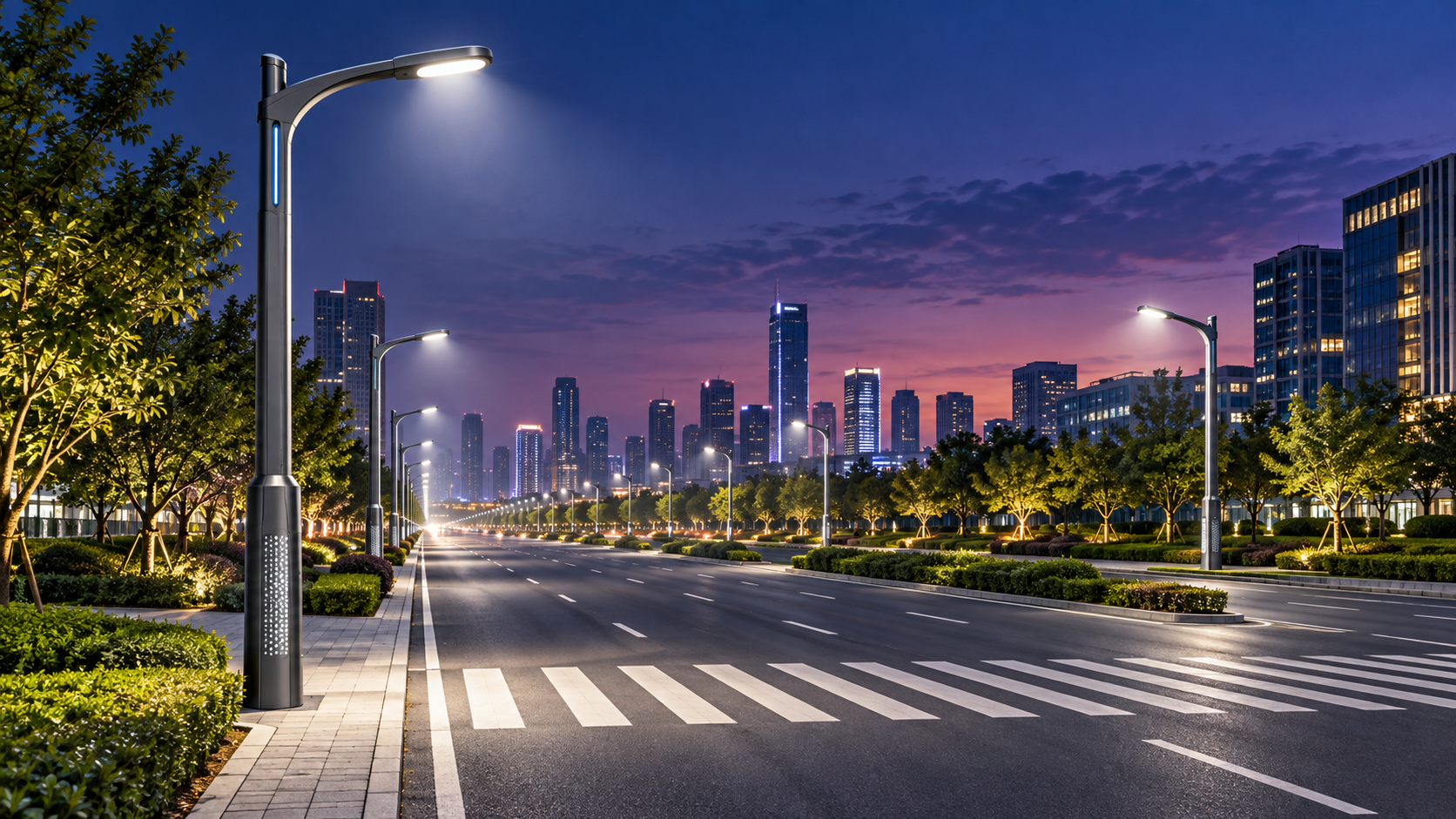
Smart City Street Lighting investment should begin with the operating model of the street, not with a luminaire catalogue. A high-traffic arterial road, a pedestrian-oriented civic district, and a mixed-use urban corridor can all use LED streetlights, yet they demand different optical distributions, pole configurations, control responses, and maintenance access. Projects that treat every road as a simple fixture replacement often achieve lower initial wattage while inheriting uneven illumination, unnecessary control complexity, or difficult future repairs.
The strongest current trend is the shift from isolated lighting assets to coordinated infrastructure. Streetlights are increasingly specified as connected field devices that can report status, follow schedules, respond to defined operating conditions, and support a phased urban control architecture. The investment question is therefore no longer limited to fixture efficacy. It includes whether the pole, electrical compartment, driver, communication method, mounting arrangement, and control interface can remain serviceable throughout the planned asset life.
Adaptive control is changing what "efficient" means
Fixed overnight operation remains appropriate for locations where traffic patterns and safety requirements stay consistent. Elsewhere, adaptive dimming is influencing design decisions because light output can follow real use rather than a single maximum setting. A corridor with late-evening activity may need full output through the active period, a moderated level later at night, and a defined response if a local event changes the expected pattern.
That logic only produces useful results when the lighting design has enough reserve at the intended dimmed level. Reducing output from an overpowered installation is not equivalent to designing the road lighting correctly. The initial photometric layout must account for mounting height, pole spacing, setback, road width, lane arrangement, surrounding reflectance, and glare control. Otherwise, control schedules can expose dark transitions between poles or poor vertical illumination at crossings.
Control specifications also need clear boundaries. A networked controller is valuable when the project has a genuine need for remote grouping, fault visibility, calendar schedules, or measured energy reporting. Adding sensors and communications to every point without defining commissioning ownership, data access, failure behavior, and replacement procedure can create a maintenance burden that exceeds the operational benefit. A practical requirement is that each luminaire retain a safe, predictable local operating state if communication is interrupted.
The pole is becoming a long-life infrastructure decision
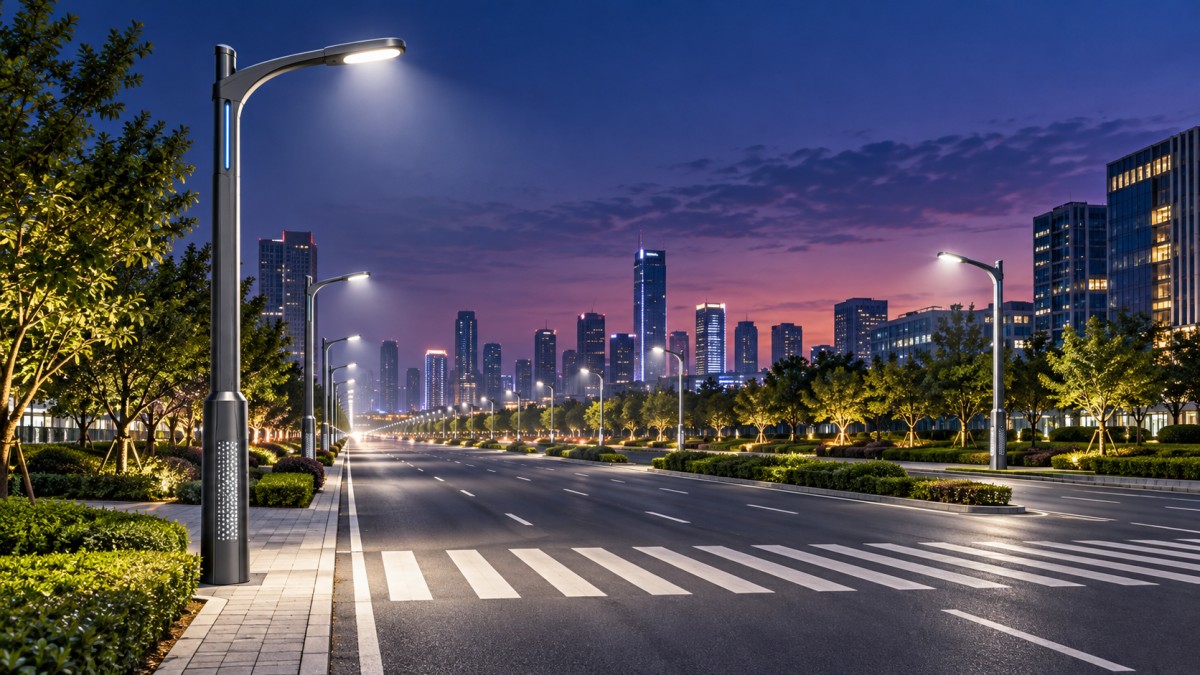
Connected lighting draws attention to electronics, but the structural assembly often determines whether the installation remains dependable after years of exposure. Pole selection needs to be matched to local wind loading, arm geometry, luminaire area, cable routing, access-door design, foundation interface, and any future equipment intended for the structure. A pole that is adequate for one luminaire may not suit an enlarged bracket, decorative attachment, or additional communication hardware.
Surface protection deserves the same project-stage attention as lighting output. Hot-dip galvanizing provides corrosion protection to the steel substrate, while powder coating can add a durable finished appearance when coating preparation and application are properly controlled. The interface between pole, base plate, anchor bolts, and foundation is particularly important because water retention, damaged coating, poor drainage, or incompatible site repairs can accelerate localized deterioration.
For example, a configuration such as Modern Street Lighting|MSL-HCH combines an 8-14 m Q235 steel pole range with a 4-8 mm pole thickness, hot-dip galvanizing and powder coating. Its stated wind resistance of at least 150 km/h should be read as one part of the structural review, alongside the installed luminaire configuration, arm length, foundation design, and project-specific wind assessment. A figure on a product sheet does not remove the need to verify the complete installed assembly.
Lifecycle value is moving upstream into specification work
Public infrastructure budgets increasingly benefit from separating initial purchase cost from lifecycle exposure. The useful comparison is not simply one luminaire's rated life against another's. It is the expected cost and disruption associated with driver access, surge damage, connector condition, optical compartment sealing, pole corrosion, control-node replacement, and traffic management during maintenance.
Ingress protection ratings are often interpreted too broadly. An IP67 rating addresses resistance to dust ingress and temporary water immersion under defined test conditions; it does not independently prove resistance to every coastal atmosphere, polluted environment, cable-entry error, or installation defect. The gasket design, pressure equalization, connector placement, enclosure material, and workmanship at the wiring interface all influence field reliability. A sealed luminaire paired with a poorly protected external connector still leaves a vulnerable system point.
Similarly, luminous efficacy should be assessed with the delivered lighting task in view. A rating of at least 140 lm/W can support lower energy demand, but it does not confirm that the selected optic places light where it is needed. Excess upward spill, glare toward adjacent properties, or insufficient light at a pedestrian crossing can require redesign even when the fixture efficiency is strong. Photometric files, mounting geometry, and calculation assumptions should be reviewed as a group.
Parameters that need to stay connected
- Power and optic: A 150-250W main light range can suit very different road sections. Selecting wattage before confirming the distribution, mounting height, and spacing tends to produce either overlighting or weak edge coverage.
- Colour temperature and place use: 3000K and 4000K create different visual environments. The appropriate choice depends on the character of the street, surrounding architecture, vegetation, nighttime activity, and any local lighting requirements, rather than a universal preference for a cooler or warmer appearance.
- LED life and service access: A rated LED lifespan of at least 50,000 hours is relevant, yet replaceable drivers, accessible control gear, and documented component compatibility determine whether the asset can be economically maintained before the LEDs reach their stated life.
- Colour rendering and safety tasks: Ra≥70 may be suitable for many roadway applications, while locations with higher visual-identification demands need the lighting calculation and colour quality expectation considered together.
Interoperability is replacing closed-system assumptions
As lighting networks expand, project teams are placing more weight on interfaces than on individual smart features. The practical issue is whether nodes, gateways, central software, and field controllers can be commissioned, updated, diagnosed, and replaced without making the entire installation dependent on a single unavailable component. Compatibility should be confirmed at the level of physical connectors, electrical supply, dimming protocol, communications architecture, addressing method, and fault reporting.
This does not require every project to adopt the most complex network. A contained park path may operate reliably with scheduled control zones, while a citywide road network may justify centralized monitoring and granular reporting. The costly mistake is specifying the same architecture for both because it appears technically advanced. Scope should follow operational need, available maintenance capability, and the expected expansion path.
Commissioning records are now part of the asset, not just handover paperwork. Each installed point should be traceable to its pole location, luminaire type, driver configuration, controller identity, circuit, schedule group, and relevant installation notes. When a fault appears, this record distinguishes a network issue from a supply issue, a controller issue, or a luminaire issue. Without it, routine replacement work can accidentally introduce mismatched settings or incompatible components.
Installation constraints are shaping procurement choices
Street lighting packages frequently encounter delays through small coordination gaps: anchor bolt templates that do not match the delivered base plate, cables that are too short for the access compartment, brackets altered on site without structural review, or control components arriving without a final addressing plan. These are not minor site details. They determine whether the installed system follows the approved lighting and structural design.
Base plate geometry and slotted-hole tolerances need to be coordinated with the foundation drawings before production and before concrete work begins. Slotted holes can accommodate alignment variation, but they cannot correct a foundation that is materially out of position, out of level, or incompatible with the bolt pattern. Transport also matters for taller poles: lifting points, protective packing, stacking method, and inspection on arrival should prevent coating damage and deformation before erection.
The direction of public infrastructure investment is clear in practical terms: dependable Smart City Street Lighting is being judged as a coordinated physical and digital asset. Projects gain resilience when energy performance, light distribution, structural durability, controls, installation interfaces, and maintainability are evaluated together at specification stage rather than corrected after the poles are in the ground.
◉ MESSAGE

Blog
- How to avoid vendor lock-in in a government smart lighting project
- Sizing the communications power budget for smart city solar street lights
- How energy-saving mode affects solar bollard light operating time
- Comparing lead times from LED street light luminaire suppliers in Europe
- What spare parts support should a smart street light exporter offer?
- Where to place a solar garden light in a partially shaded garden
- Which battery alerts matter in remotely monitored solar street lighting?
Message