
Selecting an LED Street Light Partner for Coastal and Corrosive Sites
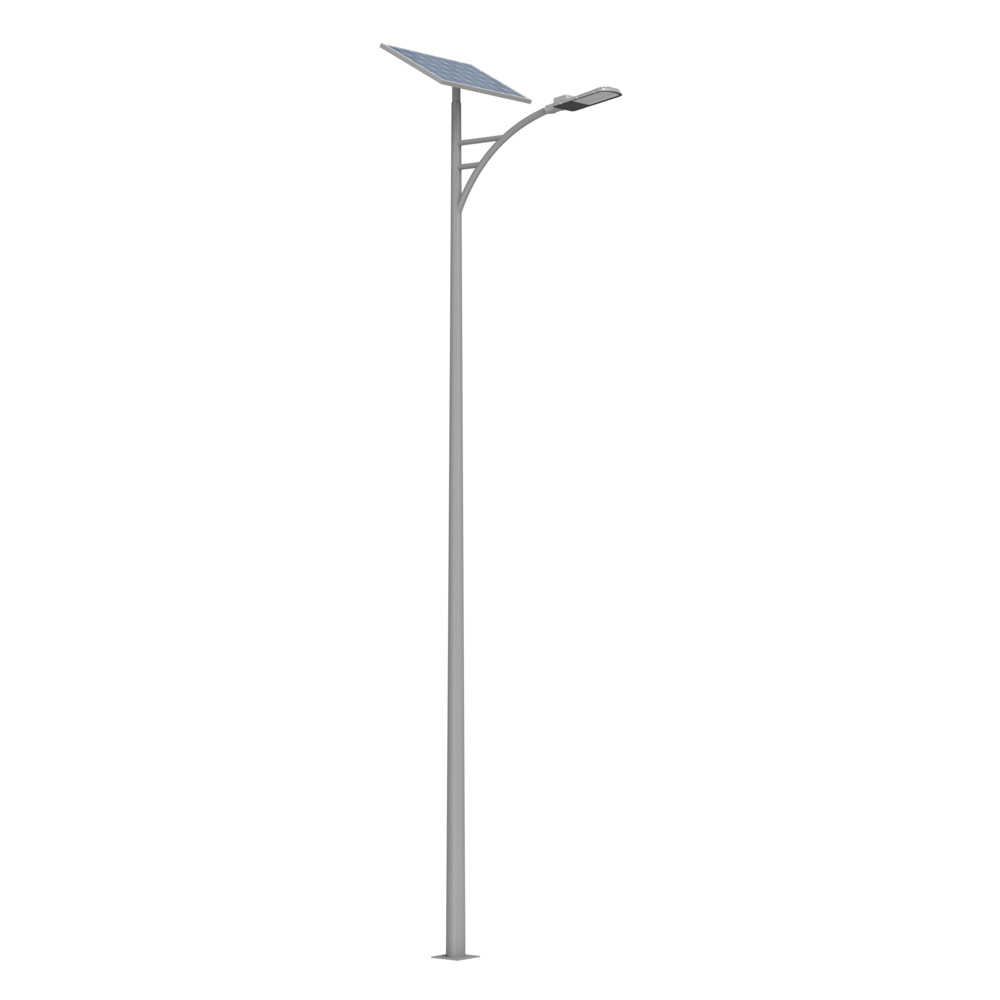
Coastal roads, port approaches, waterfront promenades, and island communities all share a difficult operating reality: outdoor luminaires are exposed to salt-laden air for years, not just during a storm. Moisture penetrates small gaps, chloride deposits remain on surfaces, and high wind can drive spray into areas that appear protected on a standard site drawing. In this setting, choosing an LED Street Light Manufacturer is not simply a matter of comparing lumen output, wattage, or unit price.
For business evaluators, the central question is more practical: can this partner supply a lighting system that remains safe, stable, maintainable, and visually consistent after repeated coastal exposure? The answer depends on details that are often overlooked in early procurement—housing construction, fastener selection, sealing design, heat dissipation, control-system integration, and the supplier’s ability to support delivery at project scale.
Start with the site, not the catalogue
A coastal location should not be treated as one uniform condition. A boulevard several kilometres inland may experience humid air and periodic salt deposition, while a road beside a harbor can face direct spray, continuous windborne salt, vibration from heavy vehicles, and industrial pollutants. A marina, fishery zone, bridge, or shoreline park may have its own combination of corrosion risks.
Before issuing a request for quotation, define the operating environment in terms that engineering and procurement teams can use:
- Distance from the shoreline and likely exposure to direct salt spray
- Humidity, rainfall patterns, fog, and seasonal temperature changes
- Industrial emissions or traffic pollution that may accelerate surface degradation
- Mounting height, wind loading, pole material, and bracket configuration
- Access constraints for cleaning, inspection, and future replacement
- Whether lighting will be dimmed, networked, or managed as part of a smart-city platform
This early classification prevents a common mistake: specifying a light that is suitable for ordinary urban roads but under-engineered for a marine-facing installation. A reliable LED street lighting proposal should respond to the actual exposure level rather than offering the same fixture for every application.
What corrosion resistance really means in a street light
“Corrosion resistant” is often used broadly, yet evaluators should ask what materials and processes sit behind the claim. The luminaire body, coating, screws, hinges, cable glands, brackets, optical frame, and electrical connections all matter. A robust die-cast aluminum housing can be an appropriate foundation, but its long-term performance also depends on surface preparation, coating quality, drainage paths, and compatibility between different metals.
Pay close attention to the interfaces. Corrosion frequently starts at fasteners, seams, damaged coating edges, or areas where water remains trapped after rain. If a fixture has external components made from incompatible materials, galvanic corrosion can develop faster than expected in salty conditions. Ask the manufacturer to explain the housing finish, fastener material, sealing approach, and how the design avoids water accumulation.
Ingress protection is equally important, but it should be understood correctly. A suitable IP rating indicates protection against dust and water entry under defined conditions; it does not, by itself, prove resistance to long-term salt corrosion. A serious LED Street Light Manufacturer should be able to discuss both enclosure protection and the broader durability of the material system.
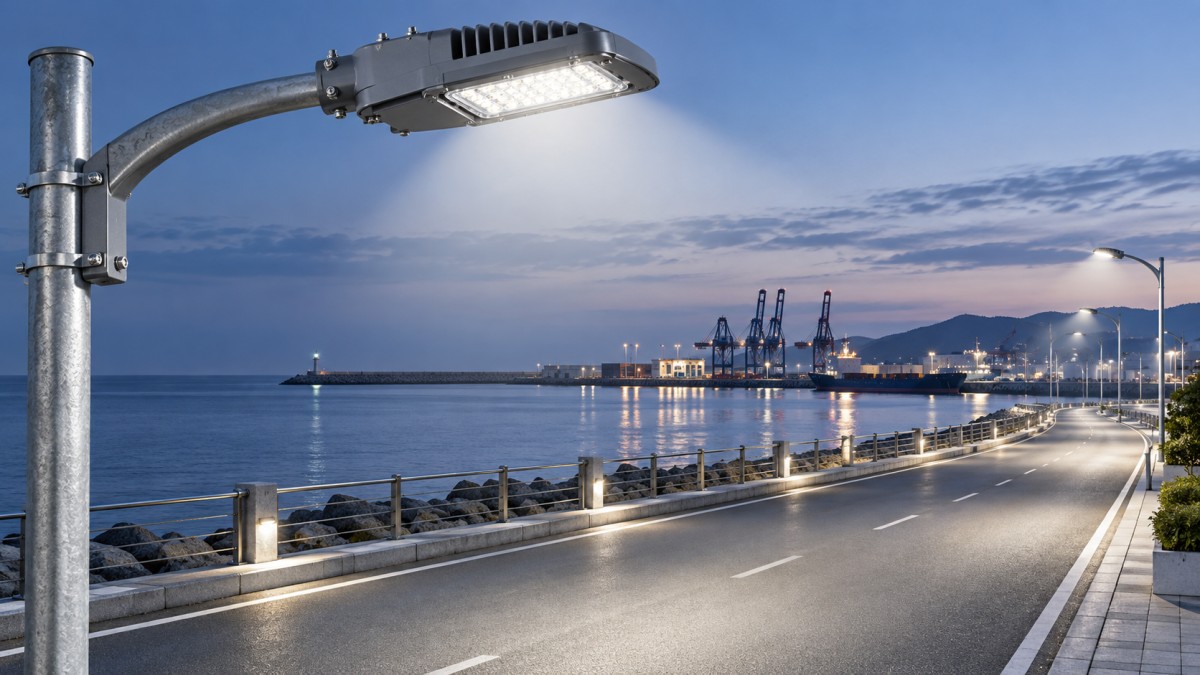
Thermal design remains a coastal reliability issue
It is tempting to associate coastal air with cooling. In practice, high humidity, solar gain, enclosed electronics, dirt buildup, and restricted airflow can still place stress on LED drivers and light engines. Heat has a direct effect on lumen maintenance and electronic component life, so the fixture’s thermal path deserves careful review.
Look for a design that moves heat efficiently away from the LED module while protecting internal components from moisture. Fin geometry, housing mass, driver compartment layout, gasket stability, and the separation of optical and electrical chambers can all influence real-world performance. If a supplier only discusses initial efficacy, the assessment is incomplete. Ask how the luminaire is designed to preserve output and electrical stability over its intended service life in harsh outdoor conditions.
Evaluate the whole assembly: fixture, pole, controls, and maintenance
A street light is part of an installed system, not an isolated product. In corrosive sites, the pole and mounting bracket deserve the same scrutiny as the luminaire. A well-specified fixture cannot fully compensate for a poorly protected arm connection, unsuitable bolts, or an installation method that allows water to collect around cable entries.
Maintenance planning should also influence product selection. On a long coastal road, repeated truck rolls can become more expensive than a slightly higher initial equipment cost. Consider whether the driver can be accessed without dismantling the full fixture, whether surge protection can be serviced, and whether the optical chamber is designed to remain clean. Clear labeling, standardized components, and sensible installation instructions reduce uncertainty for contractors working under tight schedules.
Smart control capability is another useful evaluation point. Dimming schedules can lower energy use during quiet night hours, while fault reporting can help operators identify issues before a dark section of road becomes a public-safety concern. Compatibility with common control approaches—such as photocell operation, standalone dimming, or networked management—should be confirmed at the project stage, especially where the lighting package will connect with wider municipal infrastructure.
Questions that reveal a supplier’s project capability
Procurement teams do not need to become luminaire engineers, but a focused technical conversation can reveal whether a supplier understands large-scale delivery. Rather than asking only for a price list, request answers to questions such as:
- Which configuration is recommended for this site, and what assumptions support that recommendation?
- How are coatings, seals, cable entries, and external hardware selected for corrosive exposure?
- Can the supplier provide photometric files and support road-lighting calculations for the proposed mounting arrangement?
- What driver, surge-protection, and control options are available, and how are they integrated?
- How will samples, production consistency, packaging, delivery schedules, and on-site technical questions be managed?
- What documentation will be available for installation, commissioning, and maintenance teams?
The quality of the response matters as much as the response itself. A partner with genuine project experience will usually ask for pole spacing, road width, mounting height, target illuminance, local grid conditions, and control requirements. That is a better sign than a generic promise that one model “fits all” applications.
When the coastal project includes public-space identity
Many waterfront developments combine road lighting with placemaking. Entrances to promenades, tourism districts, marina walkways, and civic squares may need visual cues that are different from functional street illumination. This does not mean adding decorative equipment without a plan; it means coordinating the lighting hierarchy so that roads remain safe and adjacent public spaces feel intentional.
For landmarks, event areas, or wayfinding features, an LED Pattern Projector can complement the wider scheme by projecting logos, graphics, or changing patterns. Its die-cast aluminum body, IP65 protection level, OSRAM LED source, multiple beam-angle options, and DMX512 control support make it relevant for managed landscape-lighting zones. It should be specified separately from roadway luminaires, with careful consideration of aiming, glare control, wind exposure, and maintenance access.
A balanced procurement decision protects the project after handover
The lowest purchase price can look persuasive during bid review, especially on a project with hundreds or thousands of luminaires. Yet corrosive-site lighting should be evaluated through lifecycle risk. Early coating failure, driver instability, difficult maintenance, inconsistent batches, or incompatible controls can quickly erase an initial saving and create operational friction for the owner.
A stronger decision balances technical suitability, photometric performance, system compatibility, manufacturing discipline, and project support. Contractors need products that arrive consistently and install predictably. Owners need a system that continues to perform after the ribbon-cutting. Designers need confidence that the completed site reflects the intended road safety and nighttime character.
Lishida Smart Lighting supports this broader delivery process with outdoor lighting products, smart control options, and project-based engineering coordination. For coastal and corrosive sites, the most useful partner is not merely a vendor of fixtures. It is a team prepared to examine site conditions, align the product configuration with the application, and help move the project from specification to long-term operation with fewer avoidable compromises.
◉ MESSAGE

Blog
- How to avoid vendor lock-in in a government smart lighting project
- Sizing the communications power budget for smart city solar street lights
- How energy-saving mode affects solar bollard light operating time
- Comparing lead times from LED street light luminaire suppliers in Europe
- What spare parts support should a smart street light exporter offer?
- Where to place a solar garden light in a partially shaded garden
- Which battery alerts matter in remotely monitored solar street lighting?
Message