
Reducing Import Risk When Sourcing Solar Street Lights From China
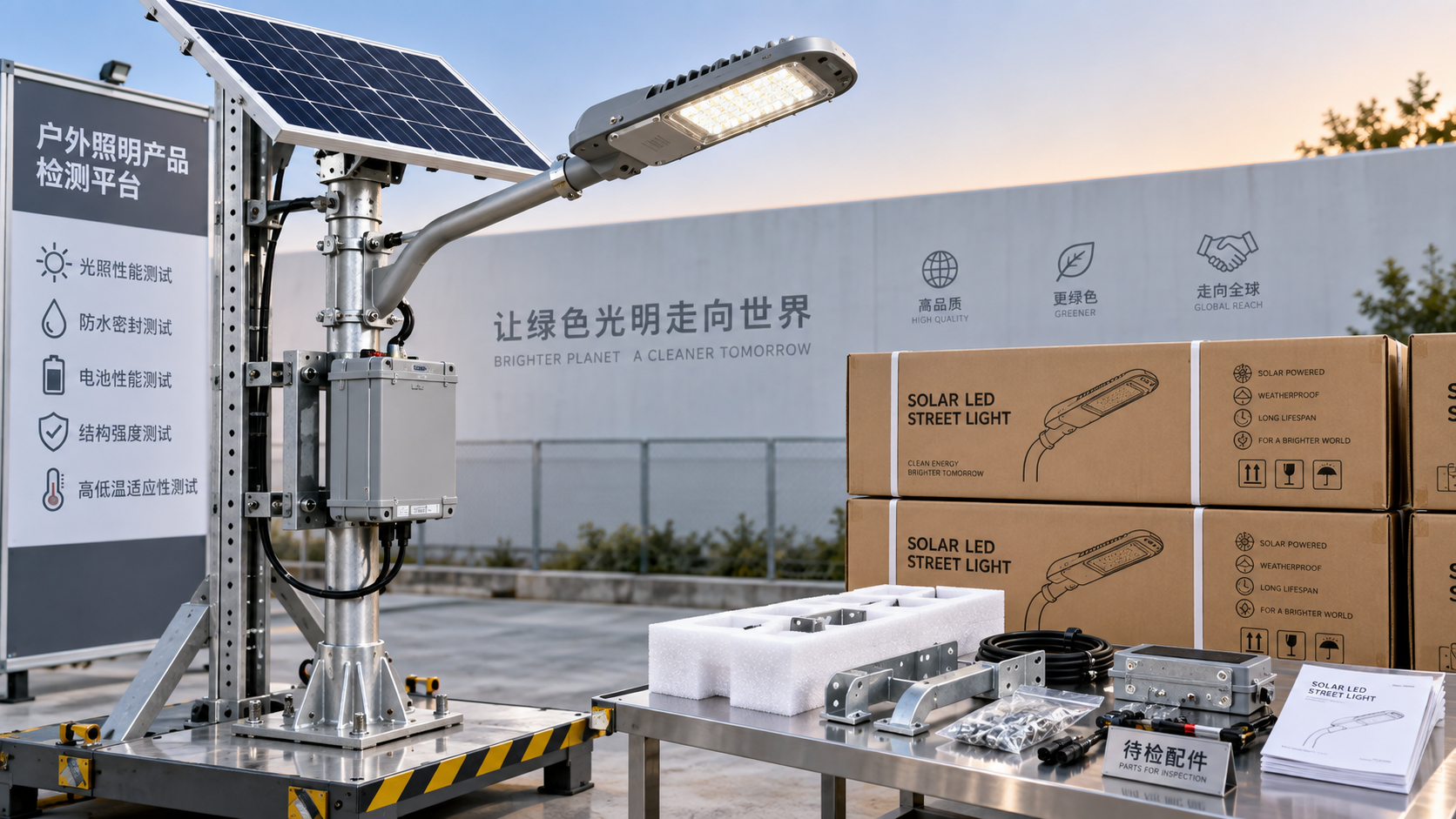
Import risk is reduced when the purchase order describes the delivered lighting system rather than a headline wattage and an attractive unit price. A solar street light is a combined electrical, mechanical, and energy-storage product. A weakness in the battery, controller settings, panel mounting, corrosion protection, or packing method can appear only after the shipment has reached site. By then, replacing parts often costs more than resolving the uncertainty before production begins.
Start with the operating condition: road width, mounting height, pole spacing, local solar resource, seasonal weather, night-time operating hours, ambient temperature range, wind exposure, and maintenance access. These inputs determine whether a proposed configuration is realistic. A solar fixture that performs acceptably on a lightly used park path may not sustain road lighting through a cloudy period when the required illumination time is longer and the mounting height is greater.
Turn the requirement into a verifiable system specification
“All-in-one solar street light, 100 W” is not a usable technical requirement. Solar LED wattage often describes the maximum LED load, while actual nightly operation may use stepped dimming. Without a lighting profile, the stated wattage does not indicate energy use, autonomy, or road performance. Request a document that links the LED power schedule to battery capacity, photovoltaic panel output, controller logic, and expected operating duration.
The specification should state the following in connected terms:
- Required illumination level or lighting calculation criteria, together with installation height, outreach, road geometry, and pole spacing. A broad beam on a wide road and a narrow beam on a pedestrian route cannot be judged by lumen output alone.
- LED power at each dimming period, the start and end trigger for each period, and whether timing is based on a clock, ambient light, or controller programming.
- Battery chemistry, nominal voltage, usable capacity, cell arrangement, low-temperature charging limits, battery enclosure location, and the controller’s low-voltage cutoff point.
- Solar panel type, rated power, physical size, tilt or orientation limits, connector type, and the allowable voltage range at the controller input.
- Housing material, coating process, fastener material, ingress protection claim, cable entries, drainage path, and pole interface dimensions.
Battery capacity deserves particular attention. A large nominal amp-hour figure has little value unless it is paired with voltage and permitted depth of discharge. Two batteries with similar labels can have materially different usable stored energy. The controller setting also matters: excessive discharge can shorten battery life, while an overly conservative cutoff can cause early switching-off despite remaining nominal capacity.
Separate fixture quality from system performance
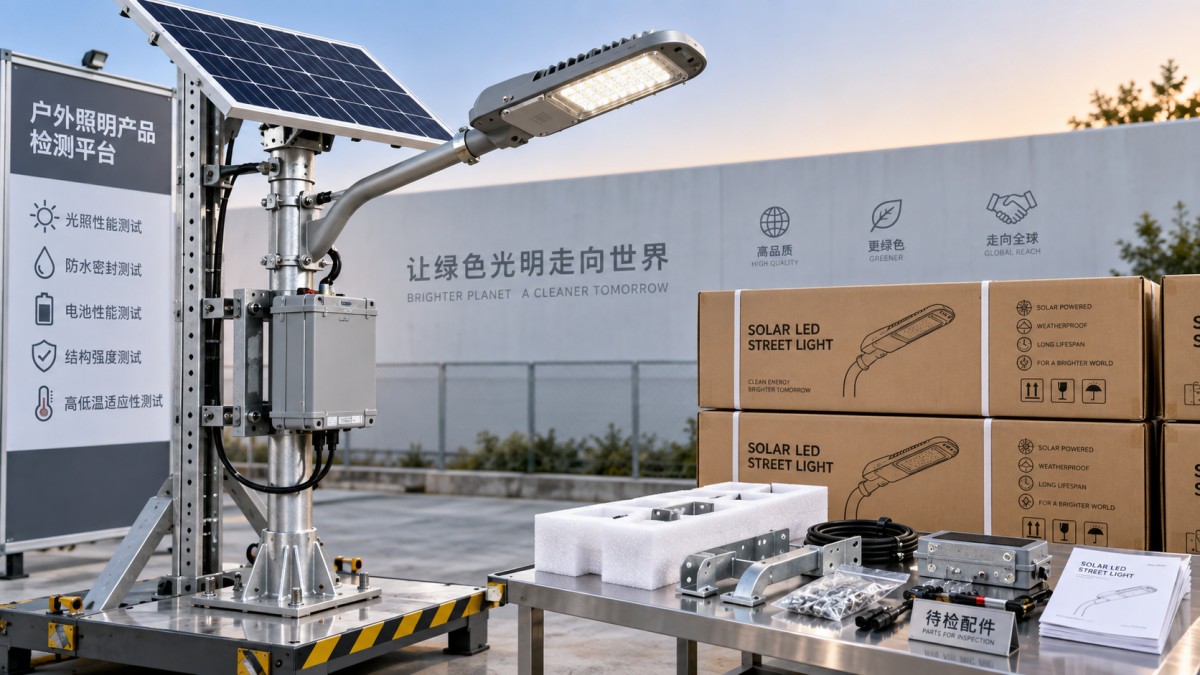
A sample can look well finished and still leave major production risks unresolved. Inspect the solar assembly as a system. Confirm that the panel bracket resists vibration, the cable route does not chafe against metal edges, seals remain compressed after assembly, and the battery compartment can be opened without damaging gaskets or wiring. On integrated units, heat from the LED driver and battery placement should be considered together. Battery life can be affected when the enclosure retains heat during the day and operates in high night temperatures.
Ask for the exact bill of materials for the approved version, not a generic catalogue sheet. It should identify the LED package, driver or controller model, battery cell type, panel, lens, housing alloy, coating, and mounting hardware. This creates a reference point if substitutions are proposed later. A change from stainless fasteners to ordinary plated hardware, for example, may have little visible effect before shipment but can lead to seized or corroded mounting points in coastal or humid locations.
For projects that combine solar units with grid-connected sections, evaluate the interface requirements separately. An LED Street Light Luminaire intended for roads or highways has different input and control assumptions from a self-contained solar light. Its optical distribution, IP rating, dimming protocol, pole connection, and AC voltage range must be reviewed as a conventional luminaire package. Treating it as interchangeable with a solar unit can cause errors in cabling, controls, and commissioning scope.
Use samples to answer production questions
An approval sample should match the configuration that will be shipped, including optics, battery, solar panel, finish, controller program, mounting bracket, and packaging. A showroom sample assembled from available parts cannot validate the final supply. Mark the approved sample or retain detailed photographs of labels, internal wiring, connectors, screw locations, and controller settings. These records are useful when cartons arrive with visually similar but different versions.
Testing should focus on failure modes that relate to the site. Energize the fixture through its dimming sequence, verify charging indication and automatic on/off behavior, and inspect the light distribution at the intended mounting angle. Where access permits, review internal workmanship: wire gauge, crimp quality, strain relief, connector locking, conformal protection around electronic boards, and separation between live wiring and sharp cast edges.
Laboratory reports can support a claim, but the report must identify the same model and configuration. A protection rating for an empty housing does not automatically confirm the assembled product’s resistance to water entry. Likewise, a report for one battery pack cannot be extended to another pack merely because the external housing is unchanged. Require traceable model references and compare the dates, tested sample description, and declared parameters against the purchase specification.
Control the shipment before it becomes a site problem
Delivery delays often begin with incomplete technical confirmation rather than factory capacity. Solar panel dimensions, battery availability, custom brackets, labels, cartons, and controller programming can all affect the production sequence. The order should define the approved drawing date, pre-production sample milestone, inspection point, packing completion point, and shipping document deadline. These are practical control points because a finished fixture without compliant labels or ready export packaging may still miss the planned departure.
Pre-shipment inspection should use a sampling method agreed in advance and include both appearance and functional checks. Confirm quantity, model marking, LED color temperature, mounting dimensions, charging function, switch-on behavior, controller schedule, accessories, carton markings, and packing protection. Photograph the loading condition where relevant. Solar panels, integrated fixtures, and battery-containing products can be damaged by loose stacking, compression, or moisture during transit even when the individual carton appears acceptable.
Battery transport documentation and destination requirements need review early. Requirements vary by battery type, shipment mode, and destination. The shipping arrangement should identify the battery configuration and documentation needed for the selected carrier, rather than leaving that issue until goods are ready to dispatch. The same approach applies to product marking, electrical documentation, and local installation rules: determine the project requirements first, then ensure the supplied configuration and paperwork match them.
Write after-sales obligations into the order
After-sales support is easier to manage when spare parts and fault diagnosis are defined before shipment. Specify which replaceable items will be available, such as controllers, battery packs, solar panels, drivers, photocells, lenses, brackets, and cables. Record part numbers and connector details. A replacement battery that fits physically but uses a different voltage, connector pinout, or protection setting may not restore the fixture safely.
Fault reporting should require evidence that distinguishes common causes. A light that fails to turn on may have a depleted battery, insufficient panel charging, a disconnected cable, water ingress, an incorrect controller schedule, shading, or a failed LED board. Site photographs, controller indicators, battery voltage readings, installation orientation, and a record of recent weather give a clearer basis for technical support than a general failure description.
Import risk falls when each claimed feature has an acceptance method: drawings confirm dimensions, samples confirm construction, functional tests confirm control behavior, inspection confirms shipment consistency, and documented spare parts support field repairs. That chain of evidence is more dependable than selecting a Solar Street Light Manufacturer China solely from catalogue specifications or initial quotations.
◉ MESSAGE

Blog
- How to avoid vendor lock-in in a government smart lighting project
- Sizing the communications power budget for smart city solar street lights
- How energy-saving mode affects solar bollard light operating time
- Comparing lead times from LED street light luminaire suppliers in Europe
- What spare parts support should a smart street light exporter offer?
- Where to place a solar garden light in a partially shaded garden
- Which battery alerts matter in remotely monitored solar street lighting?
Message