
China Solar Street Light Manufacturers: OEM Capabilities That Matter

A delayed shipment, inconsistent battery specifications, or a solar street light that performs well in a sample but poorly after installation can quickly turn a profitable order into a difficult service issue. When evaluating a China-based supplier, the central question is not simply whether the factory can produce a solar lamp. It is whether it can control the components, documentation, customization process, and production consistency that an OEM program requires.
A capable Solar Street Light Manufacturer China should be able to translate a market requirement into a repeatable product specification. That includes matching solar resource conditions, operating hours, pole arrangement, installation practices, branding needs, and replacement-part expectations. Low unit pricing has value only when the delivered configuration remains stable from the first container to later replenishment orders.
Start with the OEM request, not the catalog model
Catalog products are useful as a reference point, but they do not prove that a manufacturer can support private-label or project-based supply. A standard model may use one battery type, solar panel size, controller setting, and housing design today, while later production may change without a clear notification process. That creates problems when a buyer needs identical mounting parts, performance expectations, or spare components across multiple orders.
Before comparing quotations, define what must remain fixed and what may be adjusted. A practical OEM brief usually covers:
- Required lighting output, distribution pattern, and mounting height
- Expected nightly operating period and local seasonal solar conditions
- Battery chemistry, usable capacity, battery compartment design, and replacement access
- Solar panel wattage, cell type, panel orientation, and cable protection
- Controller functions, dimming schedule, motion sensing where relevant, and remote-control options
- Housing finish, logo treatment, packaging artwork, manuals, and carton marks
- Installation hardware, pole interface, and spare-part quantities
Not every point needs to be customized. In fact, unnecessary changes can add cost and lead time. The goal is to identify the items that directly affect field performance or commercial continuity, then ask the supplier how those items are controlled.
Check whether the power system is engineered as one system
Solar street lighting failures are often blamed on the luminaire, although the real cause may be an unbalanced energy system. A high-output LED module cannot compensate for insufficient panel generation. A large battery cannot solve chronic shading. A controller with aggressive dimming may extend runtime but leave the road underlit during the hours that matter most.
Ask the manufacturer to explain the relationship between LED load, solar panel generation, battery storage, controller settings, and autonomy assumptions. The answer does not need to be complicated, but it should be specific. A reliable supplier should be able to state which inputs are needed before recommending a configuration: location, daily lighting schedule, mounting height, road width, weather pattern, shading exposure, and required brightness profile.
Be cautious when every inquiry receives the same panel and battery combination regardless of application. A pedestrian path, rural access road, parking area, and arterial street have different operating demands. The right response may be a different wattage, a lower lighting level after midnight, a separate panel arrangement, or a decision that solar is not suitable for the site.
Component traceability matters more than a long feature list
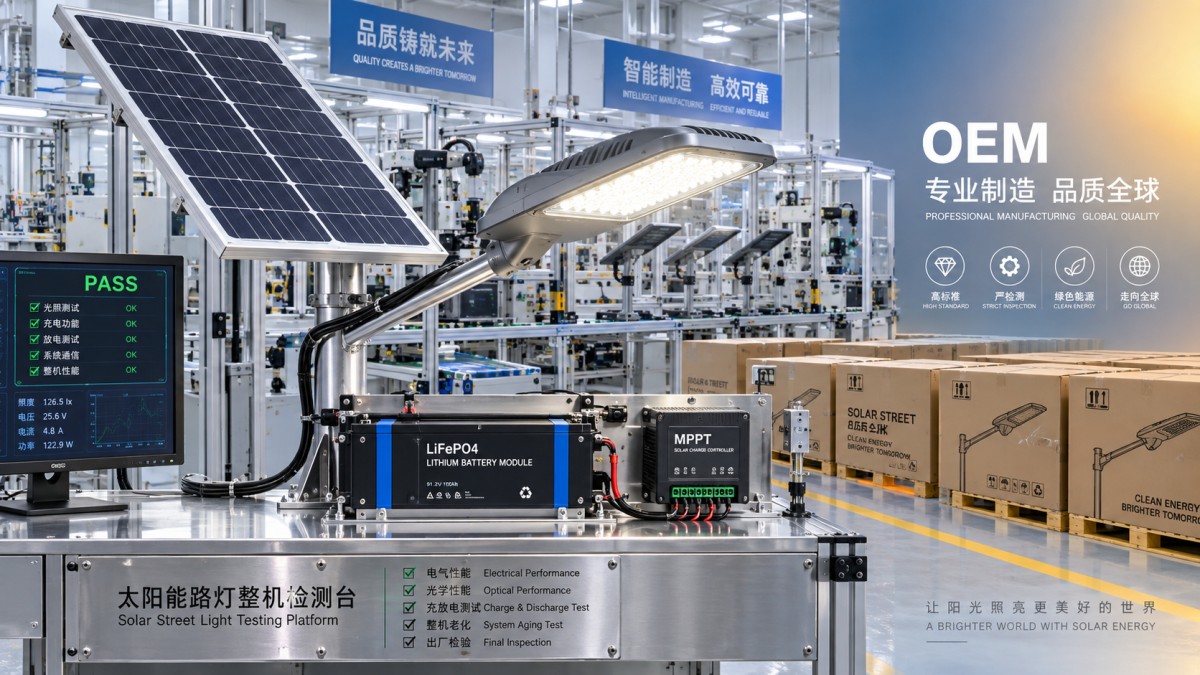
OEM supply depends on knowing what is inside the unit and whether it can be repeated. Request a component schedule that identifies the LED source, driver or controller, battery type, solar panel specification, lens, housing material, fasteners, and key cables. The purpose is not to force a supplier to disclose every commercial detail; it is to prevent vague descriptions such as “high-capacity battery” or “premium solar panel” from becoming the only basis for comparison.
Pay special attention to the battery and controller. These parts influence operating hours, charging behavior, low-temperature performance, and long-term maintenance. Ask whether the battery is modular, how it is protected from moisture and heat buildup, and whether the controller settings can be documented for future orders. If a replacement is needed several years later, a different controller profile can change the behavior of an otherwise identical lamp.
The same approach applies to mechanical parts. Housing thickness, heat dissipation design, gasket placement, cable glands, mounting brackets, and bolt compatibility determine whether the product remains serviceable outdoors. A sample that looks clean on a showroom bench does not reveal whether water paths, vibration, or repeated installation work have been considered.
Factory capability is visible in the questions they ask
A manufacturer with meaningful OEM capability will usually ask for more than target quantity and desired price. It should want to know the installation environment, expected order rhythm, local voltage requirements for any hybrid equipment, branding scope, package requirements, and whether the order is for stock distribution or a defined installation.
That questioning is useful because it exposes practical limitations early. For example, a custom die-cast housing may require volume that does not suit an initial market test. A special powder-coating color may be manageable, while a custom lens can affect optical performance and tooling cost. A supplier should distinguish between changes that are simple production variations and changes that require engineering validation.
Ask for a clear response on these points:
- Which customizations can be made from existing parts and which require new tooling?
- Who approves drawings, samples, packaging, and final production specifications?
- How are material or component substitutions handled after approval?
- Can the factory maintain the same bill of materials for repeat orders?
- What records accompany inspection and shipment?
- Which spare parts can be ordered separately, and how are they identified?
Do not separate the luminaire decision from the pole decision
Solar street lights are frequently evaluated as standalone products, while pole strength, bracket geometry, foundation interface, wind exposure, and maintenance access receive less attention. That separation can cause installation delays or create an unstable visual and structural result. The panel adds surface area and wind load; the battery arrangement can change handling weight; and the lamp bracket must place the optical distribution where it is needed.
For projects that combine solar units with conventional or grid-connected street lighting, reviewing the manufacturer’s pole engineering can also reveal its broader fabrication discipline. As one example, Modern Street Lighting|MSL-XM is specified with Q235 steel, hot-dip galvanizing and powder coating, pole heights from 8 to 14 m, and stated wind resistance of at least 150 km/h. Those details do not make it a solar product, but they illustrate the type of mechanical information that should be available when assessing pole and mounting compatibility.
For a solar configuration, request the pole drawing, bracket dimensions, anchor-bolt arrangement, panel support details, and installation sequence. Confirm who supplies each item. A lamp supplier may provide the luminaire only, while the local installer expects the pole kit to be included. Ambiguity at this stage often appears later as missing bolts, mismatched hole patterns, or unsuitable cable routes.
Use samples to validate decisions, not just appearance
A pre-production sample should be checked against an agreed specification sheet rather than a general expectation. Inspect the labeling, logo position, package protection, housing finish, connectors, mounting hardware, battery access, panel support, and instruction content. Record the approved version with photos and part numbers where possible.
Functional review should also focus on practical behavior: charging indication, programmed dimming, motion-sensor response if included, controller settings, and ease of assembly. A unit can illuminate successfully during a short indoor check while still leaving unanswered questions about runtime assumptions, weather exposure, or replacement procedures. The sample stage is the best time to resolve those questions because changes are less disruptive before production begins.
Build quality control into the purchase terms
Quality control is stronger when it is tied to measurable checkpoints. Instead of relying on a general promise of inspection, agree on what will be checked: incoming materials, LED and electrical assembly, battery installation, charging function, sealing points, finish quality, packaging, and final quantity verification. The exact method will vary by product, but the acceptance criteria should be understood before mass production.
Also define how deviations are reported. A supplier that finds a component shortage or proposed substitution should not proceed silently because the replacement appears equivalent. For OEM programs, an equivalent part may still affect mounting, service stock, labeling, or future compatibility. Written approval protects both sides and preserves product consistency.
The strongest manufacturer choice is usually the one that can show disciplined control over design inputs, component records, samples, production changes, and after-sales parts—not merely the lowest first quotation. That capability gives a private-label program a better chance of remaining manageable as orders, applications, and market expectations expand.
◉ MESSAGE

Blog
- How to avoid vendor lock-in in a government smart lighting project
- Sizing the communications power budget for smart city solar street lights
- How energy-saving mode affects solar bollard light operating time
- Comparing lead times from LED street light luminaire suppliers in Europe
- What spare parts support should a smart street light exporter offer?
- Where to place a solar garden light in a partially shaded garden
- Which battery alerts matter in remotely monitored solar street lighting?
Message