
How Battery Capacity and Pole Height Change Solar Street Light Pricing
How Battery Capacity and Pole Height Change Solar Street Light Pricing
For project evaluators, Solar Street Light Price is rarely defined by the luminaire alone. A quotation may appear competitive until the team compares battery autonomy, mounting height, pole engineering, transport, foundation work, and the level of lighting performance actually delivered on site.
That is where many procurement decisions become difficult. A lower initial unit price can look attractive in a spreadsheet, yet a battery that is too small for local weather or a pole that is undersized for its height may create operational risk long after installation. For roads, parks, public squares, and urban perimeter areas, the more useful question is not “Which solar light costs less?” but “What level of service is this price designed to support?”
Battery capacity and pole height are two of the clearest answers to that question. They affect material cost, structural design, installation scope, and the probability that a lighting system will remain dependable through changing seasons.
Battery Capacity Is Buying More Than Nightly Runtime
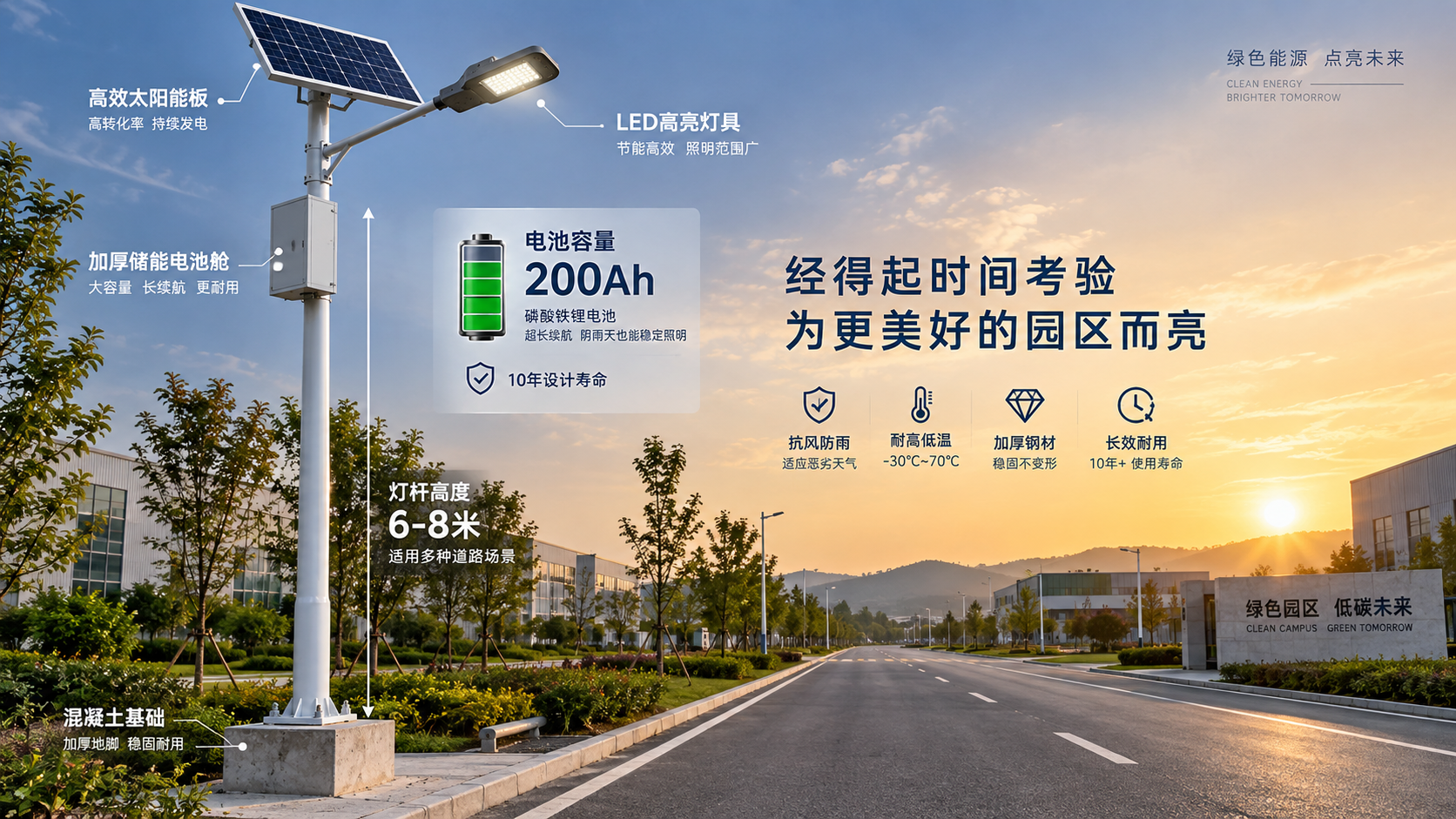
In a solar street lighting system, the battery stores daytime solar energy and releases it after sunset. Its capacity is usually expressed in watt-hours (Wh) or ampere-hours (Ah), but project teams should avoid treating those figures as isolated specifications. A meaningful battery assessment starts with the load profile: luminaire wattage, dimming schedule, required operating hours, expected solar radiation, and the number of low-sunlight days the system must withstand.
A larger battery generally raises the Solar Street Light Price because it requires more battery cells, a larger enclosure or battery compartment, associated protection components, and sometimes a stronger pole or bracket arrangement. However, it also provides a wider margin during cloudy periods, winter conditions, dust accumulation on panels, and gradual battery aging.
For example, a light intended to operate at full output for every hour of the night requires substantially more stored energy than one using an intelligent schedule: brighter during early evening traffic, then reduced output during quieter hours. Neither approach is automatically better. The right choice depends on the site’s safety expectations, pedestrian activity, traffic pattern, and local maintenance capability.
What a low battery price may leave out
When comparing offers, an unusually low battery-related cost may indicate a shorter autonomy target, a reduced usable capacity allowance, or a design based on ideal sunshine rather than seasonal reality. It may also reflect a different battery chemistry, warranty scope, or charging-control strategy. These differences are not always obvious in a summary quotation.
Evaluation teams should ask suppliers to clarify the design basis in practical terms:
- How many nights of autonomy are included under the stated lighting schedule?
- What is the expected daily energy consumption after dimming or motion-based control?
- Which battery chemistry is specified, and how is battery temperature managed?
- What solar resource assumptions were used for the project location?
- What happens to operating time as the battery ages?
These questions shift the discussion from a nominal capacity number to a deliverable lighting outcome. In large-scale projects, that distinction matters because replacing batteries across hundreds of poles is far more disruptive than selecting adequate capacity during the design stage.
The Battery, Panel, and Controller Must Be Sized as a System
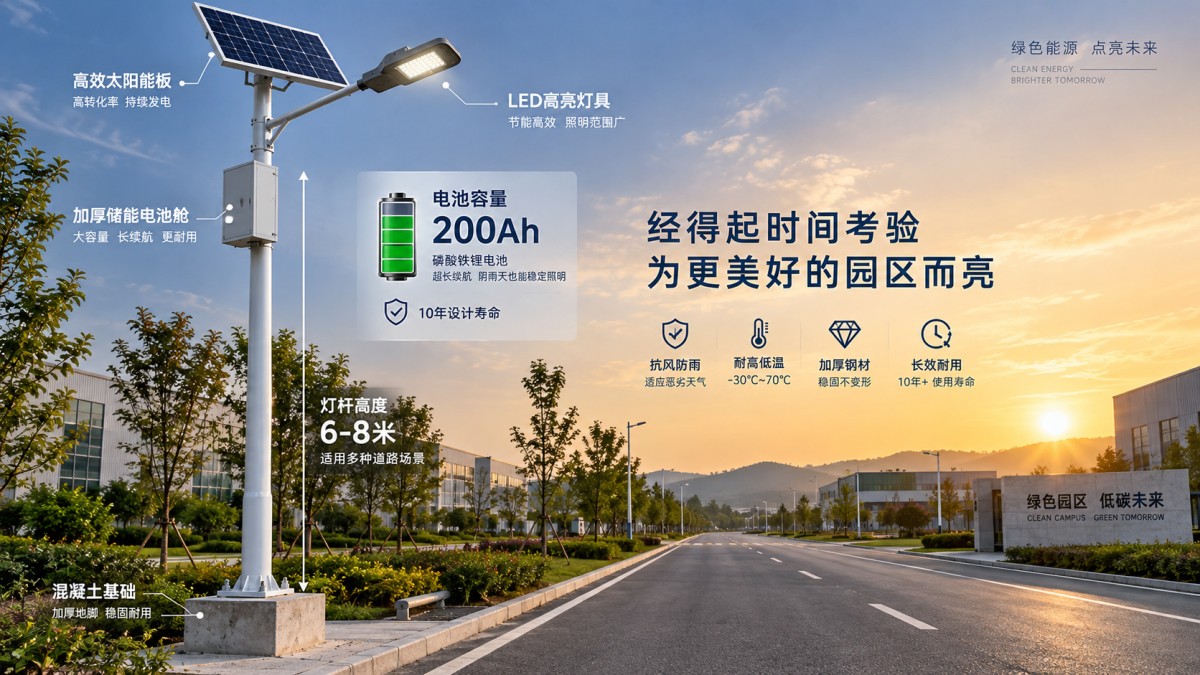
Battery capacity cannot be evaluated independently from solar panel output and controller performance. A large battery that cannot be recharged effectively after several overcast days does not create resilience; it simply adds cost and weight. Conversely, an efficient LED source and well-configured controller can reduce nightly energy demand, allowing a more balanced storage design.
For this reason, the most credible Solar Street Light Price comparison includes a system energy calculation. It should show the LED load, controller losses, battery reserve, solar module power, and anticipated charging window. Project owners do not need to dictate every engineering detail, but they should expect the supplier to explain the relationship between these components.
Smart control is especially relevant in public environments where lighting demand changes by time or activity. Scheduled dimming, remote monitoring, fault alerts, and adaptive settings can help preserve battery energy without leaving a road or pedestrian zone feeling neglected. The value is not simply lower consumption; it is the ability to manage the lighting asset with evidence rather than assumptions.
Pole Height Changes the Quote from the Ground Up
Pole height affects much more than appearance. As mounting height increases, the fixture can distribute light over a wider area, potentially reducing the number of poles needed along a route. At the same time, the light source is farther from the ground, so the luminaire’s optics and output must be selected carefully to maintain useful illuminance and uniformity.
From a pricing perspective, a taller pole usually means more steel, thicker wall sections, a larger base plate, stronger anchor bolts, and a more substantial concrete foundation. Wind loading also becomes more significant because the pole, luminaire, solar panel, and any brackets present a larger exposed structure. Delivery and installation may require different lifting equipment, which can further influence the installed cost.
In other words, increasing pole height may lower pole quantity on a long road but raise the cost of each location. The optimum point depends on roadway width, spacing, lighting class, surrounding obstructions, wind conditions, and the cost of civil work. A simple “higher is better” or “shorter is cheaper” rule can lead to poor coverage or excessive infrastructure spending.
Height also changes battery and solar-panel decisions
The connection between pole height and battery pricing is often overlooked. A taller installation may need a higher-output luminaire to achieve the required light level at ground level. Higher fixture wattage increases nightly energy consumption, which can require a larger battery and solar panel. The chain is direct: mounting height influences lighting power; lighting power influences energy storage; storage influences the final Solar Street Light Price.
This is why a quotation should identify the proposed pole height, luminaire wattage, panel size, battery capacity, and spacing together. Reviewing them line by line, without their design relationship, can create misleading comparisons.
Compare Installed Cost, Not Just the Pole-and-Light Package
A sound commercial evaluation separates product price from installed project cost while still considering both. The following cost areas deserve attention:
For mixed developments, solar street lights may serve remote paths, park edges, or roads where trenching is difficult, while grid-connected decorative lighting supports landscaped areas with available power. This allows project teams to match technology to site conditions instead of forcing one solution across every zone.
For instance, a product such as LED Garden&Lawn Lighting | GLL-TY can be relevant in gardens, parks, and commercial landscapes where an AC supply is practical and a lower mounting height is preferred. Its 3.5–4.5 m pole range, hot-dip galvanizing and powder coating, IP67 protection, and wind resistance of at least 150 km/h illustrate the structural and environmental details that should also be examined when assessing solar pole alternatives. The technologies differ, but the procurement discipline is the same: evaluate lighting performance, pole durability, weather exposure, and installation conditions as one coordinated package.
A Practical Review Before Approving the Budget
Before selecting a solar street lighting proposal, request a layout rather than relying only on a bill of materials. The layout should show pole locations, mounting height, spacing, aiming direction where relevant, and expected coverage. Pair it with the energy design assumptions and structural information for the local wind environment.
Then compare proposals on an equivalent operating basis. If one supplier prices a three-night autonomy design with adaptive dimming and another prices one night at a fixed lower output, they are not offering the same solution—even if their luminaire shapes look similar. The same applies to poles: a 6 m pole designed for a sheltered park cannot be treated as equivalent to a 6 m roadside pole engineered for higher wind exposure and heavier solar modules.
The most reliable budget decision comes from aligning battery reserve, pole height, lighting target, and civil-work scope with the actual site. Lishida Smart Lighting supports contractors and project owners through this project-based evaluation process, combining lighting products, smart control considerations, and engineering coordination for complex outdoor environments.
Ultimately, a well-judged Solar Street Light Price reflects a system that can light the intended area consistently, stand securely in its environment, and remain manageable over its service life. That is a more useful measure of value than the lowest number on the first quotation.
◉ MESSAGE

Blog
- How to avoid vendor lock-in in a government smart lighting project
- Sizing the communications power budget for smart city solar street lights
- How energy-saving mode affects solar bollard light operating time
- Comparing lead times from LED street light luminaire suppliers in Europe
- What spare parts support should a smart street light exporter offer?
- Where to place a solar garden light in a partially shaded garden
- Which battery alerts matter in remotely monitored solar street lighting?
Message