
Smart City Street Lighting: Building Safer Roads With Adaptive Controls

Adaptive street lighting can improve road safety and operating efficiency, but only when the lighting design, control logic, communications network, and maintenance model are planned as one system. Installing LED luminaires with a remote dashboard is not enough. For a city or project owner, the practical question is whether the system can deliver the right light at the right time without creating dark transitions, maintenance blind spots, or a control platform that becomes difficult to manage after handover.
Smart City Street Lighting is most valuable where road use changes materially by time, location, or condition: arterial roads that quieten overnight, intersections with variable traffic flow, pedestrian crossings, public-space edges, tunnels, and corridors affected by fog or rain. In these environments, fixed-output lighting often treats every hour as the peak period. Adaptive controls allow the lighting level to follow an approved operating strategy while retaining defined minimum conditions for visibility and safety.
Begin With the Road Condition, Not the Control Platform
A lighting control system should respond to a defined operational need. Before selecting nodes, gateways, or software, project teams should map each road segment by traffic pattern, pedestrian activity, conflict points, surrounding land use, and maintenance access. A low-volume industrial road, a mixed-use urban corridor, and a high-speed approach road may all use poles and LED luminaires, yet they should not necessarily share the same dimming profile.
For many projects, a schedule-based approach is the appropriate starting point. Light output can reduce gradually after evening traffic declines, then rise before commuter activity resumes. This is simpler to commission than a highly reactive system and can produce predictable energy savings. Sensor-led adaptation becomes more compelling where traffic conditions are irregular, where crossings need a temporary uplift in illumination, or where weather materially changes driver visibility.
The safety test is not whether a system can dim. It is whether it avoids compromising the visual task. A poorly configured reduction in output can make intersections, merging points, bus stops, or pedestrian routes feel underlit even when average road traffic is low. Transition speed matters as well: abrupt changes in brightness can distract drivers and create uneven visual adaptation. Control scenes should therefore be designed around road hierarchy and risk points, with clear limits on the minimum permitted operating level.
Use a layered control strategy
Reliable schemes commonly separate routine energy management from safety-driven overrides. Time schedules manage predictable demand. Local sensors or centrally defined events can raise output at selected locations. Fault alarms alert operators when a luminaire, feeder, or communications device is no longer reporting correctly. This layered approach reduces unnecessary runtime at full output without relying on a single sensor reading to govern an entire corridor.
- Base profile: an approved schedule for normal evening, late-night, and early-morning operation.
- Local response: a temporary increase near crossings, junctions, public transport stops, or monitored activity areas.
- Operational override: the ability for authorized staff to apply a defined scene during incidents, maintenance, or public events.
- Fail-safe behavior: a documented default light level if communications or a control device fails.
The final item is often underestimated. A connected luminaire should not leave a road in an unsuitable state simply because a gateway is offline or a control command is missed. Teams should establish the fallback behavior before procurement, then verify it during commissioning.
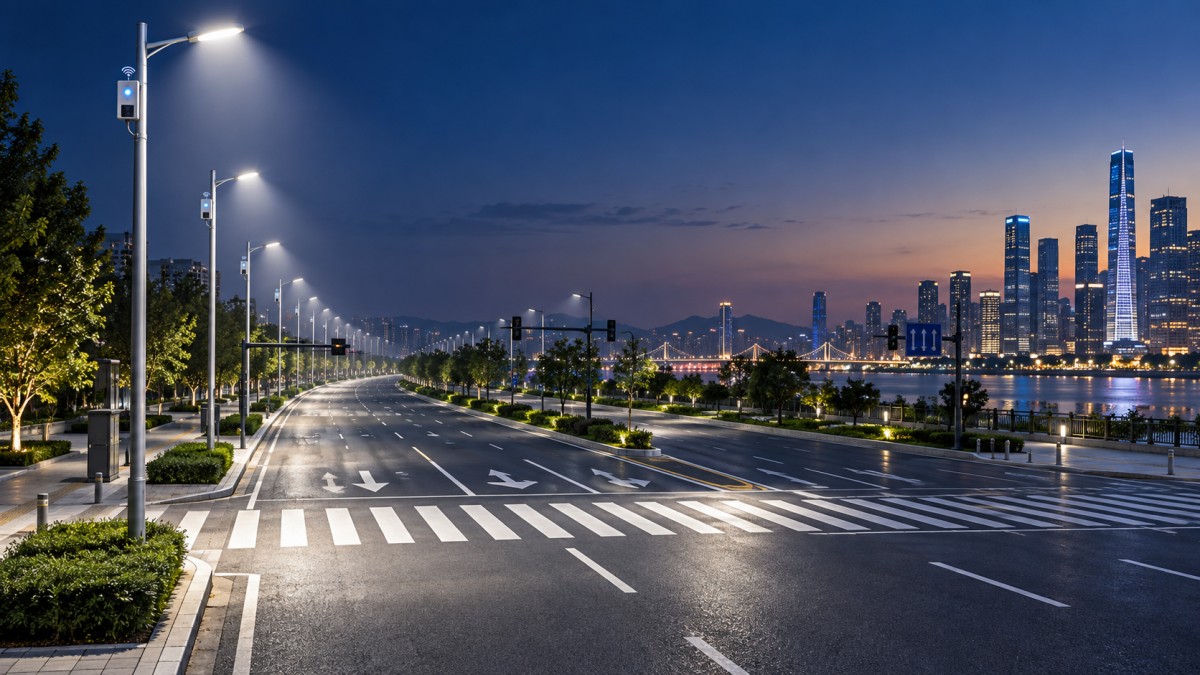
Lighting Hardware Still Determines Whether the System Performs
Controls can optimize output, but they cannot correct weak optical design, premature driver failure, inadequate ingress protection, or a pole structure unsuited to the installation environment. Smart functionality should therefore be specified alongside the conventional engineering requirements: mounting height, spacing, road geometry, wind loading, corrosion exposure, access for maintenance, and the required distribution of light on the carriageway and adjacent pedestrian area.
For example, an 8-14 m street-lighting arrangement may suit different road classes, but the correct height and power cannot be selected from a range alone. The lighting calculation must account for lane width, pole setback, bracket geometry, median placement, trees, signage, and the risk of glare to approaching drivers or residents. Higher wattage may increase light output, but it can also create excessive brightness, wasted spill light, and a less useful dimming range if the base design is oversized.
Durability is equally relevant to an adaptive scheme because smart components increase the number of assets that must remain operational. A luminaire with robust ingress protection, long-life LED and driver components, and a corrosion-resistant support structure reduces the likelihood that operators spend their expected energy savings on repeated field intervention. In coastal, humid, dusty, or high-wind areas, environmental suitability should be assessed at the system level, including enclosures, connectors, control nodes, pole openings, and cable entries.
A road-lighting package such as Modern Street Lighting|MSL-HC illustrates the type of specification coordination owners should seek: pole configurations from 8 to 14 m, hot-dip galvanized and powder-coated steel construction, wind resistance of at least 150 km/h, and IP67 luminaire protection are relevant only when matched to the site conditions and lighting layout. Its stated 150-250 W output range, 3000K or 4000K options, and efficacy of at least 140 lm/W should be evaluated through a project-specific photometric design, not treated as a universal answer for every road.
Integration Risk Usually Appears After Installation
The difficult part of a smart street-lighting project is frequently the handover period. Luminaires may be installed correctly while the control system has incomplete asset records, inconsistent addressing, uncertain ownership of the communications service, or no workable process for responding to alarms. The result is a connected network that is technically present but operationally underused.
Decision-makers can reduce this risk by defining responsibilities before equipment arrives on site. The specification should identify who supplies and commissions control nodes, who validates device-to-asset mapping, who owns the central management platform, who retains administrator access, and who resolves faults across the boundaries between luminaire, network, and software. These details affect both delivery time and long-term maintainability.
Interoperability requires similar attention. A proprietary platform may be appropriate when it offers accountable integration and long-term support, but owners should understand how assets, operating schedules, alarms, and historical data can be accessed over the life of the installation. The issue is not simply whether devices can connect on day one. It is whether replacement luminaires, expansion phases, and future control requirements can be incorporated without rebuilding the entire system.
Commissioning should include more than switching lights on and off from a screen. The acceptance process should test scheduled scenes, dimming transitions, sensor or override behavior where applicable, loss-of-communications behavior, fault reporting, and the accuracy of the asset register. Night-time verification is necessary because a correct command log does not confirm that the road environment is visually safe.
Measure the Outcome That Justifies the Investment
Energy reduction is a central reason for adaptive controls, but it should not be the only measure of success. Owners also need evidence that the lighting service remains consistent, that faults are detected earlier, and that maintenance teams can identify the affected asset without extended patrols. A system that achieves aggressive dimming but produces frequent callouts or unclear alarms may not improve total operating cost.
Before rollout, establish a practical baseline: connected load, operating hours, planned lighting profiles, expected maintenance workflow, and the assets included in the first phase. After commissioning, review actual runtime by scene, fault frequency, communications availability, response time, and recurring locations of failure. These records make it easier to distinguish a design issue from an installation issue or an operational issue.
It is also sensible to phase complex deployments. A representative corridor can reveal whether the proposed schedules suit local use, whether wireless coverage is dependable around buildings or trees, and whether the maintenance team can work effectively with the platform. The purpose of a pilot is to resolve operating assumptions before they are duplicated across thousands of points of light, rather than to demonstrate that remote switching is possible.
A Safer Road Requires a Clear Operating Rule
Smart City Street Lighting earns its value when adaptive control supports a deliberate road-safety strategy. The strongest projects define where light may be reduced, where it must remain stable, what events trigger an uplift, and how the installation behaves when technology fails. They also procure the pole, luminaire, controls, and commissioning scope as connected parts of one deliverable.
For decision-makers, the next step is to turn the road network into a set of operating scenarios rather than a single lighting schedule. That creates a clearer basis for design calculations, equipment selection, control integration, acceptance testing, and the long-term service model that keeps the roads reliably illuminated.
◉ MESSAGE

Blog
- How to avoid vendor lock-in in a government smart lighting project
- Sizing the communications power budget for smart city solar street lights
- How energy-saving mode affects solar bollard light operating time
- Comparing lead times from LED street light luminaire suppliers in Europe
- What spare parts support should a smart street light exporter offer?
- Where to place a solar garden light in a partially shaded garden
- Which battery alerts matter in remotely monitored solar street lighting?
Message