
SL-004 Solar Street Lighting Runtime: Battery Sizing and Backup Days
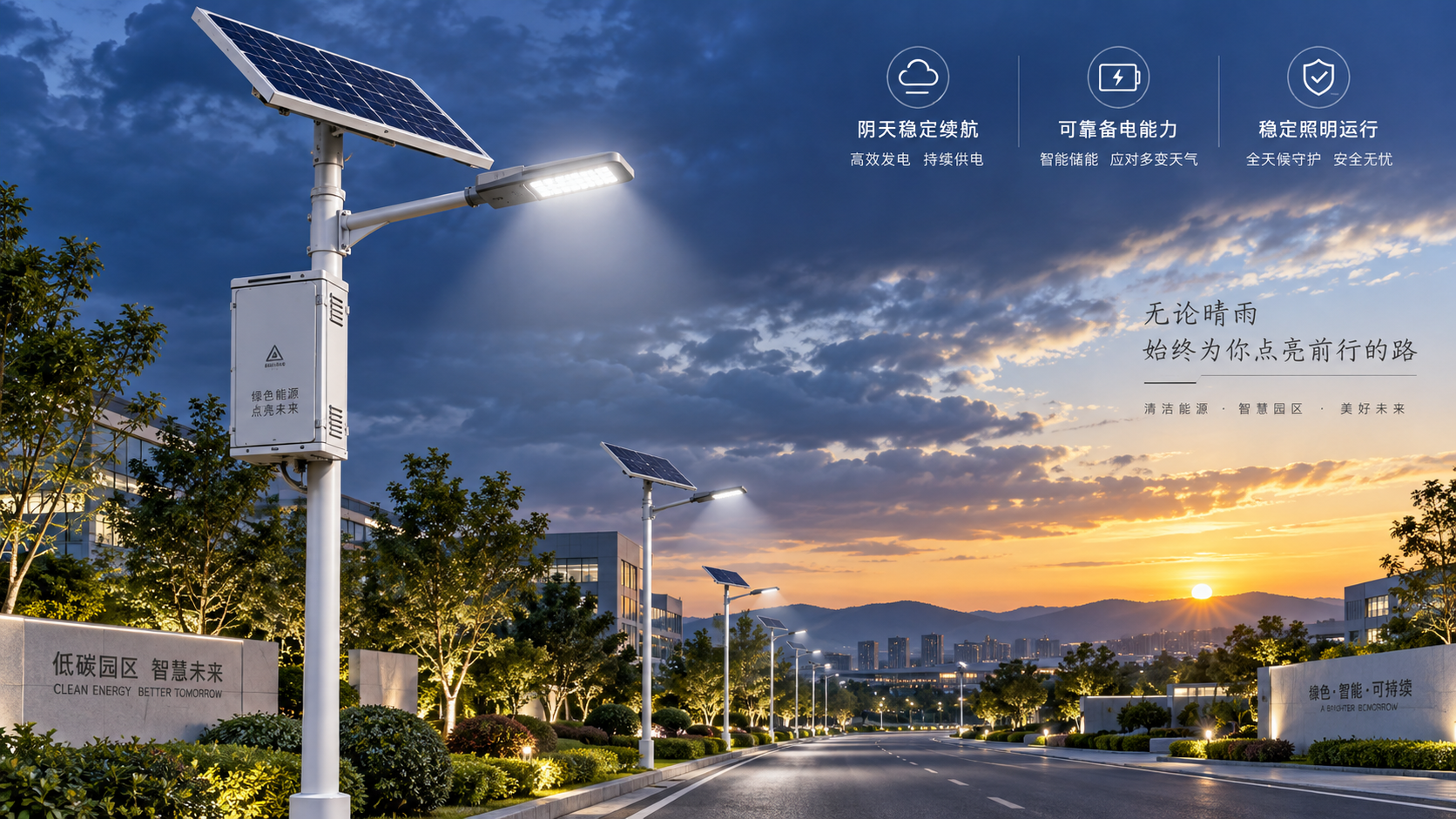
A solar street light can appear fully functional during commissioning and still fail its runtime requirement after several overcast days. The usual cause is not a single defective component. It is a mismatch between the nightly load, usable battery capacity, solar input during the worst expected period, and the selected backup-day target.
For SL-004 Solar Street Lighting, runtime should be assessed as an energy-balance question rather than a panel-wattage question. Start by calculating the actual energy consumed each night, then size usable battery energy for the required autonomy, and finally verify that the photovoltaic array can restore that energy under realistic local solar conditions. A system that only works under clear-sky assumptions does not provide dependable backup.
Begin with the operating profile, not the nameplate wattage
Quality reviews often start with the LED fixture’s rated power, but the rated value alone is incomplete. The battery must support the energy used across the entire programmed lighting schedule. That includes full-output hours, dimmed hours, controller standby consumption, communication devices where fitted, and losses in drivers and battery-management electronics.
A useful first estimate is:
Nightly load energy (Wh) = Power at each operating level (W) × Hours at that level
For example, a luminaire programmed at one output level for the early evening and a lower level after traffic falls should be calculated in separate time blocks. Do not use the highest lamp wattage for the whole night unless the actual control logic keeps it there. Conversely, do not use an attractive dimming schedule on paper unless it is locked into the controller specification and can be verified during inspection.
- Confirm the switching time or daylight-trigger setting.
- Record every dimming stage, its output percentage, and duration.
- Include the controller, sensor, wireless node, and driver idle load where applicable.
- Check whether winter night length exceeds the schedule used for design calculations.
A runtime estimate based on a six-hour night may look acceptable, while the same system becomes marginal when the actual winter operating period is much longer. This is particularly important for roadways, crossings, access routes, and public areas where loss of light has a direct safety consequence.
Convert backup days into usable battery capacity
Backup days, also called autonomy days, describe how long the lighting system can continue operating when solar charging is insufficient. They should not be confused with calendar days of normal operation. The requirement must be stated clearly: does one backup day mean one complete programmed night with no useful charging, or a full 24-hour period? The former is often more practical for lighting design, but specifications and test procedures should use the same definition.
The base calculation is:
Required usable battery energy = Nightly load energy × Required backup nights
That result is not yet the nominal battery rating. A battery cannot normally be treated as 100% usable in field conditions. Design capacity must account for the allowable depth of discharge, conversion efficiency, temperature effects, capacity reduction over service life, and a reasonable engineering margin.
A fuller screening formula is:
Nominal battery capacity (Wh) = Nightly load × Backup nights ÷ (allowable discharge × system efficiency × temperature factor × ageing factor)
Each factor should be documented rather than hidden inside a supplier statement. For lithium batteries, the allowable discharge limit may be controlled by the battery-management system. Lead-acid systems require particular caution because usable capacity is affected by discharge rate and temperature. Regardless of chemistry, the capacity shown on a battery label should be checked against its voltage and ampere-hour rating, then compared with the system’s declared usable energy.
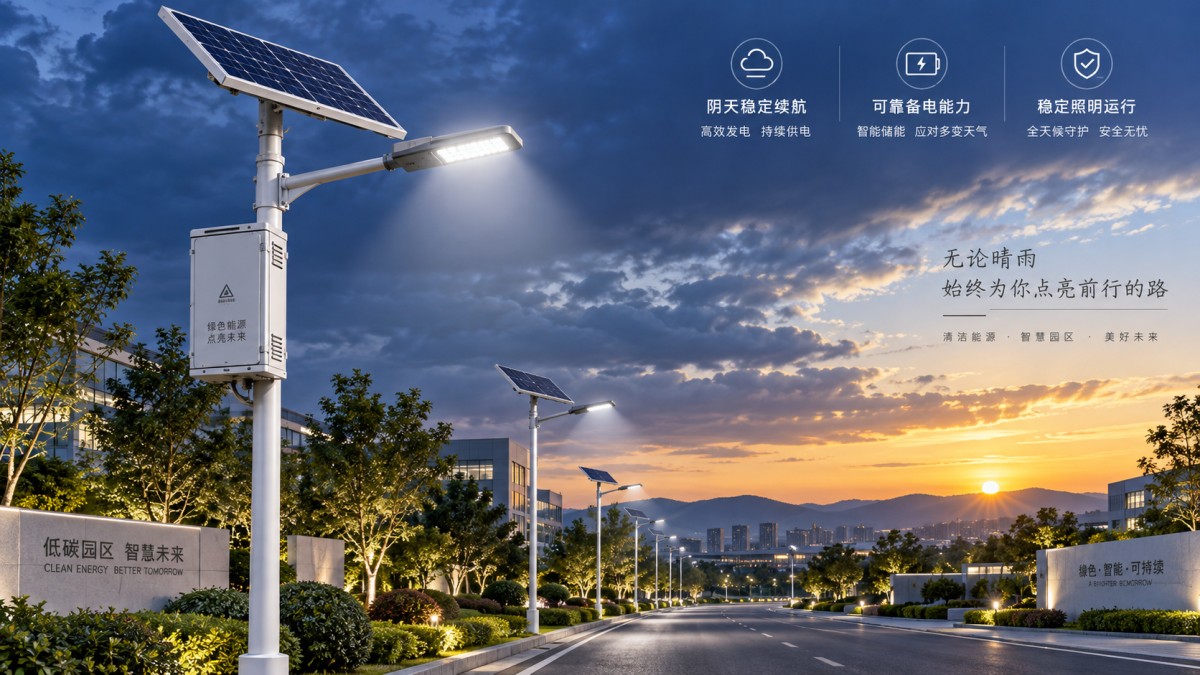
Why nominal capacity can create a false sense of security
A battery marked with a large ampere-hour figure may still be unsuitable if its nominal voltage is low, its permitted discharge window is narrow, or its capacity rating is stated at a test condition unlike the installation environment. Battery energy is expressed in watt-hours:
Battery energy (Wh) = Nominal voltage (V) × Rated capacity (Ah)
That conversion is only a starting point. Inspection should also confirm the battery’s operating voltage range, low-voltage cutoff, charge limits, enclosure thermal conditions, and whether the controller reduces lighting output before final shutdown. Controlled dimming can extend service through poor weather, but it must be treated as part of the approved operating profile, not as an unrecorded emergency behavior.
Weather verification is where runtime assumptions are tested
Solar input must be based on the least favorable expected charging period, not an annual average. A location may have high annual irradiation while still experiencing seasonal cloud cover, haze, rain, snow accumulation, or short winter days that limit available charging. Solar street lighting that performs well in summer may therefore show repeated low-battery warnings in another season.
Panel output is also affected by more than local sunshine data. Review the installed orientation, tilt angle, nearby shading, dust accumulation, bird droppings, and any future obstruction from trees or adjacent structures. A small shadow crossing part of a module can reduce output disproportionately, depending on the module layout and bypass-diode arrangement.
The panel should be sized to replace the previous night’s consumed energy during the available solar window while also recovering from partially depleted conditions. Where the expected weather sequence includes several weak charging days, recovery capacity becomes as important as the stated backup period. A design may technically survive three nights without charging yet take too long to recover afterward, leaving little reserve for the next poor-weather interval.
Separate runtime verification from visual acceptance
Night-time illumination checks are necessary, but they do not prove battery autonomy. A newly installed system may begin a test with a fully charged battery and deliver normal light output for one night even when panel capacity or controller programming is inadequate. Runtime acceptance should include both documentation review and operational observation.
Before handover, examine the battery datasheet, photovoltaic rating, controller settings, wiring diagram, and declared autonomy basis. Verify that component ratings match the approved design rather than relying on generic catalog values. The controller should provide traceable settings for time control, dimming, low-voltage protection, and fault indication. Where remote monitoring is included, logs of battery voltage, charging status, and operating mode can help identify a recurring energy deficit before lighting failure is reported by the public.
Field checks should also focus on installation quality. Loose terminals, reversed polarity, damaged cable insulation, water ingress, and poorly sealed enclosures can reduce available energy or create safety hazards. A protection rating only supports the intended performance when cable entries, gaskets, fasteners, and enclosure closures are assembled correctly on site.
When a battery calculation needs to be revised
Recalculate rather than simply replace components when any key project condition changes. Common triggers include an increase in fixture wattage, longer night operation, revised dimming logic, a change in pole spacing that requires higher light output, added surveillance or communication equipment, altered panel orientation, or a new requirement for more backup nights.
The same discipline applies when comparing solar equipment with grid-connected roadside lighting. A robust pole and luminaire arrangement may be required in both cases, but its electrical architecture must not be assumed to be interchangeable. For projects using conventional mains-powered fixtures alongside solar sections, equipment such as Modern Street Lighting|MSL-XM may be considered according to its stated 150–250 W light-power range, IP67 protection level, and pole options. Those characteristics should be assessed as part of the grid-connected lighting package; they do not establish solar battery autonomy.
A practical approval decision should therefore answer four questions without ambiguity: What is the nightly energy demand? How much usable battery energy remains under the specified discharge and temperature limits? How many no-charge or low-charge nights must the system survive? Can the installed panel restore the consumed energy under the project’s limiting weather condition? When those answers are documented and tested against the actual control schedule, SL-004 Solar Street Lighting runtime becomes a measurable project requirement rather than a broad claim of backup capability.
◉ MESSAGE

Blog
- How to avoid vendor lock-in in a government smart lighting project
- Sizing the communications power budget for smart city solar street lights
- How energy-saving mode affects solar bollard light operating time
- Comparing lead times from LED street light luminaire suppliers in Europe
- What spare parts support should a smart street light exporter offer?
- Where to place a solar garden light in a partially shaded garden
- Which battery alerts matter in remotely monitored solar street lighting?
Message