
How to Assess SL-004 Solar Street Lighting for Low-Sunlight Regions
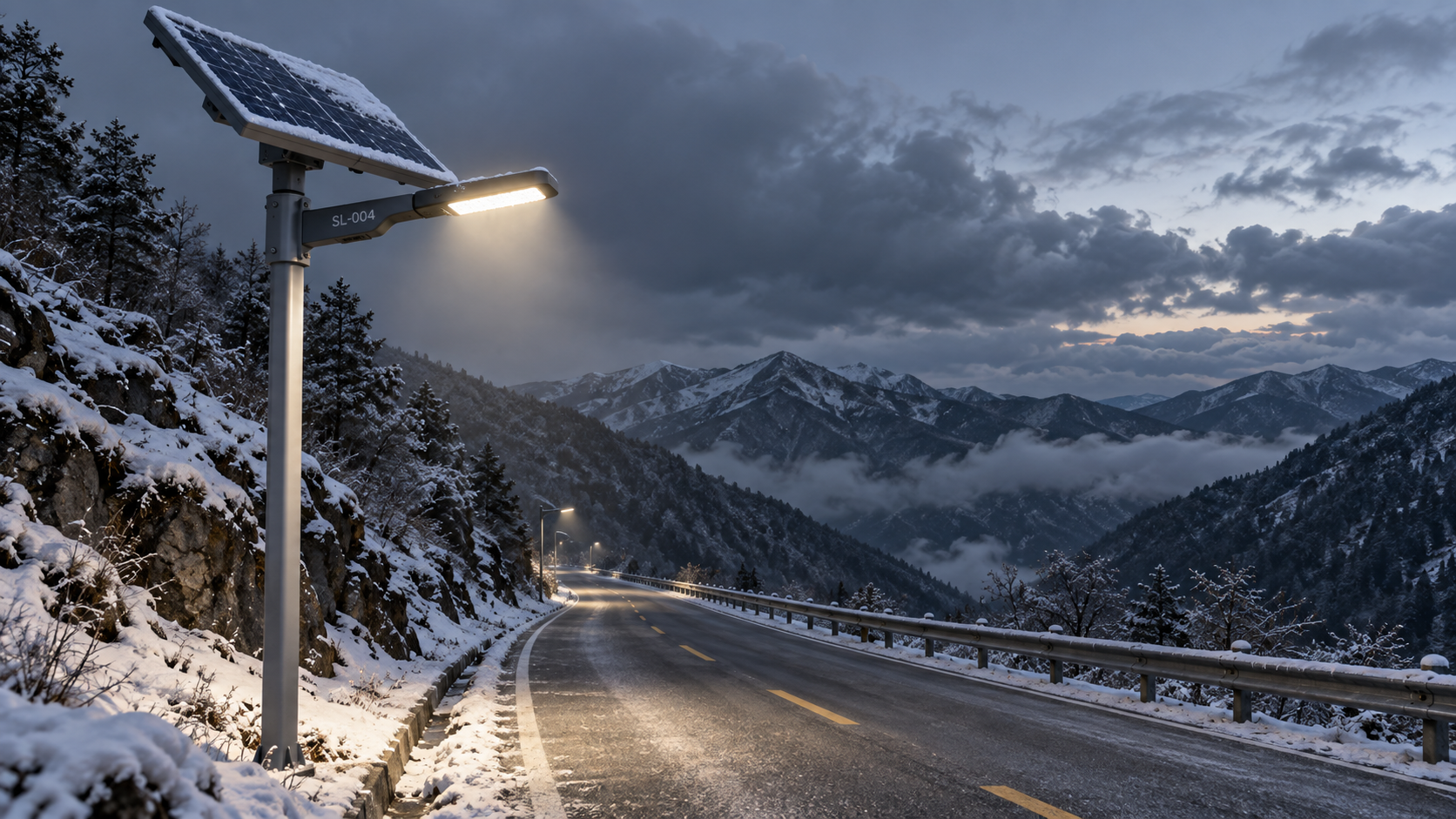
In low-sunlight regions, a solar street light can appear adequate during commissioning and still become unreliable after several overcast days. The practical risk is not simply reduced brightness: it can mean early shutoff before morning traffic, uneven illumination along a road, repeated maintenance visits, and disputes over whether the product was correctly specified. For procurement teams, assessing SL-004 Solar Street Lighting should begin with one core question: can its energy generation and stored energy support the required lighting schedule through the site’s least favorable solar period?
The answer cannot be taken from LED wattage or a nominal battery capacity alone. A sound evaluation links local solar availability, seasonal weather, mounting conditions, operating profile, battery reserve, and controller behavior into one project-specific calculation. If the SL-004 supplier cannot provide clear information for those points, the product should not be approved for a low-sunlight installation without further technical confirmation.
Start with the site’s worst operating period
Solar street lighting is often selected using annual average sunshine figures. That approach can mask the conditions that cause failure. A road may receive reasonable solar exposure across much of the year, while the shortest winter days bring persistent cloud cover, low sun angles, snow accumulation, fog, or shading from terrain and nearby buildings. These conditions are more relevant than the annual average because they determine whether the battery can recover after consecutive nights of use.
Before comparing SL-004 Solar Street Lighting quotations, define the project conditions in writing:
- Minimum expected daily solar resource during the critical season, rather than an annual average alone.
- Required hours of operation, including whether lighting must remain active from dusk to dawn.
- Road class, pedestrian activity, security requirements, and acceptable dimming periods.
- Expected number of consecutive low-generation days the system should withstand.
- Panel orientation, pole location, nearby trees, building shadows, mountains, and seasonal obstructions.
- Ambient temperature range, especially prolonged cold that can affect battery charging and available capacity.
A procurement specification should distinguish between “the light turns on” and “the lighting system maintains the required illumination profile.” Those are not equivalent. A unit may activate normally at dusk but reduce output sharply or shut down before dawn when energy reserves are insufficient.
Read the power balance, not isolated specifications
The central technical check is the daily energy balance. The panel must harvest enough energy to cover the light’s actual consumption, controller losses, battery charging losses, and a reserve for poor weather. In low-sun areas, a product with a larger panel but an unsuitable lighting profile may perform better than a higher-lumen unit with limited generation capacity.
Ask the supplier to show the calculation assumptions behind the proposed configuration. At minimum, the review should identify LED input power at each dimming stage, operating hours per stage, usable battery energy, solar-panel rating, assumed solar resource, and controller efficiency. It should also state whether the calculation includes losses from dust, temperature, cable connections, panel aging, and partial shading.
Do not accept “all-night lighting” as a sufficient technical statement. Request the exact operating mode used to make that claim. A motion-sensing or time-based dimming schedule can be appropriate for low-traffic roads, but it should be reviewed against the lighting expectation at the site. A highway junction, public square, or pedestrian crossing may require sustained output that a lightly used access road does not.
Assess battery behavior beyond its nominal capacity
Battery selection is usually where low-sun projects gain or lose reliability. Lithium batteries can offer useful cycle life and energy density, but the relevant question is how the battery, battery-management system, and controller behave under repeated partial charging and cold-weather operation. A system that rarely reaches full charge during winter can experience a different operating pattern from one installed in a sunny climate.
Review whether the proposed battery is sized around usable energy rather than only stated ampere-hours. Voltage, discharge limits, charge limits, and controller settings affect the energy available to the luminaire. Confirm the enclosure arrangement as well. Battery access should allow inspection or replacement without dismantling major pole components, while the enclosure should provide suitable protection from moisture, corrosion, heat buildup, and unauthorized access.
Ask for the low-voltage protection threshold and the recovery behavior after the next charging period. A protective shutdown can prevent battery damage, but procurement teams need to know whether the fixture resumes automatically, at what energy level, and whether diagnostic information can identify the reason for the previous outage.
Panel placement and mechanical design can undermine a good configuration
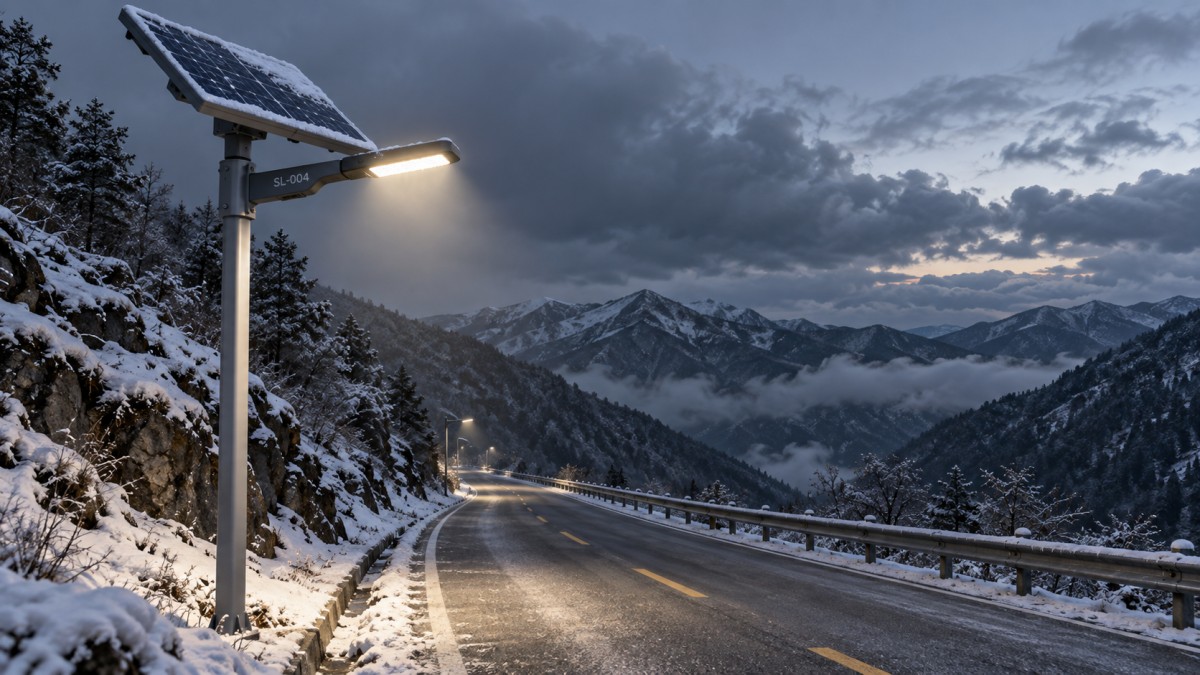
A correctly sized solar panel does not deliver its expected output when installed in shade or at an unsuitable angle. During a site walk, check shadows across the intended panel position at different times of day and consider changes in vegetation. In northern or mountainous locations, surrounding ridges and tall structures can delay morning exposure and shorten afternoon generation even where the open-sky solar figure appears acceptable.
Mechanical suitability matters as well. Low-sun regions may also experience snow, ice, strong wind, salt exposure, or heavy rain. Confirm the pole design, bracket arrangement, panel fixing method, drainage, and corrosion protection against the actual location. A panel that collects snow or is difficult to clean may deliver much less energy during the period when reserve is most important.
Use controls to protect service continuity
Smart controls are valuable when they are applied to an agreed lighting strategy rather than treated as a generic feature. For example, scheduled dimming can preserve battery energy after late evening, while motion-responsive brightening may suit paths, service roads, and low-traffic public areas. Remote status monitoring can help maintenance teams distinguish between a lighting fault, low battery condition, charging issue, or communication problem.
For SL-004, request a clear description of controller functions: MPPT or other charging method, dimming schedules, sensor inputs, remote-management capability, fault records, and manual override options. The controller should be matched to the energy design. Aggressive brightness settings may look attractive in a sample demonstration but can shorten autonomy in real winter weather.
When a hybrid energy source is the more defensible option
Some locations have both limited sunlight and usable wind resources, especially coastal roads, islands, elevated rural routes, mountain corridors, industrial sites, and remote off-grid areas. In those cases, adding wind generation may reduce dependence on daytime solar recovery. This is not automatically the better choice: wind availability, turbulence, structural loading, noise considerations, maintenance access, and local siting conditions must be assessed first.
Where the site supports it, Wind-Solar Hybrid Street Lighting | SHL-003 provides a configuration route using solar panels, a 200W–600W wind turbine, lithium battery storage, and an MPPT hybrid controller. Its available LED range is 30W–150W, with tailored pole heights and battery capacities. This type of hybrid arrangement is relevant when the procurement goal is dependable off-grid operation during low-sun periods, rather than relying on a larger solar array alone.
Compare suppliers using evidence that can be checked
For a decision that will hold up after installation, request a configuration sheet specific to the project rather than a standard catalogue page. It should identify every major component, the proposed lighting schedule, the energy-balance assumptions, expected autonomy, mounting arrangement, and warranty scope. Confirm whether substitutions are permitted and how component changes would affect the calculation.
It is also useful to separate product acceptance from installation acceptance. Before handover, inspect panel orientation, shading, fixture aiming, controller programming, battery connections, grounding arrangements where applicable, and the actual dimming schedule. A well-selected system can still underperform when panels are misaligned, controls are left at factory settings, or poles are placed beneath future tree growth.
The strongest purchasing decision is therefore not based on the highest stated output or the lowest initial unit price. It is based on a documented operating profile that SL-004 Solar Street Lighting can sustain during the site’s least favorable solar conditions, with enough energy reserve and diagnostic visibility to keep maintenance predictable.
◉ MESSAGE

Blog
- How to avoid vendor lock-in in a government smart lighting project
- Sizing the communications power budget for smart city solar street lights
- How energy-saving mode affects solar bollard light operating time
- Comparing lead times from LED street light luminaire suppliers in Europe
- What spare parts support should a smart street light exporter offer?
- Where to place a solar garden light in a partially shaded garden
- Which battery alerts matter in remotely monitored solar street lighting?
Message