
Road Lighting Tenders: Writing Measurable Technical Specifications
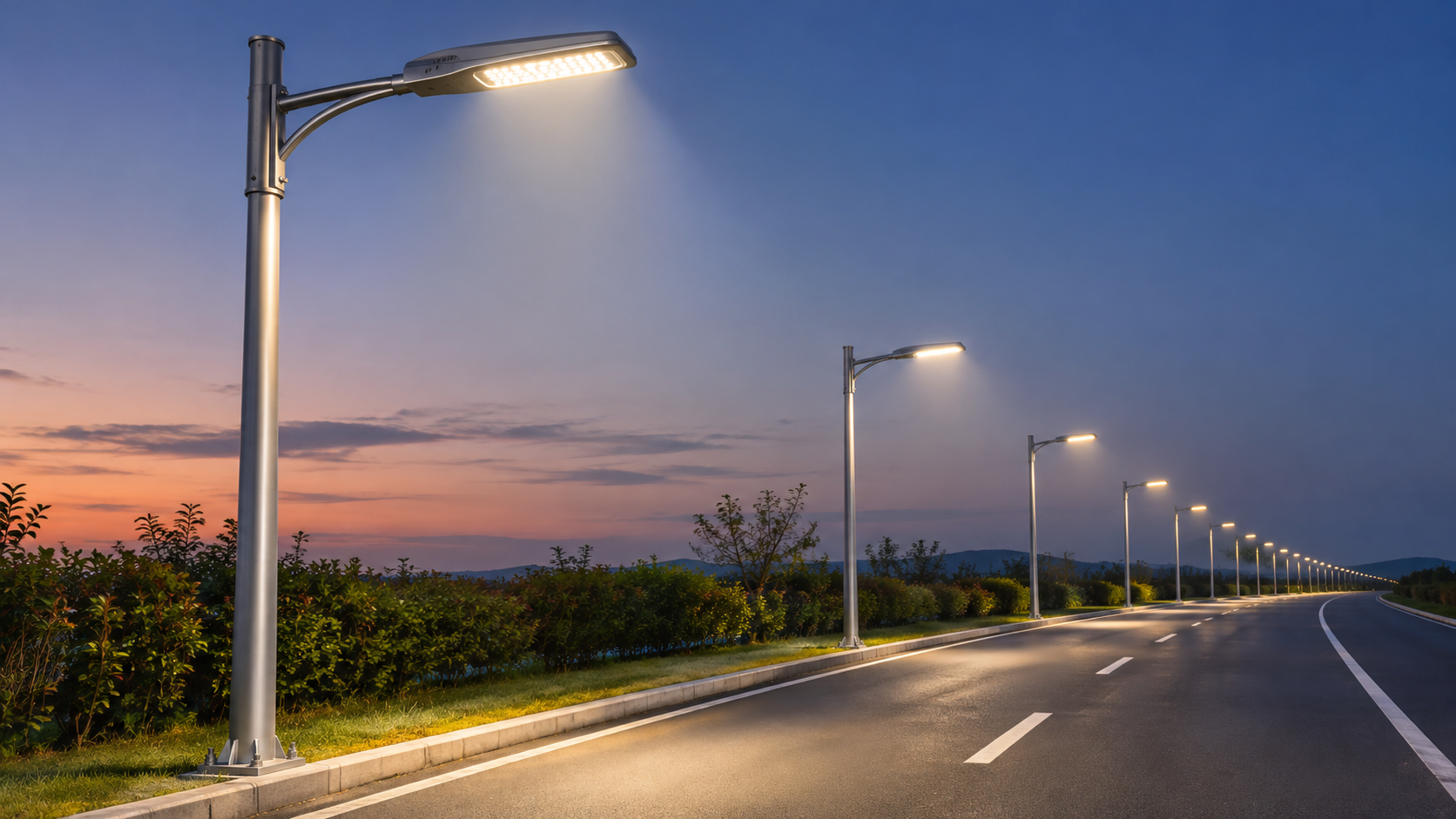
A road lighting tender produces comparable prices only when bidders work from the same design conditions, quantities, and evidence requirements. A specification that asks for “high-efficiency LED luminaires” leaves room for different power ratings, optical distributions, warranties, and installation assumptions. Those differences can make the lowest initial bid more expensive to operate or incomplete for the site.
Set measurable outcomes alongside the conditions under which they must be achieved. Define what is included in the price, what documents accompany the bid, and how compliance will be verified before and after installation.
Start with the road and the lighting calculation
Describe the road geometry using drawings and schedules: carriageway and lane widths, footpaths, medians, junctions, crossings, mounting positions, and any restrictions caused by trees, utilities, or overhead lines. Identify the applicable lighting class and calculation method under the standard adopted for the project. Where conditions vary along a route, divide it into sections rather than assigning one target to the entire road.
State the required maintained luminance or illuminance, uniformity, glare limits, and other applicable criteria for each section. Include the calculation grid, observation conditions where relevant, maintenance factor, road-surface assumptions, mounting height, spacing, outreach, tilt, and setback. These inputs allow competing designs to be assessed on the same basis.
A luminaire with higher rated output does not automatically deliver a better road design. Light distribution determines where that output lands; excessive spill or glare can coexist with inadequate illumination on the carriageway. Require a lighting calculation using the proposed luminaire’s photometric file and the stated site geometry. If alternative pole spacing is permitted, ask for both the lighting results and the revised equipment quantities so the total installed cost remains visible.
Turn performance claims into bid requirements
For each luminaire, request rated input power, initial luminaire luminous flux, luminaire efficacy, correlated color temperature, color rendering index, and optical distribution. Specify acceptable values or ranges where the project requires them. Identify whether power includes the driver and other integral components; comparing LED package efficacy with complete luminaire efficacy gives a misleading result.
Lifetime needs a defined basis too. A statement such as “50,000-hour life” does not say how much light remains at that point or what failure criteria apply. Request the declared lumen-maintenance designation, operating conditions, and supporting test or projection documentation. State separately the warranty term and the remedy for driver, LED module, or other failures. A lifetime claim is not the same as a warranty.
For example, the published information for Modern Street Lighting | MSL-GH lists a 12 m pole, main light power of 150–250 W, auxiliary light power of 140–210 W, and rated efficacy of at least 140 lm/W. These values are useful starting points, but a bid still needs to identify the selected configuration, its total input power, and the photometric data used in the road calculation. The listed main and auxiliary power ranges should not be treated as the consumption of every configuration.
Define durability against the actual exposure
Specify the luminaire’s ingress protection rating and identify the assembly to which it applies. An IP rating addresses enclosure protection against dust and water under specified test conditions; it does not establish resistance to corrosion, impact, heat, or electrical surges. Request separate evidence for each property required by the site.
For poles, include material grade, height, wall thickness or engineered design, base plate, anchor arrangement, and protective finish. A thickness alone is not proof of structural adequacy: pole shape, mounting height, luminaire area, terrain, and local wind conditions all affect loading. Require structural calculations for the proposed assembly and foundation assumptions, including any signs, brackets, or additional equipment attached to the pole.
Where hot-dip galvanizing is specified, define the applicable coating standard, inspection requirements, and treatment of damaged areas after transport or installation. Coastal exposure, de-icing salts, and buried interfaces warrant particular attention in the corrosion specification. Ask for the proposed access arrangement and replacement method for drivers, LED modules, and control devices; maintenance access affects future labor and road-closure costs.
Specify controls as functions and interfaces
A phrase such as “smart lighting compatible” is too broad to price consistently. State whether the scope includes autonomous dimming, scheduled operation, remote monitoring, fault reporting, energy metering, or integration with an existing management system. For each required function, identify the interface or protocol, communication method, coverage assumptions, and ownership of configuration data.
Separate hardware from continuing costs. A connected system can require gateways, network access, software licenses, hosting, and ongoing support. Request the duration and price basis for each recurring item, as well as the behavior of the lights if communications fail. If dimming is included in the energy calculation, use the same operating schedule for every bid and state whether control-system consumption is included.
Make the price schedule match the design
Use a common bill of quantities with units and scope boundaries. Separate luminaires, poles, foundations, cabling, controls, installation, testing, and commissioning. Identify who supplies excavation, reinstatement, electrical connections, traffic management, and disposal of existing equipment. If quantities are provisional, request unit rates for additions and omissions so later design changes can be valued consistently.
Compare alternatives using the same operating period and electricity tariff assumption. Annual energy can be calculated from input power and operating hours, adjusted for the specified dimming schedule. Include replacement components and maintenance where a defensible schedule is available, while showing uncertain costs separately. Do not combine a guaranteed purchase price and an unsupported lifetime saving into one figure.
Attach evidence and acceptance to each requirement
A concise compliance schedule makes deviations visible. For every mandatory requirement, provide a field for the offered value, a document reference, and any exception. Supporting documents can include luminaire photometric files, test reports, data sheets, pole calculations, control interface descriptions, and warranty terms. Identify the model and configuration covered by each document; a report for a different driver or optical assembly does not establish the performance of the offered unit.
Define acceptance stages before bids are submitted. Document review can verify the proposed design; delivery inspection can confirm labels, quantities, finish, and physical configuration. After installation, commissioning records should cover electrical and control functions. Where field lighting measurements are required, specify the measurement locations, conditions, method, and acceptance tolerances in advance. Measured values and design calculations are not directly interchangeable unless their differing conditions are accounted for.
Require deviations and substitutions to be declared before award, with their effect on lighting performance, structural design, price, and maintenance. This gives each proposal a clear technical basis and reduces disputes over what was included.
◉ MESSAGE

Blog
- Urban Lighting Solutions: Comparing Grid and Solar-Powered Systems
- Lawn Streetlight EPC Contractors: Assessing Installation Capability
- Dusk-to-Dawn Urban LED Lighting: Photocells vs Astronomical Timers
- Waterfront Pedestrian LED Lighting: Addressing Glare and Salt Air
- LED Street Light Manufacturers: Evaluating Warranty and Support
- Connected Smart Poles: How Connectivity Enables Remote Monitoring
- Solar Highway Lighting: Managing Battery Failures on Remote Roads
Message