
SL-007 Wind-Solar Hybrid Street Light: How the System Works
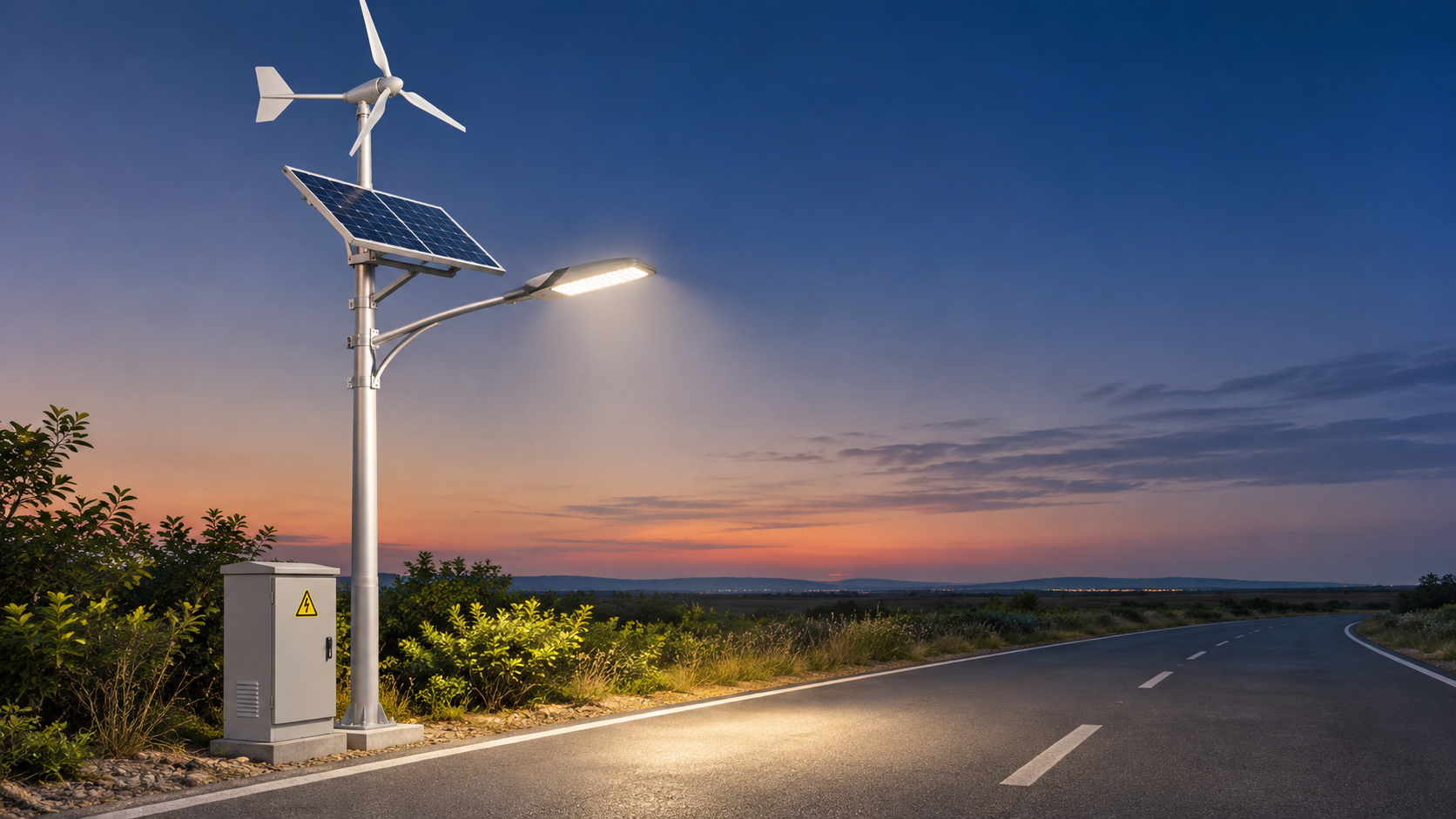
An SL-007 wind-solar hybrid street light depends on an energy balance, not simply on the presence of both a solar panel and a wind turbine. The two generators supply electrical energy through appropriate charging and control equipment; a battery stores that energy, and a lighting controller delivers it to the LED luminaire when illumination is required. Reliable operation depends on whether generation and usable storage can support the lighting load through the least favorable conditions at the site.
The available product information does not establish the SL-007’s electrical ratings, battery chemistry, control architecture or operating settings. The operating principles below describe a hybrid street-lighting system and identify the configuration details needed to assess a particular SL-007 installation; they should not be treated as confirmed specifications for every unit.
How energy moves through the system
The solar panel produces direct current (DC), with output varying with irradiance, panel temperature, orientation and shading. A solar charging stage regulates the power delivered to the battery. Depending on the design, this stage may use maximum power point tracking (MPPT) or another charging method. Its purpose is to keep charging within the battery’s permitted operating limits while making use of the available solar energy.
The wind turbine produces variable electrical output as rotor speed changes. Its generator output must be conditioned to suit the system’s DC charging circuit. The exact arrangement depends on the turbine and controller: for example, a turbine with an AC generator requires rectification before its output can charge a DC battery. Wind-side control also needs a means of managing the turbine when the battery cannot accept further charge and during high-wind conditions.
The solar and wind inputs do not need to produce equal amounts of power, and neither should be assumed to be available whenever the other is not. They can charge the battery simultaneously when conditions permit, or either source can contribute alone. The controller must prevent one source or its circuit from creating unsafe voltage or current conditions for the other. A wiring diagram is needed to establish whether the SL-007 configuration uses separate charging channels, a combined controller or another arrangement.
At night, the luminaire is supplied from the battery through an LED driver or compatible control circuit. The driver regulates current to the LEDs; the battery’s nominal voltage alone is not enough to establish compatibility. Its actual voltage range during charging and discharge must remain within the driver’s allowable input range, or a suitable DC conversion stage must be included.
Battery management determines usable autonomy
The battery separates generation from consumption: the lamp can operate after sunset even when neither source is generating. Its nominal capacity, however, is not the same as the energy available to the luminaire. Allowable depth of discharge, temperature, aging, conversion losses and the battery management system’s protection thresholds all affect usable capacity.
A basic load calculation starts with the luminaire’s actual power at each operating level. For example, a 30 W load operating for 12 hours consumes 360 Wh at the load before accounting for driver, wiring and control losses. If it dims to 15 W for six of those hours, the load energy becomes 270 Wh. These figures are illustrative, not SL-007 ratings; standby consumption and the actual dimming schedule should also be included in a project calculation.
Usable battery capacity must then cover the intended period of low generation. Dividing available battery energy by nightly consumption provides an initial autonomy estimate, but it is not a guarantee of operation: cold conditions, battery aging and intermittent charging can change the result. Battery chemistry matters as well, particularly because charging and discharging temperature limits can differ. A battery management system may restrict or stop charging outside its permitted range even when renewable energy is available.
Low-voltage protection prevents excessive discharge, but it also means the light may dim or switch off before the battery is physically empty. The relevant assessment is therefore not simply “How many hours can the lamp run?” but “At what output, battery condition and temperature will the controller reduce or disconnect the load?” Recovery settings matter too: reconnecting the lamp too soon after a low-voltage shutdown can cause repeated on-off cycling.
Lighting control is part of the energy design
A hybrid street light may use a timer, a light sensor, panel-voltage sensing or a combination of these methods to determine when to operate. Dimming can reduce consumption during selected hours, but the resulting light level must still meet the project’s road or public-space requirements. A controller that preserves battery charge by reducing output is not necessarily delivering the originally specified lighting performance.
Motion-responsive operation introduces an additional relationship between energy savings and detection coverage. Sensor mounting position, detection zone and the length of time the light remains at full output all affect consumption. The design should also account for the behavior required after a controller reset and for what happens if a sensor fails.
Luminaire selection must be checked against both the electrical system and the lighting layout. For example, the TGD-031 LED Floodlight is offered with DC24V or AC220V input options and is intended for applications such as plazas and landscapes. Its presence in a public-space design does not establish compatibility with an SL-007 battery or controller: the selected input version, driver voltage range, power draw and required beam distribution would all need separate verification.
Why nameplate ratings are not an energy yield
Adding the rated wattage of the solar panel and wind turbine does not indicate how much energy the system will produce overnight or across a low-resource period. Solar output depends on site exposure and seasonal irradiance; wind output depends on the wind-speed distribution at turbine height, not just a regional average. Turbulence from buildings, trees and nearby structures can reduce useful generation and increase mechanical loading.
A sound assessment uses site-representative solar and wind data, accounts for shading and obstructions, and applies losses to estimate energy delivered to storage. It should compare that estimate with the nightly load over the relevant seasons. Where only limited wind data are available, a system should not be credited with a specific turbine contribution without a defensible basis.
Wind can help when solar generation is weak, but the two resources can also be weak at the same time. The important design case is therefore a sequence of insufficient-generation days, not just an annual average. If battery capacity is exhausted during that sequence, the design must define whether reduced lighting, a backup supply or another operating strategy is acceptable.
Mechanical and electrical interfaces
Adding a turbine changes the load on the pole, foundation and attachments. The structural design must consider the combined effects of the turbine, panel, luminaire and brackets under applicable local wind conditions, including dynamic loading from the rotating equipment. Generator vibration, fastener retention and access for maintenance should be addressed alongside static strength. The turbine’s overspeed protection method and safe maintenance isolation are configuration-specific points to confirm.
On the electrical side, the design needs suitable overcurrent protection, isolation, grounding or bonding as required by the installation, and surge protection appropriate to the site and equipment. Outdoor enclosure protection must cover the complete assembly, including cable entries and connectors; an IP rating for one component does not automatically apply to the whole system. Battery installation also needs to follow the manufacturer’s limits for temperature, ventilation where applicable, and accessibility.
Applicable requirements depend on the installation location and the equipment supplied. IEC 60598-2-3 addresses particular requirements for luminaires for road and street lighting, while IEC 60529 defines IP protection classifications. These references do not by themselves establish compliance of an entire hybrid system. Evidence should identify the tested configuration and the standards and local electrical and structural rules applicable to the project.
A meaningful SL-007 assessment therefore requires a configuration-specific single-line diagram, component ratings, battery operating limits, controller settings, turbine protection details and a site-based energy calculation. Without those documents, the hybrid operating principle is clear, but autonomy, lighting performance and installation suitability cannot be established.
◉ MESSAGE

Blog
- Urban Lighting Solutions: Comparing Grid and Solar-Powered Systems
- Lawn Streetlight EPC Contractors: Assessing Installation Capability
- Dusk-to-Dawn Urban LED Lighting: Photocells vs Astronomical Timers
- Waterfront Pedestrian LED Lighting: Addressing Glare and Salt Air
- LED Street Light Manufacturers: Evaluating Warranty and Support
- Connected Smart Poles: How Connectivity Enables Remote Monitoring
- Solar Highway Lighting: Managing Battery Failures on Remote Roads
Message