
Urban Lighting Solutions: Comparing Grid and Solar-Powered Systems
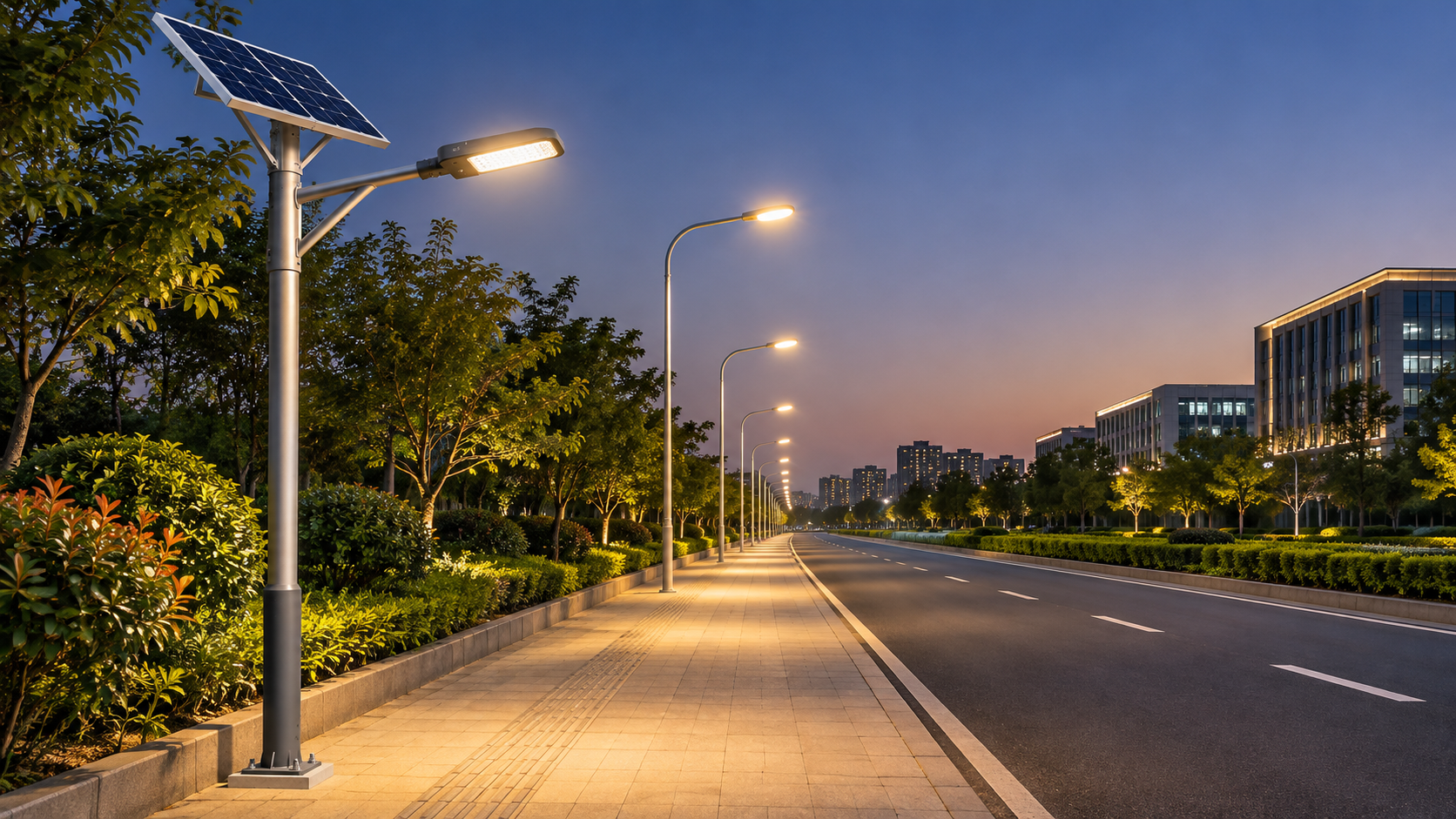
Choosing the right urban lighting solution can shape a project’s installation costs, energy use, and long-term reliability. For contractors and project owners, the choice between grid-powered and solar-powered systems also affects infrastructure requirements, maintenance, and smart control integration. The practical answer often depends less on the fixture itself than on what lies below the pavement, above the pole, and inside the maintenance budget.
Start with the site, not the power source
Grid power is often a sensible starting point where a usable supply and lighting network already exist. A road reconstruction project, for example, may provide an opportunity to install or replace cables while the ground is open. Once connected, luminaires can operate without relying on an individual battery at each pole, although the network remains vulnerable to supply interruptions and cable faults.
Solar becomes more compelling when the nearest connection is distant, crossing the site with cables is difficult, or reinstating finished surfaces would be expensive. A peripheral path or a newly developed public space may be easier to light with independent poles than with a new underground circuit. That advantage can disappear, however, if buildings or trees shade the panels or if the lighting requirement exceeds what a practical solar and battery package can support.
Before comparing quotations, agree on the required lighting performance: the area to be illuminated, operating hours, relevant local requirements, and whether uniformity or glare control is particularly important. A cheaper system is not a fair comparison if it delivers a different level of light.
Installation cost is more than the luminaire price
For grid-connected lighting, the fixture and pole are only part of the scope. The estimate may also need to cover utility coordination, connection works, trenching, ducts, cables, protective devices, traffic management and surface reinstatement. Existing infrastructure should be inspected rather than assumed usable: spare capacity, cable condition and access to connection points can change the economics substantially.
A stand-alone solar system avoids lighting power cables and associated trenching, but it still needs foundations, installation access, pole erection and commissioning. Panel orientation, structural loading and the space around each pole also matter. In a dense streetscape, the most convenient foundation location may be the worst place for solar exposure.
Compare both options over the same project boundary. If one quote includes civil works and commissioning while the other covers only equipment, the apparent saving is misleading. The same applies to warranties, spare parts and the cost of removing and replacing a battery later.
Solar reliability depends on the weakest season
Solar lighting should be sized around local conditions and the required service, not around an ideal charging day. The designer needs to account for seasonal sunlight, panel orientation, shading, temperature, night length and the number of low-generation days the system must withstand. Battery capacity should be assessed alongside the actual nightly load, including any controller or communication equipment.
Dimming can reduce energy demand, but it is a design decision, not a free gain. Ask when output will be reduced, to what level, and whether that lighting level remains appropriate for the space. A pedestrian route with occasional late-night use may need a different profile from a road where consistent visibility is required throughout the night.
For an off-grid application, Solar Street Lighting | SL-004 illustrates the type of configuration worth assessing. The available specification includes a 6 m pole, a 30–100 W power range and a LiFePO4 battery, with configurations tailored to project requirements. Those figures are a starting point, not proof that a particular layout will meet a site’s lighting and autonomy needs. Request a lighting calculation and an energy-sizing assessment for the proposed configuration.
Grid power removes the daily charging constraint, but it does not guarantee uninterrupted service. Where lighting continuity is critical, review the consequences of a power outage and whether backup power is justified for selected areas.
Plan maintenance around access, not just component life
Grid systems can require fault-finding across cables, connections and distribution equipment. Solar systems shift more attention to individual poles: panels need to remain sufficiently clean and unshaded, batteries eventually need replacement, and controllers must be accessible for diagnosis. A solar pole may avoid a cable fault, but a failed battery can still leave that location dark.
Ask suppliers where the battery is mounted, how it is replaced, what equipment is needed to reach it, and whether replacement components will remain available. A stated battery life is useful for planning, but actual service life depends on operating conditions and usage. For either power source, check how quickly a failed luminaire can be identified and who owns the response.
Smart controls need a power and communications plan
Remote monitoring, scheduling and dimming can help operators manage a large lighting inventory, but compatibility should be established before procurement. Confirm how controllers communicate, what the central platform can monitor, who provides connectivity, and whether the system can report failures at the level the maintenance team actually needs.
For solar poles, include control and communications consumption in the energy budget. For grid systems, confirm that the selected control architecture works with the proposed electrical network and luminaires. In both cases, clarify data access, ongoing service costs and what happens if a communications link fails. A sophisticated dashboard is of limited use if the operator cannot obtain replacement controllers or export its own asset data.
Lishida Smart Lighting supports large-scale outdoor projects with lighting products, smart controls and project-based solutions. Its experience across projects in China is relevant to an often overlooked part of selection: products, controls and installation responsibilities need to fit together before equipment reaches the site.
A mixed approach may be the practical choice
There is no requirement to use one power source across an entire development. Grid-connected luminaires may suit roads or public areas with accessible infrastructure and demanding lighting requirements, while solar poles serve isolated paths or locations where excavation would be disruptive. A mixed design can also limit the amount of new cabling without forcing solar into shaded or energy-intensive locations.
Before approving the design, ask for a pole-by-pole review of supply access, shading, lighting performance and maintenance access. Then compare lifecycle costs using the same operating period and assumptions for both options. Where a solar design relies on dimming or battery autonomy, have those assumptions documented in the project specification rather than leaving them in a sales proposal.
◉ MESSAGE

Blog
- Urban Lighting Solutions: Comparing Grid and Solar-Powered Systems
- Lawn Streetlight EPC Contractors: Assessing Installation Capability
- Dusk-to-Dawn Urban LED Lighting: Photocells vs Astronomical Timers
- Waterfront Pedestrian LED Lighting: Addressing Glare and Salt Air
- LED Street Light Manufacturers: Evaluating Warranty and Support
- Connected Smart Poles: How Connectivity Enables Remote Monitoring
- Solar Highway Lighting: Managing Battery Failures on Remote Roads
Message