
Waterfront Pedestrian LED Lighting: Addressing Glare and Salt Air
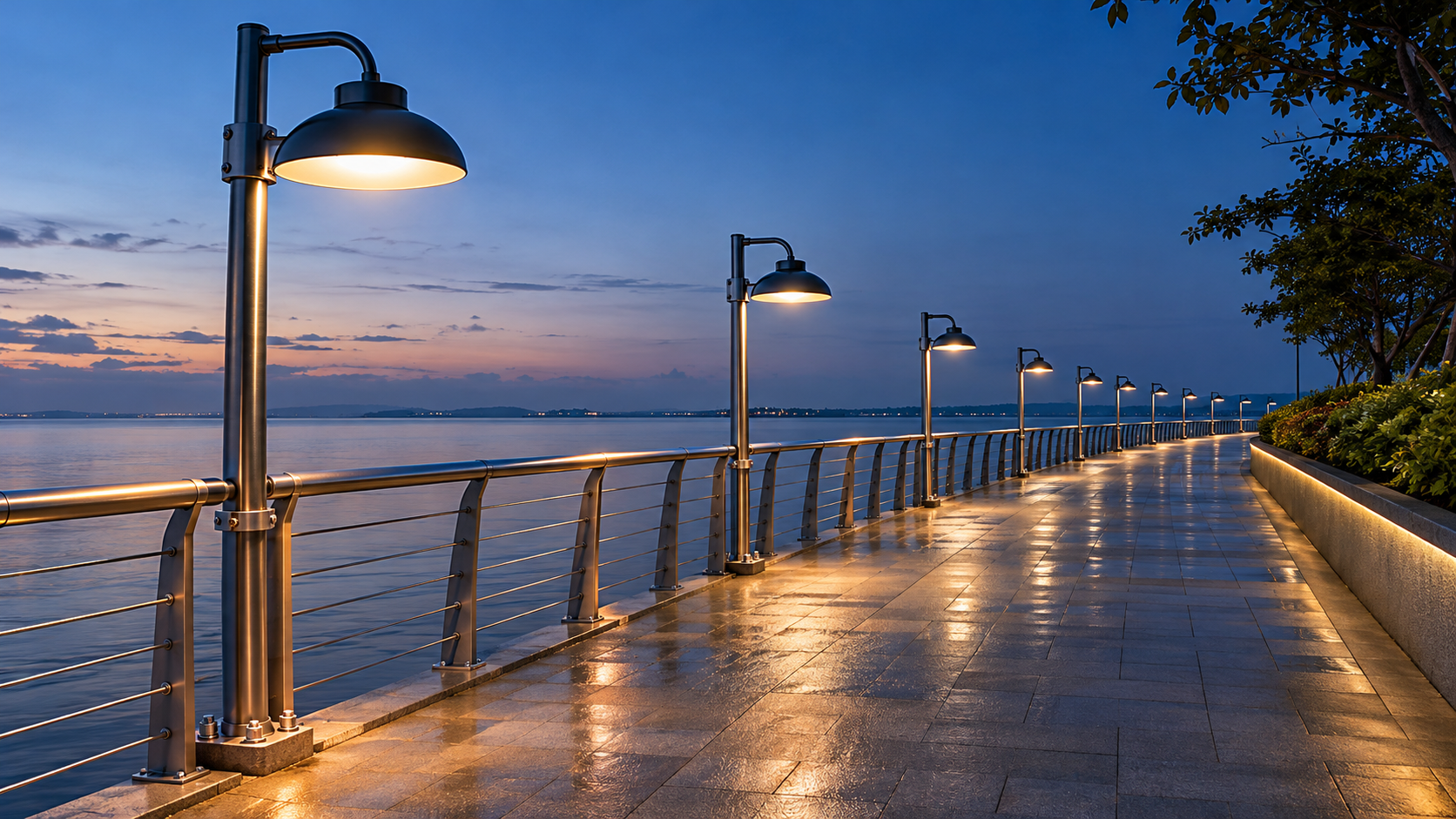
LED pedestrian lighting for waterfront areas must balance comfortable visibility with the realities of salt-laden air, moisture and long-term public use. A promenade can look inviting on a drawing yet become uncomfortable after dark if pedestrians face bright luminaires at every step. At the same time, a well-controlled optical system offers little value if corrosion makes its mounting hardware difficult to inspect or replace.
For technical evaluators, the task is to assess the complete installation: light distribution, mounting geometry, materials, sealing, electrical protection and maintenance access. The right answer may differ between a sheltered marina path and an exposed seawall, even when both projects use similar pedestrian routes.
Start with the view from the path
Waterfront routes often combine walking, cycling, seating and access to the water in a narrow space. Before comparing luminaires, identify where people need to see changes in level, intersections, handrails, steps and other users. Note nearby road traffic, residential windows and sensitive habitats as well as the direction in which pedestrians will approach each fixture.
Water adds another complication: bright sources can appear both directly and as reflections. Wet paving may produce distracting highlights too. A calculation focused only on average illuminance can therefore miss what people actually experience.
Use the applicable local lighting standard and project brief to establish performance criteria for horizontal and, where needed, vertical illuminance, uniformity and glare. Vertical illumination matters where facial recognition, wayfinding or the visibility of people near crossings is important. Check the design against the intended users and hours of operation rather than adopting a generic illuminance target.
Controlling glare without leaving the waterfront in darkness
Glare is influenced by the apparent brightness of the source, its position in the field of view and the surrounding conditions. On a dark waterfront, a small exposed LED source can be conspicuous even when the overall installation meets an illuminance calculation.
Begin with photometric files for the actual luminaire and distribution, then model the proposed mounting height, tilt, spacing and surroundings. Review views along the path in both directions, particularly at bends, seating areas and access points. Where practical, assess a representative installation at night: a mock-up can reveal bright source images and reflections that are difficult to judge from a plan alone.
- Choose distribution for the route. An asymmetric or elongated beam may place more light along a path and less into the water or neighbouring properties. Verify the distribution in the lighting model rather than relying on its name.
- Limit unnecessary tilt. Tilting a floodlight to reach farther can expose the bright source to pedestrians and increase spill. A different mounting position or optic may be a better correction.
- Examine shielding and source visibility. Recessed optics, shields or carefully selected diffusers can improve comfort, but their effect on useful light and maintenance should also be evaluated.
- Look beyond the average. Inspect uniformity and darker transition areas, especially where a lit promenade connects to a less illuminated route.
Where outdoor lighting standards specify glare limits or intensity classifications, use the method applicable to the project. A general statement that a fixture is “low glare” is not a substitute for photometric evidence and a review of its installed position.
Salt-air durability is a system requirement
Salt deposits can remain on equipment after spray or humid air dries. Rain may wash exposed surfaces, while sheltered joints, pole bases and the undersides of fittings can retain contamination. Corrosion risk also varies with distance from the water, prevailing winds and whether a site experiences direct spray.
Ask suppliers to identify the housing material, surface treatment and exposed hardware, including brackets, fasteners and adjustment mechanisms. Consider how different metals meet: dissimilar-metal contact in a wet, salty environment can accelerate galvanic corrosion. Appropriate isolation and compatible material choices should be reviewed for the whole assembly, not only for the luminaire body.
Coatings deserve the same scrutiny. Request the coating specification and relevant test documentation, then check how cut edges, scratches and damaged areas will be handled during installation. Salt-spray test results can support comparison, but a test duration alone does not establish service life at a particular waterfront site.
Inspectability matters as much as initial appearance. A bracket that traps water or a fastener that cannot be reached safely can turn routine maintenance into a disruptive closure. Where flooding or wave impact is possible, assess the mounting location and components for those conditions separately; resistance to coastal air does not imply resistance to immersion or impact.
What an IP rating does—and does not—tell you
An ingress protection rating describes resistance to dust and water under specified test conditions. IP66, for example, indicates dust-tight construction and protection against powerful water jets. It does not certify corrosion resistance, permanent immersion suitability or the condition of cable entries after years of service.
Confirm that the specified rating applies to the complete installed configuration, including cable glands, connectors and any serviceable compartment. Check gasket materials and replacement procedures, and avoid cable arrangements that direct water toward an enclosure. Drainage, sealing and access need to work together.
Where a high-power floodlight may fit
Not every waterfront location calls for a pedestrian-scale luminaire. A wider access plaza, service approach or infrastructure interface may require a higher-output fixture, provided its optics and mounting can meet the same comfort and spill-light requirements.
The LED Tunnel & High-Power Floodlight, model SDD-013, is listed for tunnel and critical-infrastructure applications. Its stated specifications include a 40–300 W power range, IP66 protection and several beam options, including 30°, 60°, 90°, 90° × 120° and 80° × 150°. A 150 W specification is also listed. These options make it a candidate for evaluation at larger waterfront access areas, not an automatic choice for a narrow promenade.
Before using it in a coastal pedestrian scheme, obtain the relevant photometric files and confirm the selected configuration, corrosion-protection details and mounting suitability with the supplier. Model source visibility and light spill at the proposed aiming angle. The listed colour temperatures are 3000 K, 4000 K and 6000 K, with a stated colour rendering index above Ra 70; the project team should decide whether those characteristics meet its visual and environmental objectives. IP66 alone should not be treated as evidence of salt-air performance.
Controls and maintenance should be evaluated together
Dimming or scheduled control can reduce unnecessary light during quieter hours, but the control strategy must preserve visibility for the people who still use the route. Consider how the system will respond to events, maintenance work, communications failures or an area that remains busy later than expected. Agree on operating levels and override responsibilities with the asset owner before commissioning.
A useful maintenance plan identifies cleaning intervals according to site exposure, inspection points for coating damage and loose hardware, and access arrangements for drivers, optics and controls. It should also record the installed luminaire versions and settings. Salt deposits on optics can change performance, while aggressive cleaning methods may damage finishes or seals; maintenance instructions should address both risks.
For project teams comparing LED pedestrian lighting for waterfront areas, a practical review package brings together the lighting calculation, glare assessment, material and coating details, ingress-protection evidence, electrical design and maintenance plan. Lishida Smart Lighting supports contractors and project owners with lighting products, smart controls and project-based integration; the relevant configurations and supporting documentation should be checked against the conditions of each site. That coordinated review makes it easier to distinguish a fixture that looks suitable in isolation from an installation that can remain usable and maintainable along the water.
◉ MESSAGE

Blog
- Urban Lighting Solutions: Comparing Grid and Solar-Powered Systems
- Lawn Streetlight EPC Contractors: Assessing Installation Capability
- Dusk-to-Dawn Urban LED Lighting: Photocells vs Astronomical Timers
- Waterfront Pedestrian LED Lighting: Addressing Glare and Salt Air
- LED Street Light Manufacturers: Evaluating Warranty and Support
- Connected Smart Poles: How Connectivity Enables Remote Monitoring
- Solar Highway Lighting: Managing Battery Failures on Remote Roads
Message