
Solar Highway Lighting: Managing Battery Failures on Remote Roads
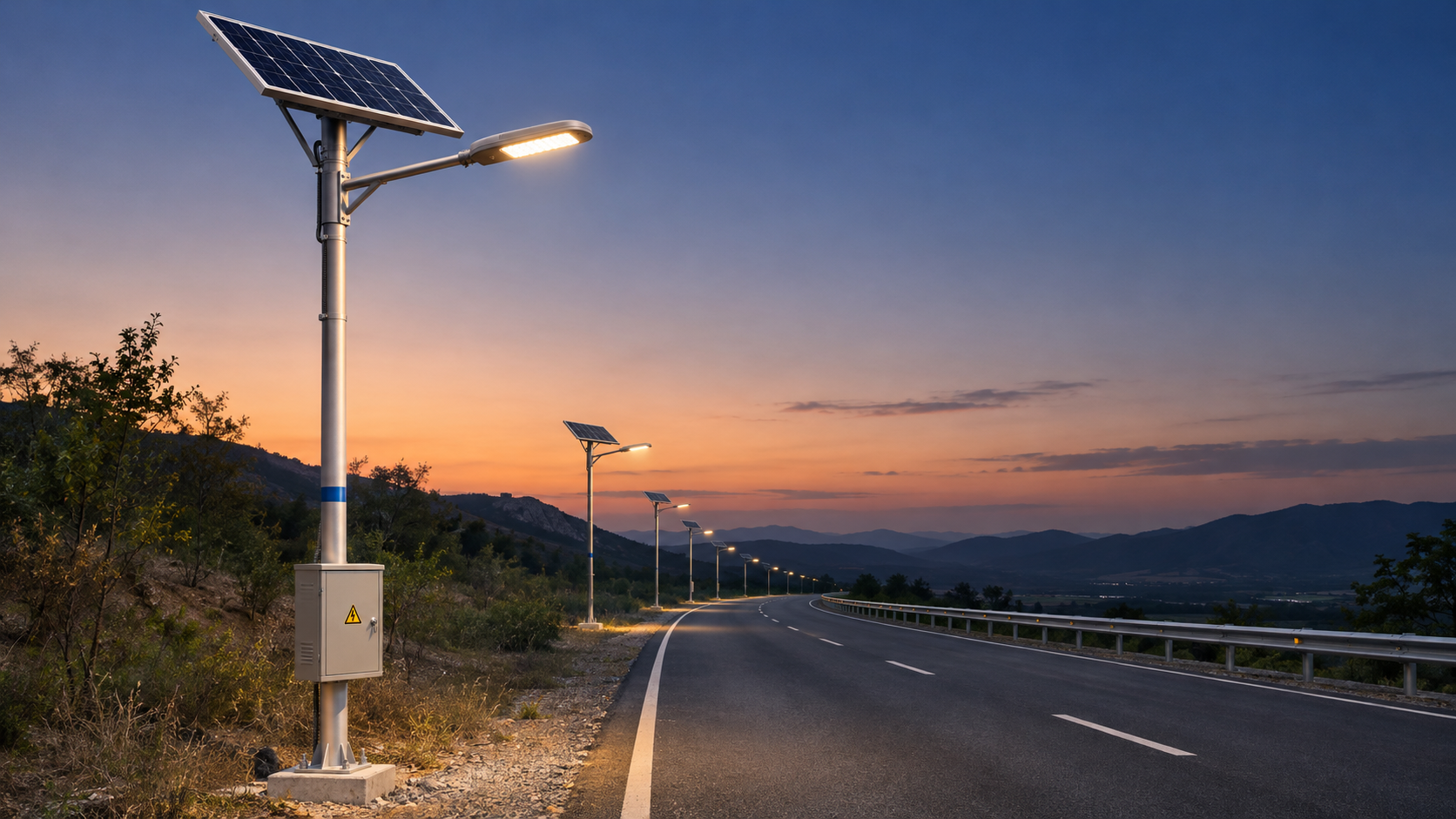
When solar powered street lighting for highways goes dark, a failed battery is only one possible cause. A battery may be discharged because the panel is shaded, a connector has corroded, or the controller has stopped charging. Replacing it before identifying the cause can restore light briefly while leaving the underlying fault in place.
The most useful first distinction is between a battery that cannot store enough energy and a battery that has not received enough energy. Check the operating history, charging path and load before deciding which components to take to a remote site.
Start with the pattern of failure
A single light that fails while neighboring units operate normally points toward a local problem: the battery, panel, wiring, controller or luminaire. If several lights in the same area show reduced runtime, look for a shared condition such as prolonged poor weather, new shading, dirt accumulation or a common control setting.
Failure timing is also useful. A light that turns on at dusk but switches off well before dawn may have insufficient stored energy, excessive load or a low-voltage cutoff issue. A light that never turns on may have the same energy problem, but it could also have a failed LED driver, an incorrect schedule or a disconnected cable. A daytime voltage reading alone cannot distinguish these causes.
Review available fault logs and historical data before dispatch. Note the last normal night, recent weather, charging current if recorded, nighttime voltage and any controller alarms. Compare the unit with a similar, correctly operating installation nearby, while accounting for differences in panel orientation and shading.
Check the charging path before replacing the battery
At the site, inspect the solar panel for dirt, damage and shading throughout the day. A panel can appear clear during a short visit yet lose useful charging time because of vegetation, a sign or another obstruction. Look for damaged cables, loose terminals, water ingress and corrosion at connectors and junction boxes.
Use the controller’s readings and appropriate electrical measurements to establish whether power is reaching the battery. Panel voltage alone does not prove that useful charging current is flowing. A disconnected panel can show voltage without delivering power, and low current can have several causes, including limited sunlight, a full battery or a controller restriction.
Follow the equipment manufacturer’s test procedure and compare readings with the system’s expected operating conditions. If the controller reports a battery temperature or protection fault, check the sensor and wiring as well as the battery itself. A sensor fault can prevent charging even when the cells are serviceable.
Determine whether the battery can still carry the load
Battery voltage provides a useful clue, but it is not a complete state-of-health test. A recently charged battery may show a normal voltage and still lose it rapidly when the light draws power. Conversely, a deeply discharged battery may recover after the charging fault is corrected, provided its chemistry, protection system and manufacturer’s recovery procedure permit it.
Check voltage at the battery terminals and, where accessible, at the controller under load. A large difference can indicate resistance in a cable, fuse or connection. Record the battery temperature and any battery-management-system alarms: protection circuits may disconnect a pack because of temperature, cell imbalance, overcurrent or low voltage.
If the charging system and connections are sound, use an approved capacity or load test to assess whether the battery can support the required lighting schedule. Compare the result with the project’s acceptance criteria and the battery manufacturer’s instructions. Do not force a protected battery back into service or bypass its protection circuit to keep the light running.
Swelling, leakage, a damaged enclosure, unusual heat or a burning smell calls for isolation and escalation under the site’s safety procedure. Handle damaged batteries according to the manufacturer’s instructions and applicable local disposal requirements.
Match the repair to the cause
- Battery aged or unable to hold sufficient charge: Replace it with a compatible pack. Match the specified chemistry, voltage, capacity, physical connections and battery-management requirements, not just the enclosure size.
- Battery undercharged but still serviceable: Correct the charging fault and recharge using the approved procedure. Check that normal nighttime operation returns after the repair.
- Controller or settings at fault: Repair or replace the controller, then set its charging profile and lighting schedule for the installed battery and project requirements.
- Energy demand exceeds supply: Review panel output, battery capacity and the actual dimming schedule together. A larger battery alone cannot compensate indefinitely for an array that does not replenish the energy used.
Do not substitute battery chemistries without checking controller compatibility. Charging limits and temperature behavior differ, and an apparently suitable replacement can fail prematurely or create a safety risk if the charging profile is wrong. For systems with multiple batteries, follow the manufacturer’s guidance on replacing individual units versus the complete bank; mismatched batteries can make performance and diagnosis less predictable.
Plan the visit around road safety and return-trip risk
A remote highway repair involves more than carrying a spare battery. Establish the exact pole location and access route, arrange the required traffic management and work authorization, and confirm whether lifting equipment is needed. Follow the site’s electrical isolation procedures and the manufacturer’s connection and disconnection sequence. Solar panels can remain energized in daylight, even when the luminaire is off.
Use the remote diagnosis to prepare a targeted kit: compatible fuses, connectors, controller components, test instruments and a correctly specified battery where the evidence supports it. Photograph and label wiring before disconnection, and document controller settings so a replacement does not inadvertently change the lighting schedule.
After the repair, record the parts fitted, terminal condition, relevant measurements and settings. Confirm charging when conditions permit and check that the luminaire responds to its intended operating command. A later review of overnight runtime and subsequent charging is more informative than a brief daytime switch-on test.
Use monitoring to reduce repeat dispatches
Remote alerts are most useful when they distinguish conditions that call for different responses. A low battery reading after extended poor weather may warrant observation; repeated low-voltage cutoffs despite adequate charging conditions call for investigation. Loss of communication is a separate fault and does not by itself prove that the light or battery has failed.
For projects considering a wider control upgrade, Smart Street Lighting | SSL-CH is a smart-pole option with remote control and real-time alert capabilities. Its suitability for a solar highway installation depends on the proposed configuration and integration with the solar controller and battery monitoring. Remote control alone does not establish battery compatibility or provide a battery diagnosis.
Keep a maintenance record by pole and compare recurring faults across the route. Repeated corrosion suggests an enclosure or connection problem; repeated early-morning outages may point to a mismatch between available charging and the programmed load. Use that pattern to correct the system condition, not just replace the next depleted battery.
◉ MESSAGE

Blog
- Urban Lighting Solutions: Comparing Grid and Solar-Powered Systems
- Lawn Streetlight EPC Contractors: Assessing Installation Capability
- Dusk-to-Dawn Urban LED Lighting: Photocells vs Astronomical Timers
- Waterfront Pedestrian LED Lighting: Addressing Glare and Salt Air
- LED Street Light Manufacturers: Evaluating Warranty and Support
- Connected Smart Poles: How Connectivity Enables Remote Monitoring
- Solar Highway Lighting: Managing Battery Failures on Remote Roads
Message