
Outdoor LED Lighting Maintenance Checks That Prevent Early Failure
Outdoor LED Lighting Maintenance Checks That Prevent Early Failure
Outdoor LED lighting can run for years, but only if small faults are caught before they turn into repeated outages, water ingress, driver failure, or unstable control behavior. In after-sales work, the problem is rarely just the luminaire itself. Early failure often comes from a chain of issues: heat that cannot dissipate, degraded seals, loose terminals, voltage fluctuation, poor drainage around poles, or smart control settings that were never reviewed after commissioning.
For maintenance teams supporting roads, parks, public spaces, and complex urban projects, a good inspection routine is less about “checking everything” and more about checking the few things that fail first in real environments. That is where reliability is protected.
Start with the failure pattern, not the fixture catalog
When one light goes dark, replacing the unit may solve the immediate complaint. When several fixtures on the same line flicker, dim inconsistently, or fail after rain, the root cause is usually elsewhere. Maintenance checks should begin with symptoms across the installation:
- Random outage on isolated fixtures often points to driver issues, internal wiring, or moisture.
- Group failures may indicate branch circuit problems, control node faults, or surge damage.
- Premature lumen loss usually suggests heat buildup, dust accumulation, or a mismatch between actual environment and original design assumptions.
- Intermittent faults after storms often lead back to sealing, grounding, connectors, or unstable supply quality.
This approach saves time. It also avoids the common mistake of replacing expensive components before confirming whether the problem is electrical, environmental, or control-related.
Driver and power compartment checks deserve more attention
In many outdoor LED lighting systems, the driver is the first weak point under long-term field stress. Not because the component is inherently poor, but because outdoor conditions are unforgiving. Heat cycles, surge events, moisture migration, and enclosure contamination all shorten driver life.
A practical driver inspection should cover housing discoloration, burnt odor, cracked potting, loose terminals, and signs of condensation. If the fixture supports dimming or smart control, check whether the driver response is still stable across the full dimming range. Some “lamp failures” are really control-driver communication problems that only appear at low output levels or during scheduled switching.
Input voltage and grounding should also be reviewed on site rather than assumed from design documents. In large projects, what was designed and what was delivered in the field are not always the same after construction adjustments.
Seals, gaskets, and cable entry points often decide service life
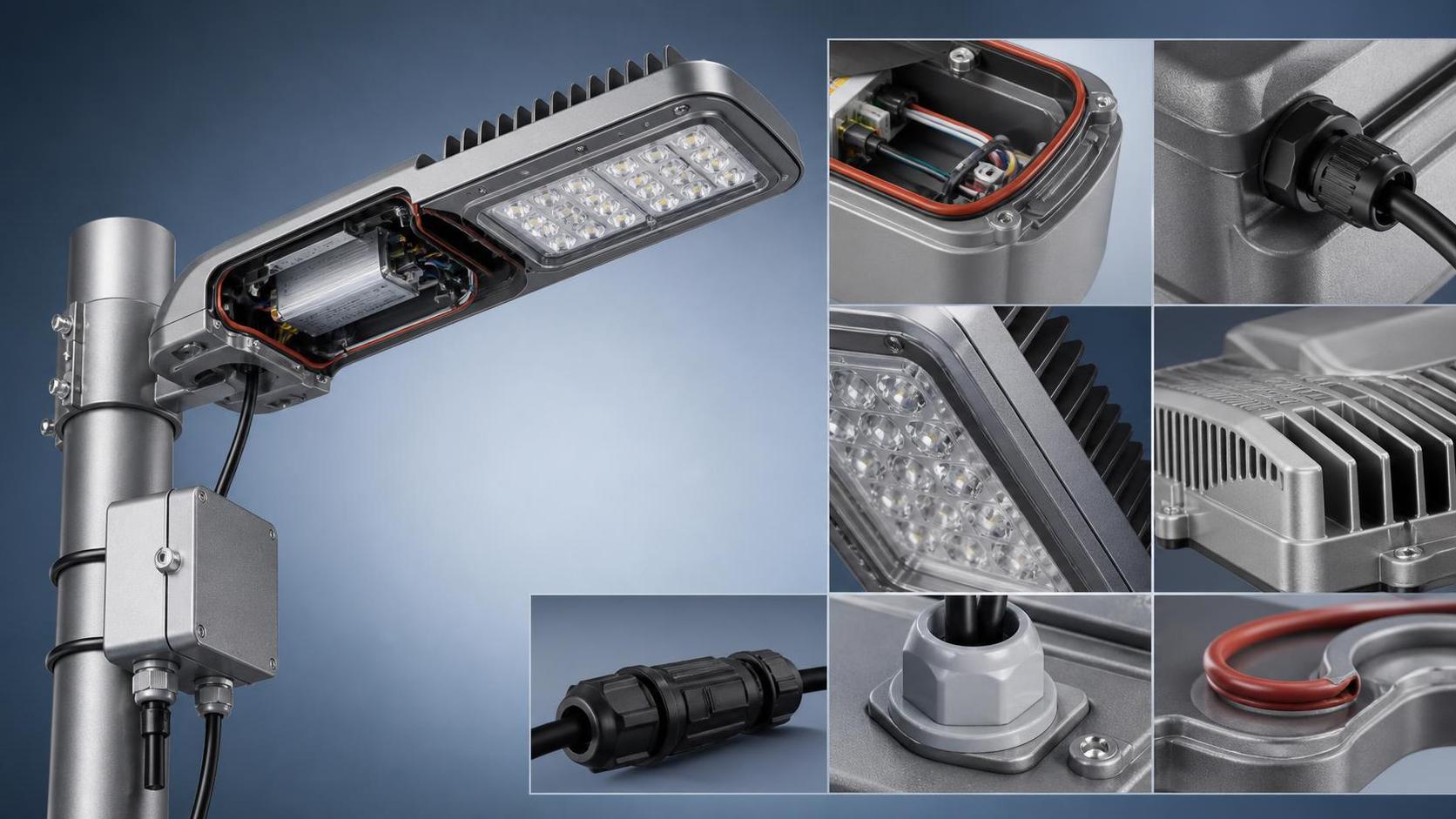
Water ingress is one of the most expensive avoidable causes of early failure. The visible damage may be minor at first: a fogged lens, corrosion around screws, residue near cable glands. But once moisture enters repeatedly, the problem spreads to drivers, LED boards, connectors, and control modules.
During maintenance, inspect gasket compression, cable gland tightness, lens edge sealing, and any opening made during previous repairs. It is also worth checking whether the pole handhole, junction box, or mounting surface is channeling water toward the luminaire. A fixture with a suitable IP rating can still fail early if installation details create a path for water.
This is one area where experienced project support matters. On large-scale jobs, teams like Lishida Smart Lighting typically look beyond the product body itself and into system integration details, because long-term reliability depends on how lighting products, controls, and site conditions work together after handover.
Thermal management is easy to overlook because failure comes slowly
A fixture does not need to shut down to have a thermal problem. It may continue operating while LEDs depreciate faster, drivers age sooner, and optical parts discolor over time. That is why heat sink condition matters during routine checks.
Look for dirt buildup, insect nests, blocked airflow paths, and deformation caused by impact or poor mounting position. In coastal or polluted environments, surface contamination can become more than a cleaning issue; it changes thermal behavior and accelerates corrosion. If repeated overheating is suspected, maintenance teams should review whether the installed fixture wattage, ambient temperature, and enclosure arrangement are still appropriate for the site.
Wiring faults are not always visible, but they leave clues
Loose neutral connections, oxidized terminals, damaged insulation, and poorly protected splices can create flicker, nuisance tripping, and unexplained driver replacement cycles. Outdoor lighting networks are especially exposed where vibration, temperature change, and moisture meet.
Check torque on accessible terminals where maintenance procedures allow, inspect for green corrosion at copper contact points, and pay attention to junctions that have been reopened multiple times. A connector that tests fine in dry weather may behave differently after humidity rises. If a site includes surge protective devices, confirm their condition as well; otherwise, maintenance teams may keep replacing downstream components while the real protection layer has already degraded.
The same discipline applies to adjacent outdoor visual systems. In projects that combine lighting with façade effects, landscape storytelling, or event-based scenes, equipment such as the Laser Engineering Projector also depends on stable power, proper cooling, and clean integration interfaces like LAN, RS232, HDBaseT, or HDMI. Different equipment, same maintenance logic: the environment punishes weak connections first.
Smart controls need maintenance too
When a lighting system includes remote monitoring, dimming schedules, segment control, or sensor-based behavior, maintenance should not stop at the luminaire. Nodes, gateways, antenna positions, and control logic can all contribute to what looks like product failure.
Review whether the reported status matches actual fixture operation. Confirm communication stability, schedule synchronization, and any recent parameter changes after site updates. In urban projects, wireless performance can shift over time as the surrounding environment changes. A system that worked at commissioning may require later adjustment because of new structures, interference sources, or revised lighting scenes.
That is one reason integrated support is useful on large projects. Product selection, controls, and maintenance planning should not sit in separate silos if the goal is fewer callbacks and more predictable operation.
Do not ignore mounting hardware and optics
Mechanical issues can become electrical failures later. Check brackets, fasteners, pole interfaces, and vibration-sensitive components. A luminaire that shifts angle slightly may still illuminate the area, but the movement can strain cable entries, compromise seals, and create uneven light distribution that triggers complaints before a technical failure is recorded.
Optical surfaces also deserve inspection. Cracked lenses, haze, and internal dirt reduce usable output even when the LEDs are still operating. In installations where lighting is combined with projection for buildings, landscapes, or staged public experiences, maintenance standards often need to be higher because visual inconsistency becomes noticeable faster. Equipment with industrial-grade design and long-life laser sources, such as JGTYD-011 used in some large-scale outdoor visual applications, still benefits from the same preventive mindset.
Build a check routine that matches the site, not a generic calendar
A highway, a public square, and a waterfront promenade should not share the same maintenance rhythm. Dust load, vibration, humidity, salt exposure, switching frequency, and control complexity all change what “routine” should mean. Some checks may need to be seasonal. Others should be triggered by weather events, repeated alarms, or patterns in replacement history.
The best maintenance plans are usually simple: inspect the components most likely to fail in that specific environment, record what changed since the last visit, and treat recurring minor issues as system warnings rather than isolated defects.
If early failures are already appearing, the next step is usually not more frequent replacement. It is a closer review of field conditions, electrical quality, sealing details, and control integration. On large outdoor lighting projects, that broader view often makes the difference between constant reactive maintenance and stable long-term operation.
◉ MESSAGE
Blog
- LED Street Luminaire Specifications That Matter for Roadway Projects
- What to Evaluate When Selecting a Smart Street Lamp Manufacturer
- How to Prepare a Compliant Solar Lighting Bid for Public Infrastructure Projects
- LED Street Lighting Solutions for Urban and Municipal Roads
- LED Street Light Installation Guide for Road Projects
- LED Street Light Lifespan: How Long Do LED Road Lights Last?
- LED Street Light IP Rating: What Should Buyers Choose?
Message