
How Distributors Can Evaluate Outdoor LED Lighting Lines for Local Demand
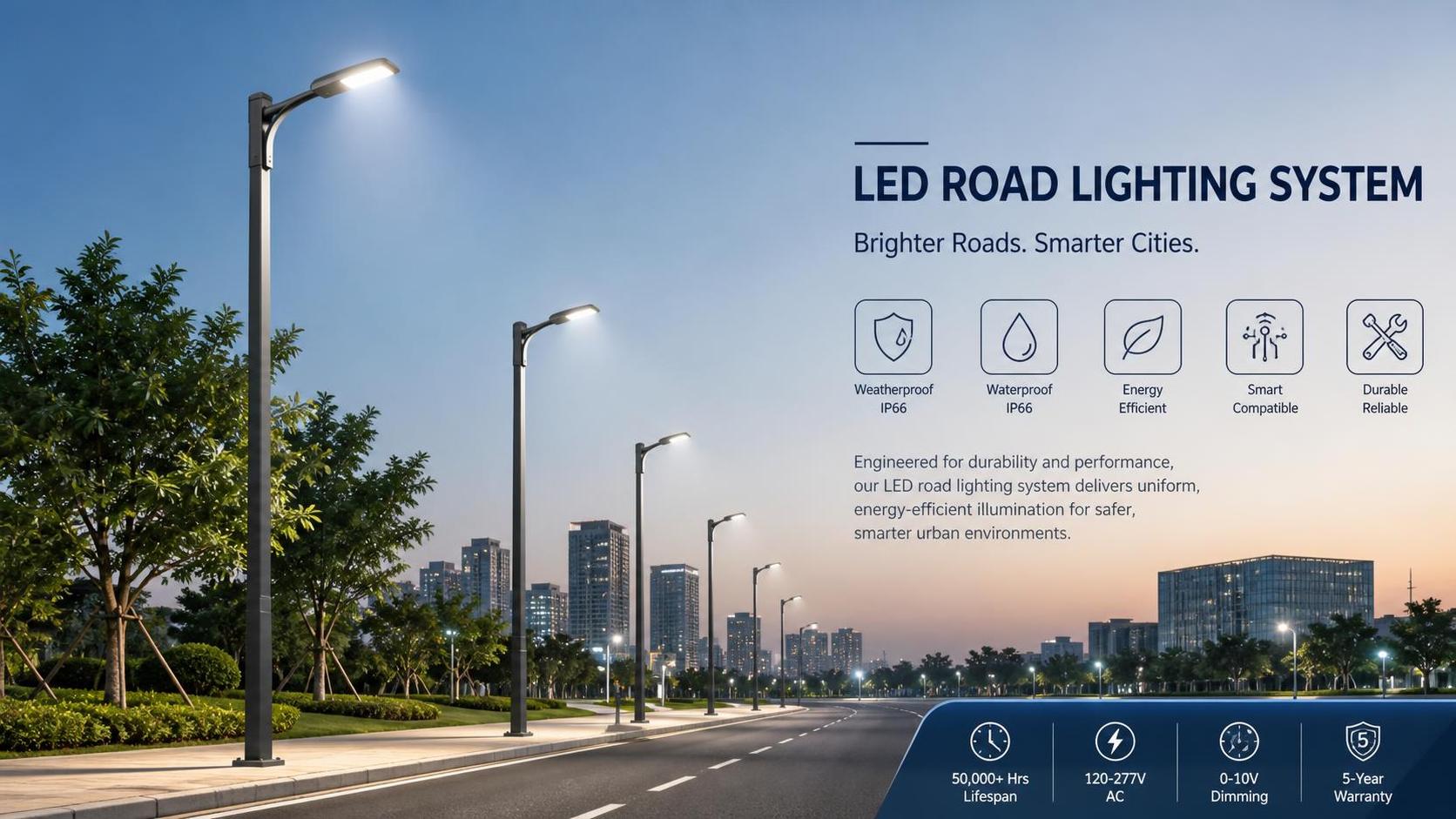
How Distributors Can Evaluate Outdoor LED Lighting Lines for Local Demand
For distributors, selecting an outdoor LED lighting line is rarely a catalog exercise. On paper, many products look similar: decent efficacy, acceptable ingress protection, a familiar wattage range. But local demand does not arrive on paper. It shows up through municipal tender requirements, contractor installation habits, climate stress, maintenance expectations, and budget pressure that changes from one city to the next.
That is why the better question is not “Which line has the best specs?” but “Which line will keep fitting the kind of projects this market is actually buying over the next few years?” In outdoor LED lighting, a distributor who gets that distinction right usually builds a more stable business than one who chases headline performance alone.
Start with project mix, not product mix
Local demand is shaped by where public and commercial spending is going. In one region, road reconstruction may dominate. In another, parks, pedestrian areas, industrial zones, and mixed-use developments may account for more volume. A line designed mainly for boulevard aesthetics may not be the right answer for logistics roads or coastal infrastructure.
Distributors often benefit from mapping demand across three layers:
- Recurring municipal needs such as street lighting replacement or expansion
- Private or semi-public projects, including campuses, residential communities, and commercial districts
- Higher-spec projects that require smart controls, system integration, or stricter durability expectations
This sounds simple, but it changes how a product line should be evaluated. If most opportunities are standard road upgrades, the priority may be a reliable core range with easy installation and stable lead times. If urban renewal projects are rising, design language, pole finish, and control compatibility start to matter much more.
Specs matter, but only in context
Too many buying decisions stop at wattage and lumen output. Those are important, of course, but they do not tell you whether the line is practical for your market. Outdoor LED lighting has to survive exposure, installation variation, and maintenance realities.
A few parameters are especially worth checking against local conditions:
- Ingress protection for rain, dust, and long-term outdoor use
- Luminous efficacy, because energy savings still drive many replacement decisions
- Color temperature options, since some municipalities prefer warmer 3000K environments while traffic-oriented roads often lean toward 4000K
- Wind resistance and structural treatment in storm-prone or coastal areas
- Service life expectations for both the luminaire and supporting pole system
For example, in a street-lighting category, a line offering 150–250W output, efficacy of at least 140 lm/W, IP67 protection, and 3000K or 4000K options may cover a wide range of practical needs. But even then, the real test is whether those specifications align with local pole heights, spacing plans, maintenance access, and project standards.
Look beyond the luminaire to the whole roadside system
In larger outdoor projects, the fixture is only one part of the reliability equation. Poles, base flanges, coatings, anchor bolt interfaces, and control systems can become failure points or installation bottlenecks if they are treated as secondary details.
This is where experienced suppliers tend to stand out. Companies that support roads, public spaces, and more complex urban environments usually understand that project execution is not just about shipping a lamp head. It is about making sure the product line can be integrated into site conditions and maintained over time. Lishida Smart Lighting, for example, positions its support around integrated outdoor solutions, which is often more relevant to distributors serving project-based demand than a simple product-only offering.
A useful example is Modern Street Lighting|MSL-HC. It combines pole and lighting considerations in a way that reflects real road applications: pole heights of 8–14 m, Q235 steel construction, hot-dip galvanizing plus powder coating, wind resistance of at least 150 km/h, and LED options using CREE or OSRAM chips. None of that guarantees suitability for every project, but it does show the kind of full-system thinking distributors should be screening for.
Check whether “smart-ready” is actually useful in your market
Smart controls are no longer a niche topic, but they are not equally relevant in every local market. Some cities are actively moving toward adaptive dimming, remote monitoring, and centralized management. Others still prioritize basic replacement with low upfront cost.
Distributors should be careful here. A smart-enabled product line can be a good strategic bet, but only if the control architecture is practical for local buyers. Ask very direct questions: Is the control system open or proprietary? Can contractors install it without special retraining? If a project starts as standard switching, can it be upgraded later? These details influence whether smart features become a sales advantage or a complication that slows adoption.
In urban projects especially, lighting is increasingly judged not only on energy use but on manageability over time. That trend is real. The pace, however, still depends on local procurement habits and infrastructure maturity.
Don’t underestimate climate, installation quality, and maintenance culture
Two distributors can sell the same outdoor LED lighting line into different markets and get very different results. The difference often comes from conditions around the product rather than the product itself.
In humid or coastal environments, surface treatment and corrosion resistance deserve more scrutiny. In areas with frequent high winds, pole thickness, flange design, and structural calculations become more than a technical note. Where maintenance crews are limited, long service intervals and easier component replacement tend to matter more than marginal performance gains.
This is why broad claims like “50,000-hour lifespan” should be read carefully. A rated LED life is useful, but real-world reliability also depends on driver quality, thermal design, surge conditions, and installation practice. Distributors who understand that usually ask better questions before they commit to a line.
Evaluate supplier depth, not just price support
Price still wins some tenders, but distribution businesses are usually built on repeatability. If the supplier cannot maintain consistency in manufacturing, engineering response, or project documentation, the short-term margin advantage can disappear quickly.
A stronger evaluation process usually includes more practical checks than many buyers expect:
- How complete is the technical documentation for project submission?
- Can the supplier adapt configurations for different road classes or urban design requirements?
- Is there engineering support when contractors run into site issues?
- How stable are manufacturing capacity and delivery schedules?
- Are control systems and lighting hardware being considered together, or separately?
This is often where manufacturers with large-project experience become easier to work with. They tend to understand that the distributor’s risk is not limited to buying stock; it also includes bid timing, specification alignment, installation coordination, and post-delivery accountability.
A line such as Modern Street Lighting|MSL-HC, with details like Ra≥70, IP67 protection, 3000K/4000K options, and a pole lifespan of 30 years or more, may be attractive because it speaks to both performance and durability. Still, the right decision depends on whether those features match the local tender language and the contractor base you actually serve.
What local demand is really signaling right now
In many markets, the direction is fairly clear even if the details vary: buyers want lower operating costs, fewer maintenance headaches, and outdoor lighting that fits more neatly into urban planning rather than standing apart from it. Aesthetic expectations are rising in public spaces, but not at the expense of reliability. Smart controls are gaining attention, though adoption still needs a practical business case.
For distributors, that means the most promising lines are usually not the cheapest and not the most overengineered. They are the ones that can cover everyday municipal and commercial demand, while still leaving room for more advanced projects when the market asks for them.
A good evaluation process should leave you with fewer products, not more. If a line fits local road classes, climate exposure, installation habits, and future control requirements, it is worth serious attention. If it only looks strong in a brochure, it probably will not stay strong once the first few projects start.
◉ MESSAGE
Blog
- LED Street Luminaire Specifications That Matter for Roadway Projects
- What to Evaluate When Selecting a Smart Street Lamp Manufacturer
- How to Prepare a Compliant Solar Lighting Bid for Public Infrastructure Projects
- LED Street Lighting Solutions for Urban and Municipal Roads
- LED Street Light Installation Guide for Road Projects
- LED Street Light Lifespan: How Long Do LED Road Lights Last?
- LED Street Light IP Rating: What Should Buyers Choose?
Message