
High Power LED Floodlight vs Standard Floodlight: What Changes on Site
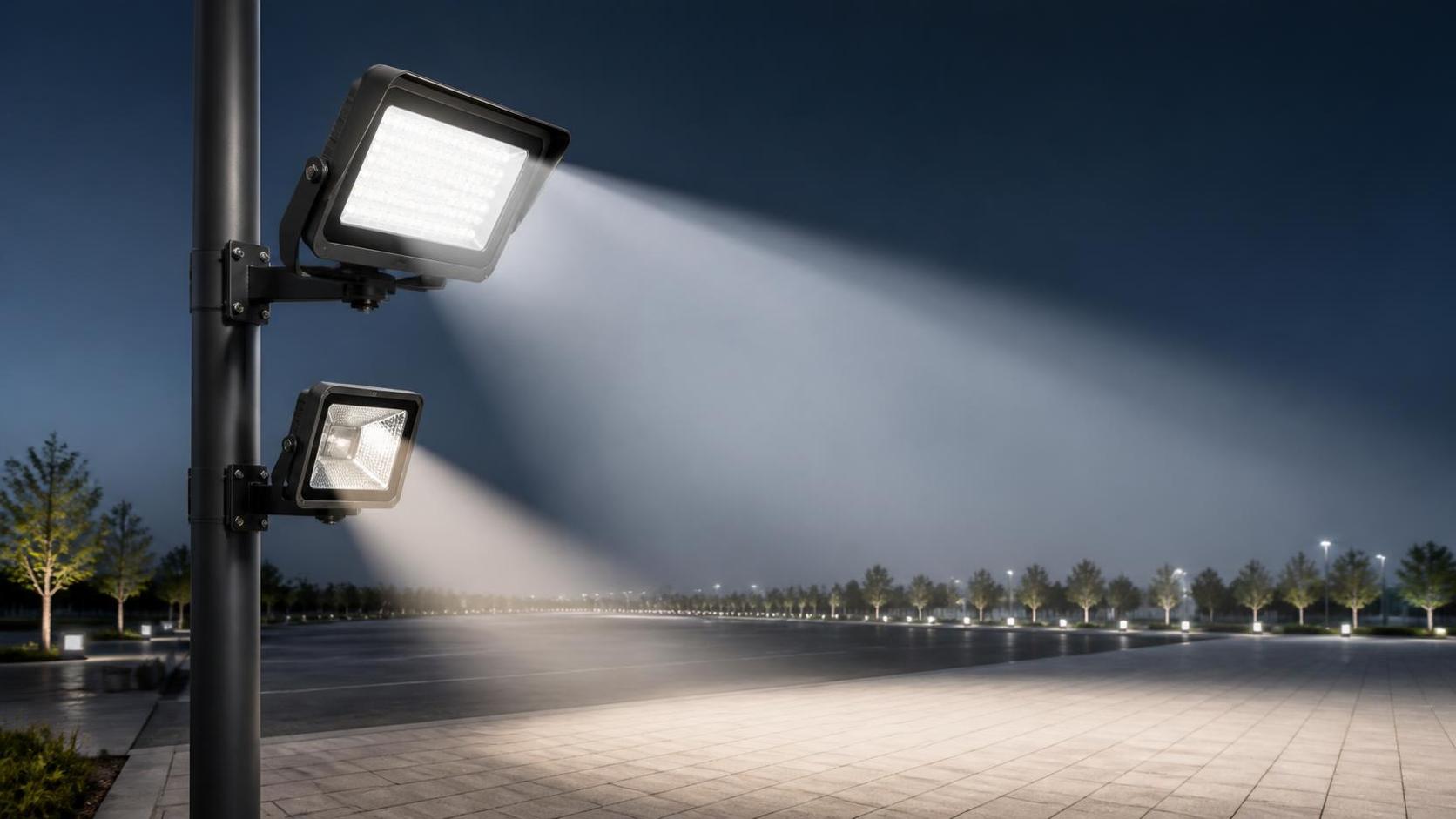
If you are comparing a high power LED floodlight with a standard floodlight, the real difference on site is not just brightness. It changes beam reach, pole spacing, cable load, bracket design, glare control, maintenance access, and even how forgiving the installation will be after handover. That matters a lot in roads, public squares, facades, yards, and other large outdoor areas where lighting performance has to stay stable for years, not just look good on day one.
A short answer is this: standard floodlights usually work well for smaller zones, shorter throws, and simpler layouts. A high-output fitting makes more sense when the site is wide, mounting height is greater, uniformity matters, or the project cannot afford dark patches, frequent replacement, or poor control of spill light.
Where the change is most noticeable with a high power LED floodlight
Many people expect a bigger fixture to simply make an area brighter. In practice, once you move into higher wattages, the entire lighting approach changes.
First, coverage becomes more strategic. A standard floodlight often suits compound walls, loading bays, small parking areas, or localized building lighting. A high power model is more often chosen when the beam has to travel farther or when fewer mounting points are available. On a site with tall poles or wide setbacks, that extra output can reduce the number of fixtures needed, but only if the optics are right.
That last part is important. A poorly selected high power fitting can create hot spots directly under the pole and leave the outer area uneven. So the gain is not “more watts equals better result.” The gain comes from matching output, beam angle, mounting height, and spacing to the actual task.
Second, installation details get less forgiving. Heavier luminaires may need stronger brackets, better aiming, and more attention to wind load. Cable sizing, driver placement, and surge protection also deserve closer review. On paper these may look like small engineering checks. On a real project, they affect labor time, commissioning, and future fault rates.
Standard floodlight is not the “lower” option in every case
There is a common mistake in outdoor lighting: assuming the larger fixture is always the more professional choice. It is not.
For pedestrian paths, small courtyards, gate areas, low-level facade washing, or modest commercial perimeters, a standard floodlight can be the better answer. It is easier to mount, easier to replace, and often easier to control visually. In these situations, using too much power can create glare, wasted energy, and complaints from nearby residents or drivers.
This is why experienced contractors usually start with the application, not the wattage. Ask what needs to be seen, from where, for how long, and under what environmental conditions. Security lighting, public circulation, and decorative lighting may all use floodlights, but they do not need the same distribution or intensity.
In large-scale work, this is also where project support matters. Lishida Smart Lighting works with contractors and project owners on outdoor lighting for roads, public spaces, and more complex urban environments, where fixture choice is tied closely to system integration, smart control, and long-term reliability rather than product specs alone.
What actually changes on site
Here is what crews and project teams usually notice after choosing one type over the other:
- Mounting height flexibility: High power units are more suitable when fixtures are mounted higher and still need useful ground-level illumination.
- Fixture quantity: In some layouts, fewer high-output luminaires can cover the same area, though this needs verification through lighting design.
- Uniformity: Standard floodlights may need more points to avoid dark gaps. High power fixtures can help, but can also worsen contrast if optics are too narrow.
- Glare risk: Higher output raises the need for careful aiming, shielding, and beam selection.
- Electrical planning: Higher wattage affects circuit loading, protection strategy, and sometimes cabinet design.
- Maintenance access: Fewer fixtures can reduce replacement points, but each fitting may be harder or slower to handle.
That is why the site impact is operational as much as optical.
Beam control matters more than many buyers expect
One reason projects underperform is that buyers compare floodlights by wattage and ignore distribution. A standard floodlight with a well-matched beam can outperform a stronger unit with the wrong optic.
For example, a narrow beam may be useful for long throws, facade accents, or focused feature lighting. A wider beam may work better for open plazas or general area coverage. The wrong choice can produce either wasted spill or underlit circulation zones.
This is also where some projects mix fixture types. A site may use general floodlighting for safe visibility, then add targeted feature lighting for landscape or branded visual effects. In that kind of application, something like the LED Pattern Projector can make sense as a separate layer rather than a substitute for floodlighting. Its use is more specific: landscape lighting, projected graphics or patterns, and controlled visual presentation, with options such as 150W, 200W, and 300W, multiple beam angles, DMX512 control, and IP65 protection. That is useful when the brief includes identity or atmosphere, not just area illumination.
Energy use is part of the decision, but not the whole decision
People often ask which option saves more power. The honest answer is that it depends on layout efficiency.
A single high power LED floodlight consumes more energy than a single standard unit. But if the higher-output fixture allows better spacing, fewer poles, or fewer total luminaires, the full-system result may be more efficient. The opposite can also happen: a project may install oversized fittings, dim them down later, and realize the original selection was heavier than necessary.
Smart controls can help, especially in public spaces and municipal projects where schedules, dimming profiles, and fault monitoring affect operating cost over time. Still, controls cannot fully correct a poor lighting layout. Good selection comes first.
When high power makes sense, and when it does not
A high power LED floodlight is usually worth considering when:
- the mounting height is significant
- the site is broad and open
- uniformity and forward reach are important
- maintenance access is difficult and fixture count should be limited
- the project needs stronger integration with centralized control or urban infrastructure
It may be the wrong choice when:
- the lit area is relatively compact
- nearby buildings or roads are sensitive to glare
- the visual task is low-level guidance rather than broad-area lighting
- the structure cannot comfortably support larger fittings
- the design team is selecting by wattage without lighting calculation
That last point causes a lot of avoidable rework. For outdoor projects, photometric review should guide the decision. Exact lux targets, pole height, spacing, and local standards should be checked against the real site conditions and official project requirements.
A practical way to compare before you decide
If you are still early in the process, compare the two options using four questions:
- How large is the area, and how far does the light need to travel?
- What matters more here: visibility, uniformity, accent effect, or perimeter coverage?
- How easy will future maintenance be at the installed height?
- Will this lighting need to connect with dimming, scheduling, or other smart control functions later?
Once those answers are clear, the choice becomes much easier. On bigger outdoor jobs, the best results usually come from treating the floodlight as part of a system, not as a standalone catalog item. That is the difference between a fixture that looks acceptable at handover and one that continues to perform well after weather, dust, operating hours, and site changes begin to add pressure.
For many projects, the right answer is not “always standard” or “always high output.” It is choosing the high power LED floodlight only where the site really benefits from its reach, control, and infrastructure value, and using standard floodlights where simplicity gives a cleaner result.
FAQ
Is a high power LED floodlight always brighter in a useful way?
Not necessarily. It produces more output, but usefulness depends on beam angle, mounting height, aiming, and spacing.
Can a standard floodlight be enough for commercial outdoor lighting?
Yes. For smaller zones, low mounting heights, and localized tasks, it is often the more balanced option.
Does higher wattage mean fewer fixtures?
Sometimes, but not automatically. A lighting calculation is needed to confirm coverage and uniformity.
What is the biggest mistake in floodlight selection?
Choosing by wattage alone and ignoring optics, glare control, and site layout.
Internal Link Anchor Text Suggestions
- Anchor text: outdoor floodlight beam angle guide - suggested page type/topic: technical selection guide
- Anchor text: smart lighting control for public spaces - suggested page type/topic: control system solutions
- Anchor text: how to choose pole-mounted LED lighting - suggested page type/topic: application advice article
- Anchor text: IP65 vs IP66 outdoor lighting explained - suggested page type/topic: product education page
External Authority Source Suggestions
- Industry association lighting design recommendations
- Government or municipal roadway and public area lighting standards pages
- Official technical documentation from established LED driver or LED chip manufacturers
◉ MESSAGE
Blog
- LED Street Luminaire Specifications That Matter for Roadway Projects
- What to Evaluate When Selecting a Smart Street Lamp Manufacturer
- How to Prepare a Compliant Solar Lighting Bid for Public Infrastructure Projects
- LED Street Lighting Solutions for Urban and Municipal Roads
- LED Street Light Installation Guide for Road Projects
- LED Street Light Lifespan: How Long Do LED Road Lights Last?
- LED Street Light IP Rating: What Should Buyers Choose?
Message