
LED Street Light Manufacturer: Factory, Quality and OEM Guide
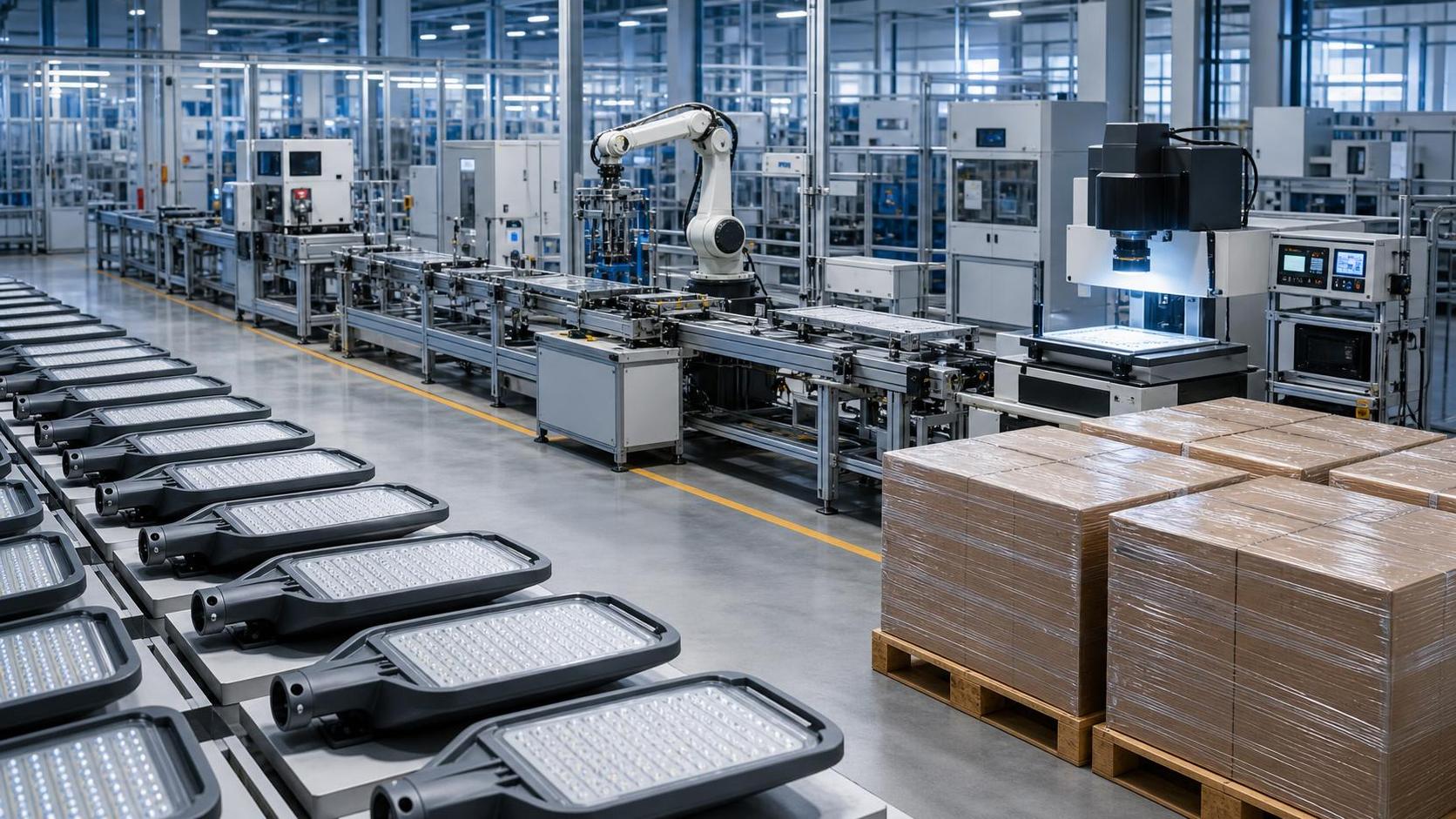
Choosing an LED street light manufacturer is rarely just about comparing wattage, housing shape, or price per unit. For contractors, developers, and public project owners, the real question is much bigger: can this factory support delivery at scale, keep product quality consistent, and respond when site conditions become more complicated than the original plan?
That is why manufacturer selection has such a direct impact on project outcome. In outdoor lighting, especially for roads, public spaces, and urban infrastructure, a capable production partner does more than ship fixtures. It helps reduce delays, improve installation efficiency, and lower the risk of long-term maintenance problems. For buyers evaluating an LED street light manufacturer, the most useful approach is to look beyond catalogs and assess the factory as a project partner.
What separates a real LED street light factory from a trading supplier?
On paper, many suppliers can offer similar street light specifications. In practice, there is a major difference between a true manufacturing facility and a company that mainly coordinates sourcing. A real LED street light factory usually has stronger control over production scheduling, component selection, assembly processes, testing, and design adaptation.
This matters when project requirements change midstream. Perhaps the pole height needs adjustment, the optics must better fit a municipal road class, or the control system has to match a smart lighting platform already specified by the client. A factory with engineering depth can usually solve these issues faster because design, production, and quality teams are connected internally rather than spread across multiple third parties.
For large-scale outdoor lighting work, factory capability often shows up in very practical ways: how clearly technical drawings are prepared, whether production lead times are realistic, how well packaging protects luminaires in transport, and whether batch consistency is maintained from the first shipment to the last.
How to evaluate manufacturing strength before placing an order
Many buyers focus first on sample appearance. That is understandable, but appearance alone says very little about a manufacturer’s long-term reliability. A better evaluation looks at production discipline and engineering support.
Start with the basics: does the manufacturer clearly explain its material standards, LED configuration logic, driver options, thermal management design, and testing workflow? A reliable supplier should be able to discuss not only what the product is, but why it is built that way for outdoor use.
Then look at production readiness. For road and public-area projects, consistency matters more than a polished sample. Ask how incoming materials are checked, how assembly quality is controlled, and how finished luminaires are tested before shipment. Even small inconsistencies in sealing, heat dissipation, or driver matching can become costly once hundreds or thousands of units are installed.
Another good sign is whether the factory understands the installation side of the project. Outdoor lighting is not just a product transaction. Mounting structure, local climate, access conditions, cable planning, and control integration all affect product suitability. Manufacturers with project experience tend to ask better questions early, which often prevents avoidable issues later.
Quality in LED street lighting is more than lumen output
When buyers compare LED street lights, lumen efficiency often gets the most attention. It is important, but it is not the whole story. Real-world quality also depends on optics, thermal performance, environmental protection, and system stability over time.
For example, a fixture that looks efficient in a data sheet may perform poorly if heat management is weak, if lens design creates uneven road illumination, or if internal components are not well matched for long operating cycles. Outdoor lighting works in heat, rain, dust, vibration, and sometimes unstable power environments. A dependable manufacturer designs for those realities, not just for laboratory performance.
This is especially relevant in large municipal or infrastructure projects where maintenance access is expensive and public expectations are high. A street light failure on an isolated road or in a busy urban area is not just a technical issue; it can quickly become an operational problem. The best LED street light manufacturers understand that reliability is part of project risk control.
Why OEM capability matters for contractors and project owners
OEM service in street lighting is often misunderstood as simple logo customization. In reality, useful OEM support goes much further. It may include adapting wattage ranges, pole compatibility, optical distribution, color temperature, control interface, battery configuration for solar systems, or packaging requirements for project logistics.
For contractors, this flexibility can make procurement smoother when project specifications are not fully standardized. For project owners, it helps align the lighting system with site conditions instead of forcing the site to fit a generic product. A good OEM manufacturer should be able to discuss what can be customized efficiently, what requires engineering review, and what trade-offs may affect cost, delivery, or long-term maintenance.
That level of transparency is important. Overpromising customization is a common risk in sourcing. A credible factory will not say yes to everything. It will help define what is practical and what is better solved through a different product structure.
Special environments require more than standard street lights
Not every project fits a conventional grid-powered LED street light setup. Remote roads, coastal areas, mountain regions, industrial zones, and places with weak power infrastructure often need a different strategy. In such cases, a manufacturer with broader solution capability becomes far more valuable than one that only supplies standard luminaires.
One example is hybrid renewable street lighting for off-grid or difficult environments. In places where trenching and cabling are costly or where weather conditions are variable, a system such as Wind-Solar Hybrid Street Lighting | SHL-003 can be a practical option. With tailored configurations including 30W to 150W LED power, solar panels from 100W to 300W, wind turbines from 200W to 600W, lithium battery options, and an MPPT hybrid controller, this type of system is designed for all-weather operation and more stable energy capture in low-sun conditions.
For contractors working in coastal roads, island areas, highways, rural roads, or remote industrial sites, such systems can reduce dependence on grid access and simplify installation planning. More importantly, they show whether a manufacturer can think in terms of application-based solutions rather than just fixture supply.
Questions worth asking before you shortlist a manufacturer
The right conversation can reveal more than a brochure. Ask how the factory handles project-specific lighting calculations, what support is available for smart control integration, and how it manages production consistency across large batches. If your project includes multiple environments—main roads, pedestrian areas, public squares, or off-grid zones—see whether the manufacturer can coordinate a solution set instead of treating each product in isolation.
It is also useful to ask how they support issue resolution. Problems do not always come from the luminaire itself; they may involve mounting interfaces, local power conditions, or installation practice. A manufacturer with engineering awareness will usually respond with troubleshooting logic, not just replacement terms.
For complex urban lighting, system integration deserves special attention. Street lights today may connect to dimming schedules, fault monitoring, energy management, or centralized control platforms. If the manufacturer understands smart control systems as part of the project, that can save significant coordination effort later.
What strong project support looks like in practice
In large-scale outdoor lighting, support quality often becomes visible only after the purchase order is issued. This is where experienced manufacturers stand out. They help confirm model selection against actual site conditions, keep communication clear during production, and provide documentation that installers and project managers can actually use.
Lishida Smart Lighting works with contractors and project owners facing exactly these challenges. The company’s focus is not limited to product supply; it includes integrated support for outdoor lighting products, smart control systems, and project-based solutions. That matters for roads, public spaces, and complex urban environments where the success of the lighting system depends on coordination as much as hardware.
With experience in large-scale projects in China, the team understands familiar project pressures: selecting the right product mix, balancing delivery requirements, and ensuring long-term system reliability. For buyers, this kind of manufacturing and engineering background often makes the difference between a supplier that simply ships and one that helps the project move forward with fewer surprises.
Choosing for long-term performance, not just procurement speed
A street lighting project may be purchased in one phase, but it will be judged over years of operation. That is why selecting an LED street light manufacturer should involve more than cost comparison or a quick sample review. Factory capability, quality discipline, OEM flexibility, and application understanding all shape how well the project performs after installation.
If your project includes standard municipal roads, public spaces, or more demanding off-grid environments, it is worth choosing a manufacturer that can adapt its solution to the site instead of pushing a one-size-fits-all product. In some cases, that may even mean combining conventional LED road lighting with hybrid systems such as Wind-Solar Hybrid Street Lighting | SHL-003 where wiring challenges or energy conditions make it a better fit.
Ultimately, the best manufacturer is one that helps reduce uncertainty. In outdoor lighting, that is often the most valuable quality of all.
◉ MESSAGE
Blog
- LED Street Luminaire Specifications That Matter for Roadway Projects
- What to Evaluate When Selecting a Smart Street Lamp Manufacturer
- How to Prepare a Compliant Solar Lighting Bid for Public Infrastructure Projects
- LED Street Lighting Solutions for Urban and Municipal Roads
- LED Street Light Installation Guide for Road Projects
- LED Street Light Lifespan: How Long Do LED Road Lights Last?
- LED Street Light IP Rating: What Should Buyers Choose?
Message