
How LED Street Light Manufacturers Ensure Product Quality
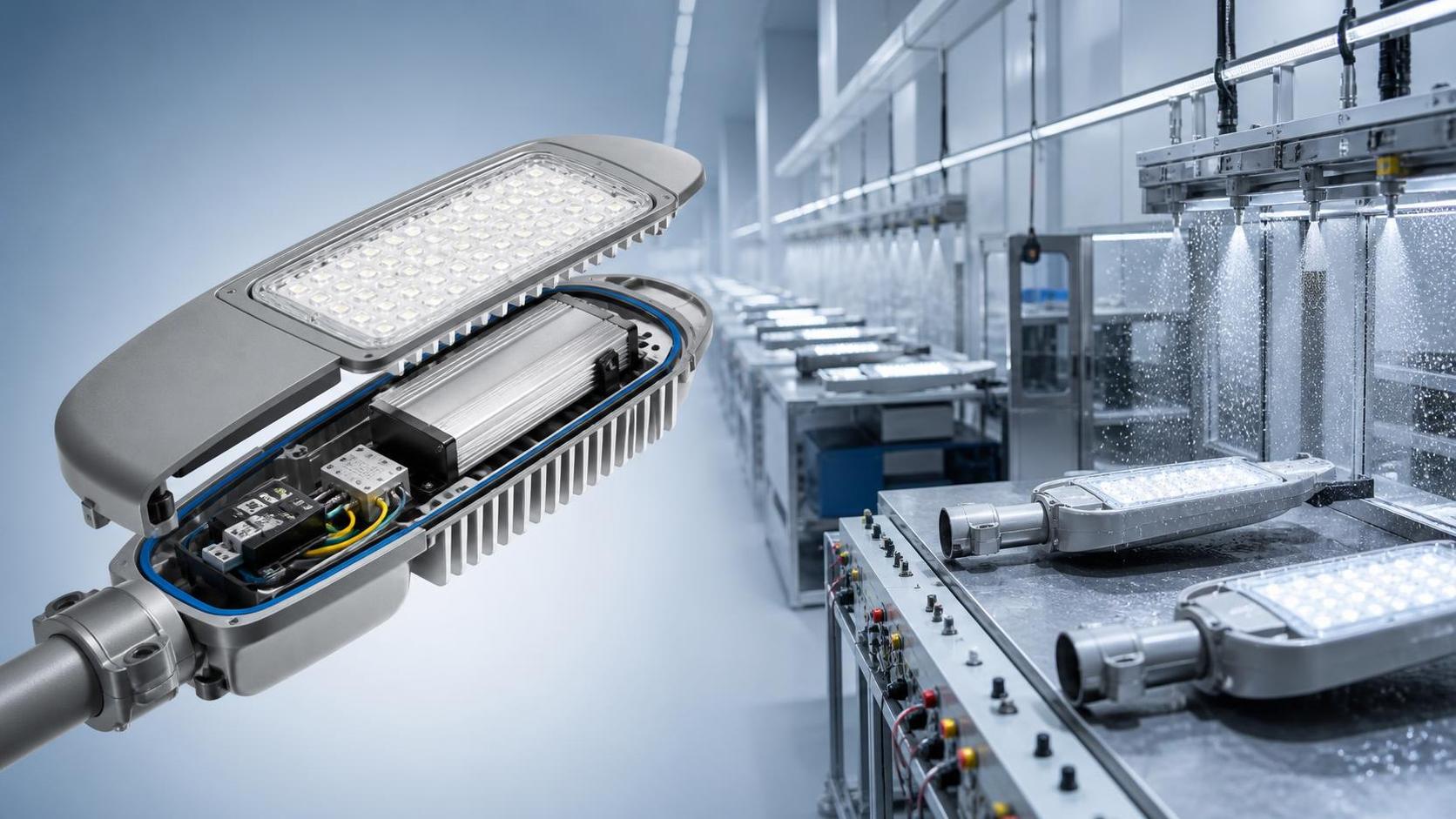
Choosing the right LED street light manufacturers is essential for contractors and project owners who need reliable performance in demanding outdoor lighting projects. From material selection and production control to testing standards and system compatibility, product quality affects safety, efficiency, and long-term maintenance costs. Understanding how manufacturers ensure consistent quality can help buyers reduce project risks and achieve better results in roads, public spaces, and complex urban environments.
In outdoor lighting, “quality” is rarely about one specification on a datasheet. Buyers often compare luminous efficacy, wattage, or housing appearance, but those are only surface indicators. The real question is whether a manufacturer can deliver stable performance across an entire project lifecycle: production consistency, environmental durability, electrical safety, optical reliability, and support for installation and maintenance years after commissioning.
This is where experienced LED street light manufacturers distinguish themselves. A good factory does not only assemble luminaires. It manages a chain of quality decisions, from thermal design and component sourcing to waterproofing, surge protection, driver matching, and batch traceability. For project buyers, especially in municipal roads, industrial parks, campuses, and urban renewal works, these upstream controls often matter more than the initial purchase price.
Quality starts before production begins
Many product failures in outdoor lighting are not caused on the production line. They begin much earlier, during design and component selection. Street lighting works in heat, rain, dust, unstable grids, and sometimes coastal or high-corrosion environments. A luminaire that performs well in a showroom may fail quickly if the thermal path is weak, the sealing structure is poorly designed, or the driver is not matched to local power conditions.
Manufacturers with strong quality systems typically begin with application-based design rather than generic product styling. That means evaluating the operating environment, expected night-time running hours, pole height, road width, local voltage conditions, maintenance access, and smart control requirements. In practical terms, a luminaire meant for an urban arterial road is not judged by the same criteria as one used in a residential street or logistics park.
At this stage, material choices become critical. The housing alloy, lens quality, gasket material, cable sealing method, and coating treatment all influence service life. In high-humidity regions, poor sealing can lead to condensation and optical degradation. In hot climates, inadequate heat dissipation may accelerate lumen depreciation and driver failure. In areas with unstable grids or frequent lightning activity, surge protection is not a premium feature but a baseline quality requirement.
Component sourcing is one of the clearest signals of manufacturing discipline
Serious manufacturers rarely treat components as interchangeable commodities. LEDs, drivers, surge protectors, connectors, seals, and fasteners all influence long-term field performance. The market has learned this repeatedly: two luminaires can look almost identical externally while having very different reliability in operation.
LED chip sourcing matters because lumen maintenance, color consistency, and failure rate depend heavily on source quality and binning control. Driver selection matters because the driver is often the first component to fail in harsh outdoor conditions. A manufacturer committed to quality usually works with controlled supplier lists, incoming inspection standards, and documented substitution rules. That last point is important. In weaker supply chains, unauthorized component replacement can create inconsistent quality between batches, which becomes a major problem on multi-phase projects.
For buyers, asking whether the manufacturer has approved supplier management, incoming quality control procedures, and batch traceability is often more useful than asking for a long list of marketing claims.
Production control is about consistency, not just capacity
Large-scale project buyers often assume that a bigger factory automatically means better quality. That is not always true. Capacity helps with delivery, but quality depends on process discipline. Outdoor luminaires need controlled assembly steps: thermal interface application, torque control for screws, sealing verification, wiring inspection, driver placement, and final electrical testing. If these processes vary from operator to operator, product performance will also vary.
Well-managed LED street light manufacturers build consistency through standard operating procedures, workstation inspections, in-process testing, and lot-based records. This matters especially when the same model is delivered over several months. Contractors do not want the first shipment and the fourth shipment to differ in optical performance, coating quality, or smart control compatibility.
One useful sign of maturity is whether the factory can explain its failure prevention methods rather than only its final inspection methods. Final inspection can catch obvious defects, but it cannot fully compensate for weak process control. Manufacturers that understand this tend to invest more in preventive quality systems than in cosmetic rework.
Testing is where many buyers should look more closely
Testing is often mentioned in brochures, but not all testing has the same value. For outdoor road lighting, the meaningful question is whether testing reflects real project risks. Photometric testing is important because road lighting design depends on actual lumen output, beam distribution, and uniformity. But photometry alone does not tell a buyer how the luminaire will behave after years of thermal stress and weather exposure.
More relevant quality assurance usually includes a combination of electrical safety testing, ingress protection verification, aging tests, temperature rise evaluation, surge testing, and in some cases salt spray or corrosion-related assessments where the installation environment requires it. Claimed IP ratings should not be treated as paperwork only; they should reflect actual design capability and assembly reliability.
Buyers should also pay attention to lifetime claims. A stated lifespan such as 50,000 hours is common in the market, but it can be misunderstood. It does not necessarily mean every component will operate failure-free for that entire period. The practical issue is how the manufacturer defines lifetime, under what test conditions, and whether the thermal and electrical design supports that claim in outdoor operation.
Compliance matters, but paperwork is not the whole story
In export and project procurement, certifications and standards are necessary, yet they are not sufficient proof of field reliability. Depending on the target market, buyers may review CE, RoHS, or other applicable certifications, and for roadway applications they may also need to consider local or project-specific technical standards. Requirements vary by country and tender framework, so project teams should verify the exact compliance path rather than relying on generic documentation.
What often gets missed is the gap between laboratory compliance and site performance. A manufacturer may hold the right certificates but still struggle with coating durability, lens yellowing, control system interoperability, or consistent waterproof assembly in mass production. That is why experienced buyers combine document review with factory audits, sample evaluation, and reference checks from similar projects.
Smart control compatibility is now part of quality
Street lighting quality used to be judged mainly by lumen output and energy savings. That is no longer enough for many urban projects. In current outdoor lighting work, especially in smart city and retrofit projects, product quality also includes compatibility with dimming systems, remote monitoring, fault reporting, and broader control architecture.
If a luminaire is difficult to integrate with a control platform, the problem becomes operational rather than purely technical. Delays in commissioning, unstable communication, or unclear interface responsibility can increase project costs significantly. Manufacturers with real project experience usually understand that quality includes system-level coordination: hardware, controls, installation logic, and after-sales troubleshooting.
This same logic applies beyond roadways. In façade and landscape environments, system compatibility and optical consistency are equally important. For example, projects using LED Linear Light solutions for building facades or landscapes often focus not only on brightness, but also on beam control, visual comfort, ingress protection, and long-term color stability. A model such as XTD-015, with IP66 protection, multiple beam angles, and options including 3000K, 4000K, 6000K, RGB, and RGBW, illustrates how outdoor quality expectations increasingly extend across different lighting categories, not just street luminaires.
After-sales support is part of the quality equation
From a project owner’s perspective, product quality is tested most clearly after installation. When failures occur, the speed and structure of the manufacturer’s response become critical. Can it trace the batch? Can it identify whether the issue is installation-related, environment-related, or product-related? Can it supply replacement units with matching specifications? Can it support driver or control troubleshooting remotely?
Manufacturers that serve large-scale projects well usually have a stronger technical feedback loop. They do not treat warranty claims as isolated events. They analyze failure patterns, update process controls, and improve future production. This operational maturity is especially important for contractors handling public tenders, where delayed rectification can affect payment milestones, reputation, and future bid eligibility.
What buyers often get wrong when evaluating manufacturers
One common mistake is overemphasizing headline efficiency while underestimating reliability. A product that looks attractive in energy calculations may become expensive if it produces high maintenance costs or repeated failures. Another mistake is treating all “equivalent” components as equal. In outdoor lighting, substitution can materially change performance.
There is also a tendency to assess quality only through samples. Samples are useful, but they do not reveal whether the manufacturer can maintain the same standard in volume production. For that, buyers need to review process control, quality records, supplier management, and previous project execution.
Price pressure creates another distortion. In competitive bidding, teams may choose a lower-cost option assuming that warranties will offset risk. In practice, warranties do not remove the operational burden of field failures, access equipment, labor coordination, traffic management, or resident complaints. The cheapest luminaire on paper can become the most expensive one in service.
How to judge whether a manufacturer is likely to deliver consistent quality
For procurement teams and project managers, the most practical approach is to assess the manufacturer across several dimensions at once: design capability, component discipline, process control, testing relevance, compliance readiness, smart system compatibility, and after-sales responsiveness. None of these alone is decisive, but together they reveal whether the supplier operates as a project-grade manufacturer or simply as a price-driven assembler.
It is worth asking detailed questions: How are components approved and substituted? What tests are performed on every unit, and what tests are done by batch? How is thermal performance validated? How does the factory verify waterproof integrity in production? What surge protection level is designed for the target market? How are field issues traced and corrected? A reliable manufacturer can usually answer these questions clearly and with evidence.
In outdoor lighting, quality is not a label applied at the end of the line. It is the result of engineering judgment, disciplined manufacturing, realistic testing, and project-based support. That is why the best LED street light manufacturers reduce risk not by making the boldest claims, but by controlling the details that determine how a luminaire actually performs once it is installed on the road and exposed to the real world.
◉ MESSAGE
Blog
- LED Street Luminaire Specifications That Matter for Roadway Projects
- What to Evaluate When Selecting a Smart Street Lamp Manufacturer
- How to Prepare a Compliant Solar Lighting Bid for Public Infrastructure Projects
- LED Street Lighting Solutions for Urban and Municipal Roads
- LED Street Light Installation Guide for Road Projects
- LED Street Light Lifespan: How Long Do LED Road Lights Last?
- LED Street Light IP Rating: What Should Buyers Choose?
Message