
What procurement teams often get wrong when comparing street lighting
The hardest part of comparing Modern Street Lighting is that “better” means different things on a six-lane main road and on a narrower side street. Buyers sometimes start with wattage or unit price because those figures are easy to line up. In practice, that is rarely enough. Road classification, mounting height, traffic speed, light distribution, control method, maintenance access, and long-term lumen stability all affect whether a lighting plan will perform as intended after handover.
For main roads, the priority is usually consistent visibility over longer distances, better uniformity, and more disciplined control of glare. Side streets tend to be more forgiving in terms of throw distance, but they often need better adaptability because pole spacing, surrounding buildings, trees, and mixed pedestrian traffic create more irregular conditions. That is why a product family that looks suitable on paper may still be the wrong fit if its optics, dimming interface, or maintenance strategy do not match the actual street type.
This is where terms like MSL-HC become useful as a selection reference rather than a buzzword. In procurement discussions, the real question is not whether a luminaire belongs to “modern” street lighting, but whether the solution can support current project expectations: efficient LED performance, robust enclosure protection, practical control compatibility, and a beam pattern appropriate to the roadway geometry.
Main roads and side streets are not a smaller-versus-bigger version of the same job
A common mistake is to treat side streets as simply a lower-power version of arterial road lighting. The operating environment is different. Main roads carry faster traffic, so the lighting system has less margin for patchy brightness, dark transitions, or poorly controlled spill. Drivers need visual continuity. That usually pushes selection toward luminaires with stronger optical control and wider project coordination around pole height and spacing.
On side streets, the procurement logic often shifts. The road may have shorter poles, more obstacles, tighter corners, and lower vehicle speed, but the scene is visually complex. You may be lighting parked cars, sidewalks, crossings, and building edges in the same field. In those cases, beam angle choice matters as much as raw output. A fixture that is too aggressive can waste light or create discomfort near homes and storefronts. One that is too narrow may leave dead zones between poles.
That distinction matters because modern street lighting decisions are usually judged years later through maintenance workload, complaint rates, and whether the smart control layer actually integrates cleanly with the project.
What to compare beyond wattage and lumen claims
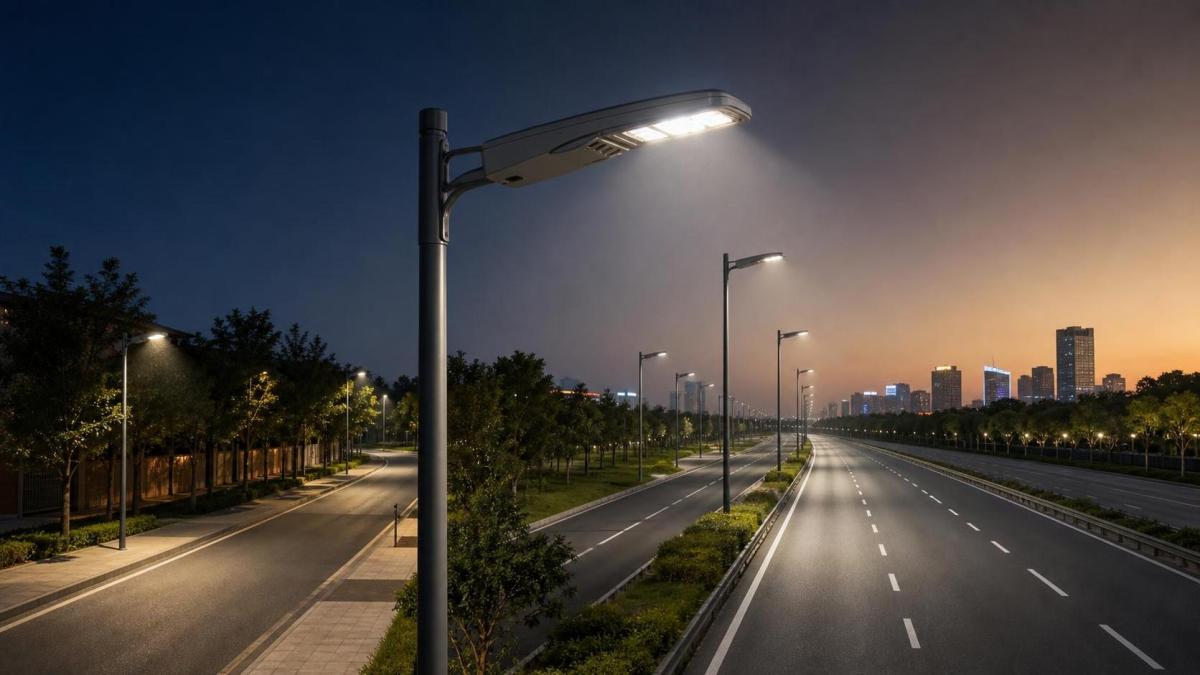
Luminous efficacy is important, but it should not be isolated from the rest of the fixture. A luminaire rated at 150 lm/W may look attractive in tender review, yet the procurement decision still depends on whether the optical distribution serves the road section. For example, available beam angles such as 30°, 60°, 90°, 90*120°, or 80*150° point to a system that can be adapted to different carriageway widths and pole arrangements. That flexibility is often more useful than chasing a headline figure.
Enclosure durability is another area where comparisons become more meaningful once tied to project conditions. An IP66 housing is generally relevant for outdoor roads and public infrastructure because it addresses dust and water ingress at a level suited to exposed installations. For long municipal routes or highway-linked corridors, that has a direct maintenance implication. Procurement teams know the issue is not only whether a fixture works on day one, but whether cleaning cycles, driver reliability, and environmental sealing support stable operation after installation crews have left the site.
Input voltage range, dimming method, and LED source brand should also be read as system-level indicators. A luminaire supporting PWM, PLC, and 0-10V dimming gives more room when a project includes phased smart lighting upgrades or mixed control architecture. In large road packages, that compatibility can simplify integration between the lighting hardware and the control layer instead of forcing a redesign later.
Where products like MSL-HC fit in a real evaluation
When buyers assess an option such as MSL-HC, the useful comparison is whether it behaves like a project-ready road luminaire rather than whether it only checks standard LED boxes. That means looking for a workable power range, optical options that cover both arterial roads and secondary streets, and a lifespan that aligns with public infrastructure expectations.
One reference point in this category is the LED Street Light Luminaire, model LD044, intended for roads, highways, and smart city applications. Its published range of 50-350W, efficacy of 150 lm/W, CCT options from 2000K to 6500K, IP66 protection, and multiple beam distributions suggest a design intended for varied roadway scenarios rather than a single fixed use case. That does not automatically make it right for every tender, but it does show the kind of specification breadth procurement teams should look for when one project includes both major traffic corridors and smaller urban links.
The same applies to source and service assumptions. LED source options such as CREE or OSRAM can matter not as branding shorthand, but as part of an overall reliability review that includes driver quality, thermal management, and parts consistency across batches. In large-scale procurement, those details affect replacement planning and performance consistency more than a one-line brochure claim ever will.
The procurement view: reliability is a delivery issue, not just a product issue
For outdoor lighting projects at city scale, product selection is inseparable from execution. Contractors and project owners often run into trouble not because the luminaire category was wrong, but because product choice, controls, and installation conditions were considered separately. A good road lighting package needs those pieces to line up. If the fixture supports dimming but the control interface is awkward for the specified platform, the “smart” capability becomes paperwork rather than operational value.
That is one reason experienced suppliers tend to be evaluated on engineering support as much as fixture data. Lishida Smart Lighting works in this part of the market, supporting contractors and project owners across roads, public spaces, and more complex urban environments with integrated lighting products, smart control systems, and project-based solutions. In large-scale Chinese projects, that kind of experience usually matters at the points where procurement teams feel the most pressure: selecting a luminaire that suits the road class, keeping installation straightforward, and avoiding mismatches between the fixture and the wider system.
A practical way to narrow the shortlist
If the road package includes both main roads and side streets, start by separating the lighting tasks instead of forcing one generic comparison sheet across all segments. Check whether the shortlisted luminaire family can cover different beam patterns and control requirements without creating unnecessary SKU complexity. Then review environmental protection, expected service life, dimming compatibility, and whether the available color temperature range fits the visual intent of the site.
The right Modern Street Lighting decision is usually the one that reduces uncertainty during delivery and operation. For main roads, that often means disciplined optics and reliable corridor control. For side streets, it means enough flexibility to handle uneven urban conditions without wasting output or creating maintenance headaches. When a product such as MSL-HC is being compared, the best question is simple: does it fit the actual road environment, the control architecture, and the maintenance reality of the project you are buying for?
◉ MESSAGE
Blog
- How Demand for LED Pattern Projectors Is Changing in Commercial Lighting
- How to Compare Modern Street Lighting Options for Main Roads and Side Streets
- How Smart StreetLightingIssL-CC Improves Streetlight Management Efficiency
- Common Deployment Issues with Smart StreetLightingIssL-CC and Practical Fixes
- LED Pattern Projector for Outdoor Branding: What to Consider Before Installation
- How to Fix Blurry Images and Uneven Output in an LED Pattern Projector
- What Gobo Size and Projection Distance Work Best for an LED Pattern Projector?
Message