
City Solar Street Lighting Projects: A Guide to Site Readiness
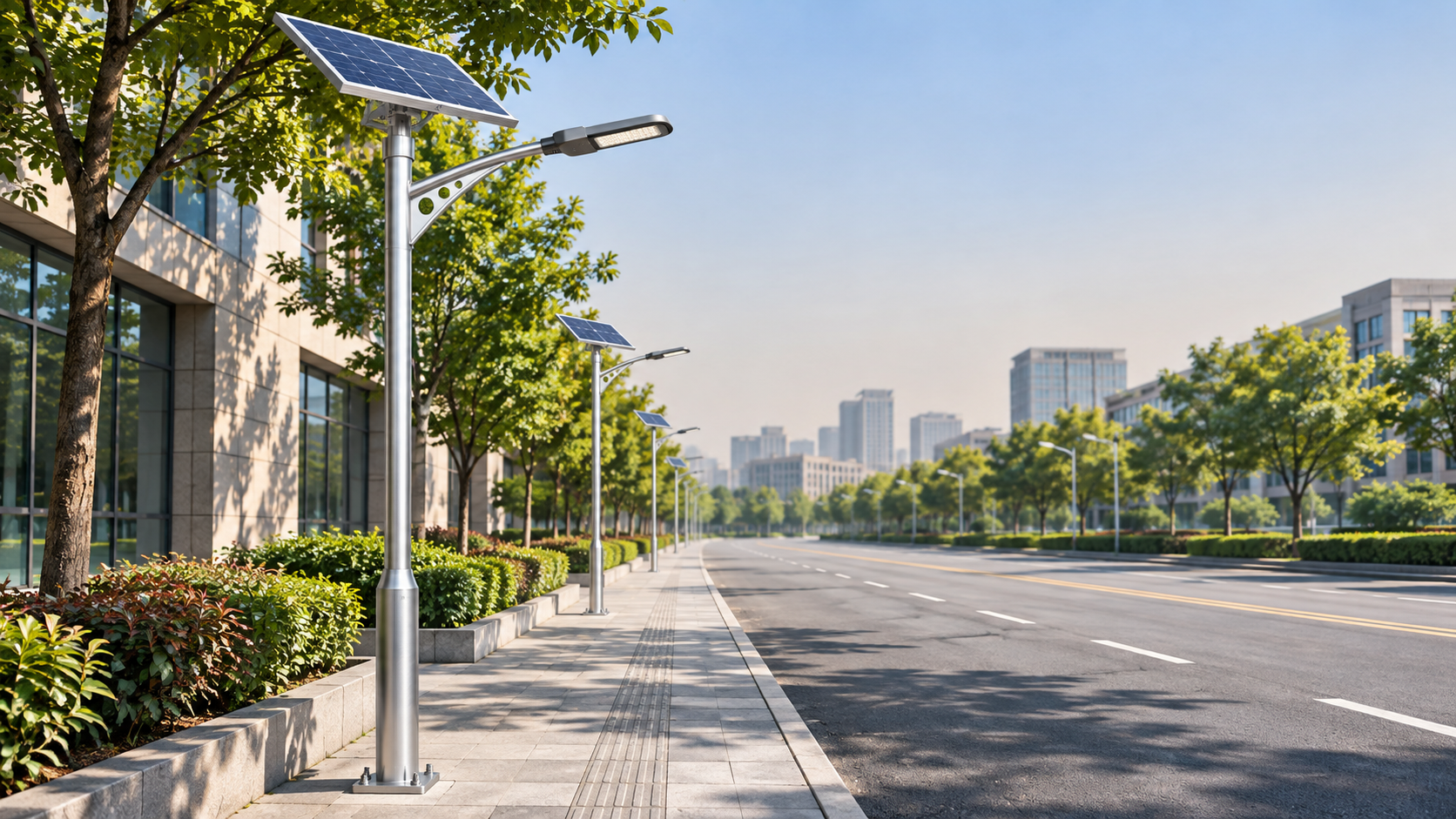
A successful city solar street lighting project depends on more than choosing the right fixtures. Project managers must assess solar exposure, installation conditions, lighting requirements, and control system compatibility before work begins. Overlooking these factors can lead to delays, inconsistent performance, and higher maintenance costs. The most useful site review is not a general confirmation that the street is sunny or accessible; it is a pole-by-pole assessment that identifies where the proposed design may not work.
Start with the lighting task, not the solar panel
A pedestrian path through a park, a residential street, and a busy junction do not need the same lighting solution. Before sizing the solar equipment, establish the required lighting levels, uniformity, operating hours, and any limits on glare or light spill. Confirm the applicable local requirements with the project’s lighting designer or approving authority.
Then check whether the proposed mounting height, spacing, and light distribution can meet those requirements. A layout that works along a straight road may need different optics or additional poles near a crossing. Reducing output late at night can lower energy demand, but the dimming schedule still has to support the intended use of the space and any applicable requirements.
Ask for a lighting calculation based on the actual layout rather than accepting fixture wattage as proof of performance. Include road width, pole offsets, obstructions, and the proposed operating profile. If the calculation only works with wider clearances or different mounting heights than the site permits, the design is not ready.
Map solar exposure at each proposed pole
A site visit at midday can give a misleading impression. Buildings, trees, signs, and elevated structures may shade a panel during part of the day or in a different season. For a long urban corridor, conditions can change considerably from one block to the next. Record potential shading at each location and assess the available solar resource for the panel’s proposed orientation and tilt, including the less favorable season.
Do not assume every pole can carry the same configuration. A shaded location may need a revised panel position, a separately mounted panel where practical, a different pole location, or a grid-connected fixture. If moving a pole solves the charging problem but leaves a crossing underlit, the lighting layout needs to be revisited as a whole.
Access for panel cleaning matters too. Dust, leaves, and bird droppings can reduce collection, while branches that are clear at installation may grow into the panel’s view. Agree who will inspect and maintain the panels before the locations are finalized.
Check the energy balance against the operating plan
The battery and panel should be sized around the actual nightly energy demand, not simply the LED’s rated power. Account for the hours at each output level, control and communication loads, system losses, local solar conditions, and the required period of operation through poor weather. Battery temperature limits, usable capacity, aging, and the manufacturer’s recommended operating conditions also belong in that review.
Request the supplier’s sizing assumptions in writing. In particular, check what happens when stored energy is low: does the system dim, shorten operating hours, or switch off? An automatic energy-saving mode may be useful, but it should not quietly undermine a lighting requirement at a critical location. There is a trade-off between a smaller system and a more conservative reserve; the acceptable balance depends on the site and the consequences of reduced output.
Resolve civil works before equipment is released
Solar lighting can reduce the need for extensive power cabling, but it does not eliminate civil engineering. Confirm underground utilities, property boundaries, pavement construction, drainage, vehicle access, and permission to excavate. A proposed pole position may conflict with a buried service or leave insufficient clear width for pedestrians.
Foundation design should reflect the soil conditions, pole geometry, panel arrangement, and applicable local wind requirements. The panel adds wind-exposed area, so a foundation suitable for a conventional luminaire should not be assumed suitable for a solar assembly. Check the anchor-bolt pattern and base plate against the approved drawings before concrete is poured; correcting a mismatch after curing can disrupt the installation sequence.
Also plan the practical details: safe lifting space, traffic management, delivery access, storage, and protection of finished surfaces. On a constrained city street, these issues can determine whether crews can install the planned number of poles during an approved work window.
Decide where solar makes sense—and where it does not
A mixed approach is often worth considering when a project includes open roads, shaded park edges, and established commercial landscapes. Solar can be attractive where exposure is good and extending a power supply is difficult. In a heavily shaded garden with existing electrical infrastructure, a grid-connected luminaire may be the more straightforward choice.
For example, LED Garden&Lawn Lighting | GLL-LGYC is intended for gardens, parks, and commercial landscapes, with a listed pole height of 3–4 m. Its specified input is AC220V±20%, so it should not be treated as a standalone solar fixture. Using it in a solar-powered arrangement would require a separately engineered compatible power conversion and supply system; a grid-connected design may be simpler where power is already available.
Test controls and handover requirements early
Smart controls can help teams monitor faults and adjust schedules, but compatibility is not automatic. Establish whether the controller, luminaire, battery system, communications network, and management platform can exchange the information the owner needs. Check coverage at the site, access permissions, data ownership, and whether any ongoing connectivity or platform costs are included.
A small field test before full deployment can reveal issues that a specification sheet will not: weak connectivity between buildings, a dimming schedule that does not match site use, or an alarm that maintenance staff cannot interpret. Test local operation as well as remote functions, including what the light does if communications fail.
At handover, the owner should receive as-built pole locations, wiring and foundation records, equipment settings, battery details, maintenance instructions, spare-parts information, and a clear fault-reporting route. Confirm who is responsible for replacing batteries and who can change control schedules. Without those decisions, a technically sound installation can become difficult to maintain.
Lishida Smart Lighting supports project teams with outdoor lighting products, smart controls, and project-based solutions, drawing on its experience with large-scale projects in China. For any proposed installation, the useful next step is to bring the lighting layout, site survey, energy calculations, civil drawings, and controls requirements into one review. Resolve the exceptions pole by pole before placing the full equipment order.
◉ MESSAGE

Blog
- Urban Lighting Solutions: Comparing Grid and Solar-Powered Systems
- Lawn Streetlight EPC Contractors: Assessing Installation Capability
- Dusk-to-Dawn Urban LED Lighting: Photocells vs Astronomical Timers
- Waterfront Pedestrian LED Lighting: Addressing Glare and Salt Air
- LED Street Light Manufacturers: Evaluating Warranty and Support
- Connected Smart Poles: How Connectivity Enables Remote Monitoring
- Solar Highway Lighting: Managing Battery Failures on Remote Roads
Message