
Choosing an LED urban furniture lighting supplier for EU compliance
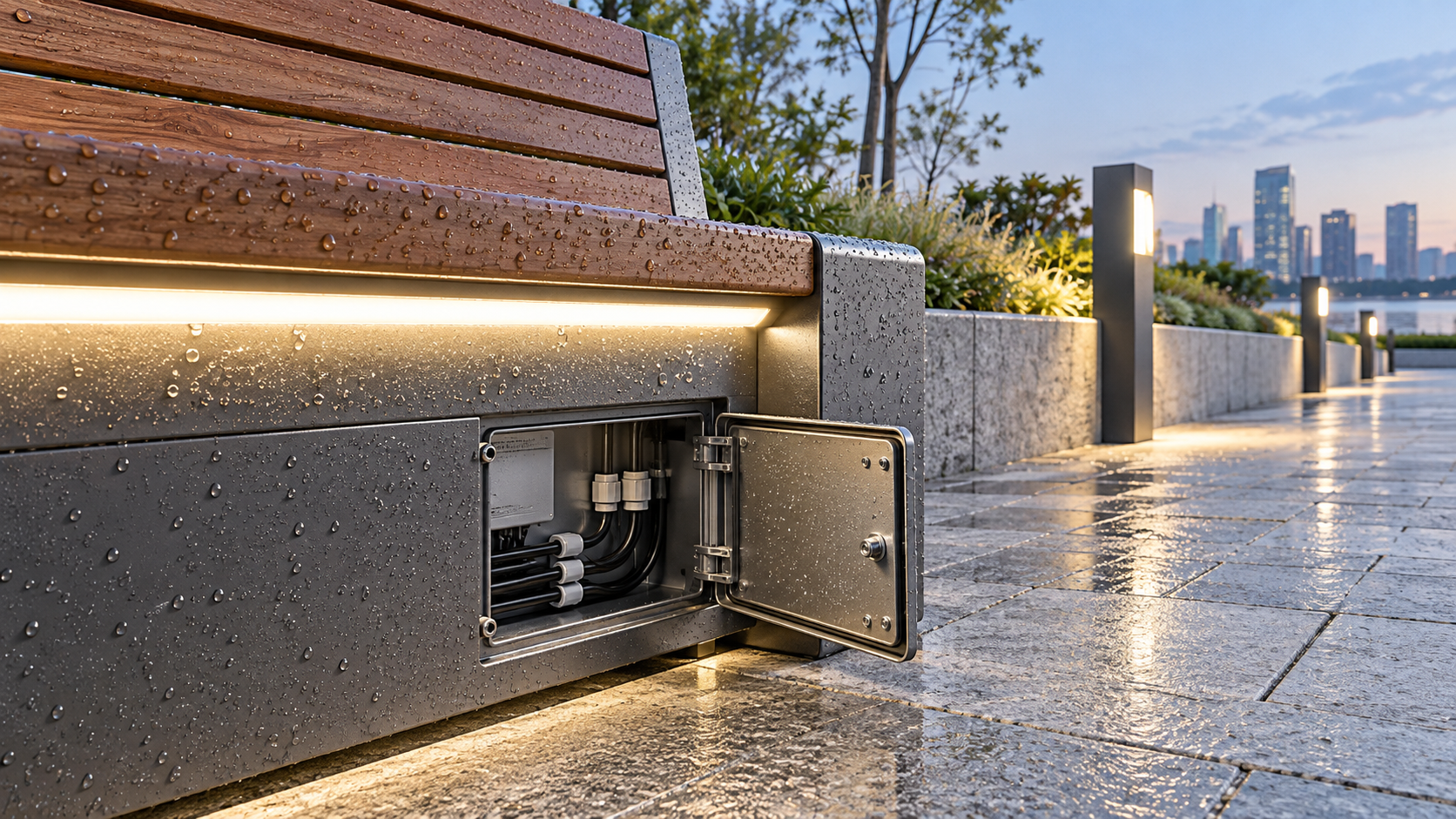
A low quotation for illuminated benches, bollards or integrated public-space lighting is only comparable with another offer when both cover the same compliance responsibilities, installation conditions and maintenance obligations. A CE mark on a catalogue image is not enough: the evidence must match the product configuration that will actually be delivered.
The strongest basis for choosing an LED urban furniture lighting supplier for Europe is a traceable link between the specification, the compliance documentation and the production unit. Establish that link before approving the price. Missing evidence discovered after manufacture can lead to redesign, additional testing, delayed acceptance or equipment that cannot legally be placed on the intended market.
Define the supplied assembly before asking for certificates
“Urban furniture lighting” is not a single regulatory category. A mains-powered illuminated bench, a low-voltage lighting module built into a planter and a wireless-controlled bollard may require different conformity assessments. The purchasing specification should identify the complete assembly, its power supply, control equipment, wiring interfaces and intended installation.
This matters when responsibility is divided between a furniture manufacturer, a lighting factory and a site contractor. A compliant LED driver does not establish compliance of the finished bench. Integration can change heat dissipation, cable protection, earthing, electromagnetic behaviour and access to live parts. Identify who assumes the manufacturer’s obligations for the final supplied product, particularly when it carries the buyer’s own brand.
Ask each bidder to provide an applicability assessment rather than a generic promise of “EU certification.” The relevant requirements can include:
EU product rules do not replace destination-country installation requirements or municipal tender conditions. Required languages, electrical installation arrangements, accessibility considerations and environmental lighting limits should be checked for the actual project location.
Read the evidence against the exact model being purchased
CE marking is generally based on the manufacturer’s conformity assessment and EU Declaration of Conformity, not a universal certificate issued by an EU authority. An independent laboratory report can support that assessment, but its value depends on its scope and connection to the delivered product.
Request the signed declaration, model identification, applicable legislation, referenced standards and supporting reports. The manufacturer must maintain the required technical documentation; the contract should also define which evidence will be supplied to support acceptance and regulatory enquiries.
For luminaires, the EN IEC 60598 series is an important safety reference, with the relevant particular requirements selected for the product. Check the applicable editions and their harmonised status rather than treating any report bearing “EN 60598” as automatically sufficient.
Compare report photographs, ratings and component schedules with the quotation. A test performed on a different enclosure, driver, cable entry or control arrangement may not cover the proposed version. Product-family reports can be valid, but the supplier should explain the variant coverage and the engineering basis for including the ordered configuration.
The decisive question is whether the supplier can demonstrate that the production design remains equivalent to the assessed design. Require notification and approval of changes to safety-critical components, seals, optical materials, power supplies and wireless modules. An unapproved substitution can undermine both compliance evidence and service performance.
Specify outdoor performance separately from legal conformity
Compliance establishes a necessary baseline; it does not establish suitability for every outdoor site. An IP rating describes tested protection against ingress under defined conditions. It does not prove resistance to corrosion, condensation, flooding, impact or every cleaning method.
For lighting integrated into seating or planters, review cable routes, drainage, joint details and access points. Water can enter through an installation interface even when the luminaire itself has a suitable rating. Ask whether ingress evidence covers the complete delivered assembly and whether installation instructions preserve that protection.
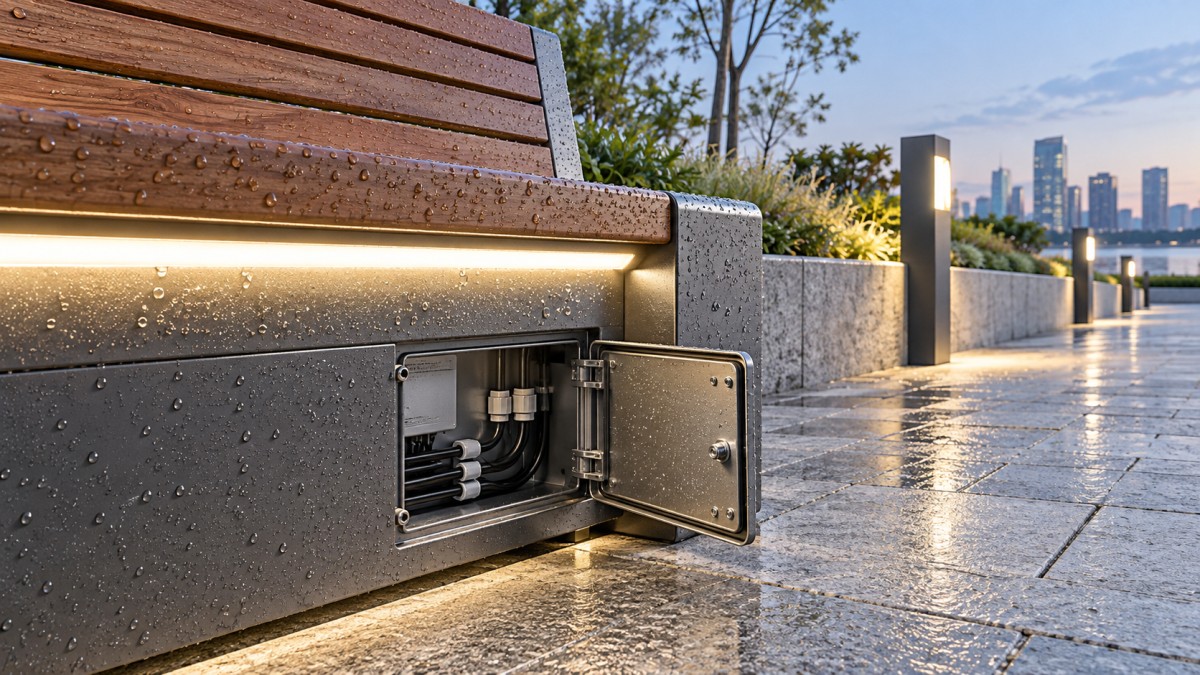
Set site-related acceptance criteria for impact resistance, corrosion protection, ambient temperature and surge protection. Coastal exposure requires evidence relevant to the proposed materials and coatings; a salt-spray duration alone is not a reliable prediction of service life. Surge protection should be coordinated with the site’s electrical design, rather than selected only from a headline component rating.
Request photometric files for the actual optical configuration and review glare, spill light and useful illumination in the installed position. A bright source at seated eye level can be unsuitable even when its lumen output meets the schedule. For decorative furniture lighting, visual comfort may matter more than maximum output.
Different equipment in the same public-space package also needs separate evaluation. The GSTYD001 LED Beam Projector, for example, is specified as a 420 W, IP65 fixture with a 2–30° beam and DMX512 control for landmark, event and architectural applications. Those characteristics describe a different duty from low-level bench illumination. Its IP rating and control protocol alone do not establish EU compliance, suitability near seated users or integration with a municipal control platform.
Make quotations comparable over the maintenance period
The cheapest delivered assembly can become the more expensive installation if a failed driver requires removing furniture, opening paving or returning the entire unit. Compare access arrangements and replacement procedures before assigning value to warranty length.
A useful evaluated-cost comparison includes purchase and transport, import costs, installation labour, controls commissioning, energy consumption, planned maintenance, replacement parts and disposal responsibilities. Keep the assumptions consistent across bidders. Energy calculations should use declared system input power and the intended operating schedule, including dimming and standby consumption where relevant.
Separate projected LED lumen maintenance from complete-product reliability. LED package data does not establish the lifetime of the driver, seals, connectors or control electronics inside the finished enclosure. Request thermal evidence for the proposed configuration and clarify what any lifetime claim measures.
Warranty wording should identify who pays for diagnosis, replacement freight, removal, reinstallation and recommissioning. Also establish spare-part availability, replacement compatibility and whether opening the enclosure for authorised maintenance affects warranty coverage.
For connected products, include software and service costs. Confirm operation if the cloud connection fails, access permissions, ownership of configuration data and the process for replacing a controller. A shared protocol name does not guarantee interoperability; acceptance testing should use the intended gateway and management system.
Tie production approval and payment to verifiable deliverables
A factory’s capacity figures are less useful than its ability to control the ordered configuration. Ask how serial or batch numbers connect finished units to component records, inspections and test results. Review routine electrical safety checks, sealing controls and the handling of nonconforming units.
Approve a representative sample with the specified driver, finish, connectors and controls before mass production. Record it as the reference configuration, while recognising that sample approval does not replace conformity assessment. Where performance depends on furniture integration, approve the integrated assembly rather than a loose lighting module.
The purchase contract should connect release and acceptance milestones to defined evidence: approved drawings, the agreed documentation package, sample acceptance, inspection records and commissioning results. State who bears the cost of retesting after supplier-initiated changes and how discrepancies will be corrected.
A supplier offering a low unit price but leaving documentation, integration and field replacement undefined is not offering the same scope as one that includes them. Award decisions become more defensible when every bidder is assessed against the same finished configuration, evidence requirements and maintenance obligations—and when those commitments remain enforceable after delivery.
◉ MESSAGE

Blog
- How to avoid vendor lock-in in a government smart lighting project
- Sizing the communications power budget for smart city solar street lights
- How energy-saving mode affects solar bollard light operating time
- Comparing lead times from LED street light luminaire suppliers in Europe
- What spare parts support should a smart street light exporter offer?
- Where to place a solar garden light in a partially shaded garden
- Which battery alerts matter in remotely monitored solar street lighting?
Message