
Choosing a beam angle for commercial flood lighting in loading yards
Choosing a beam angle for commercial flood lighting in loading yards
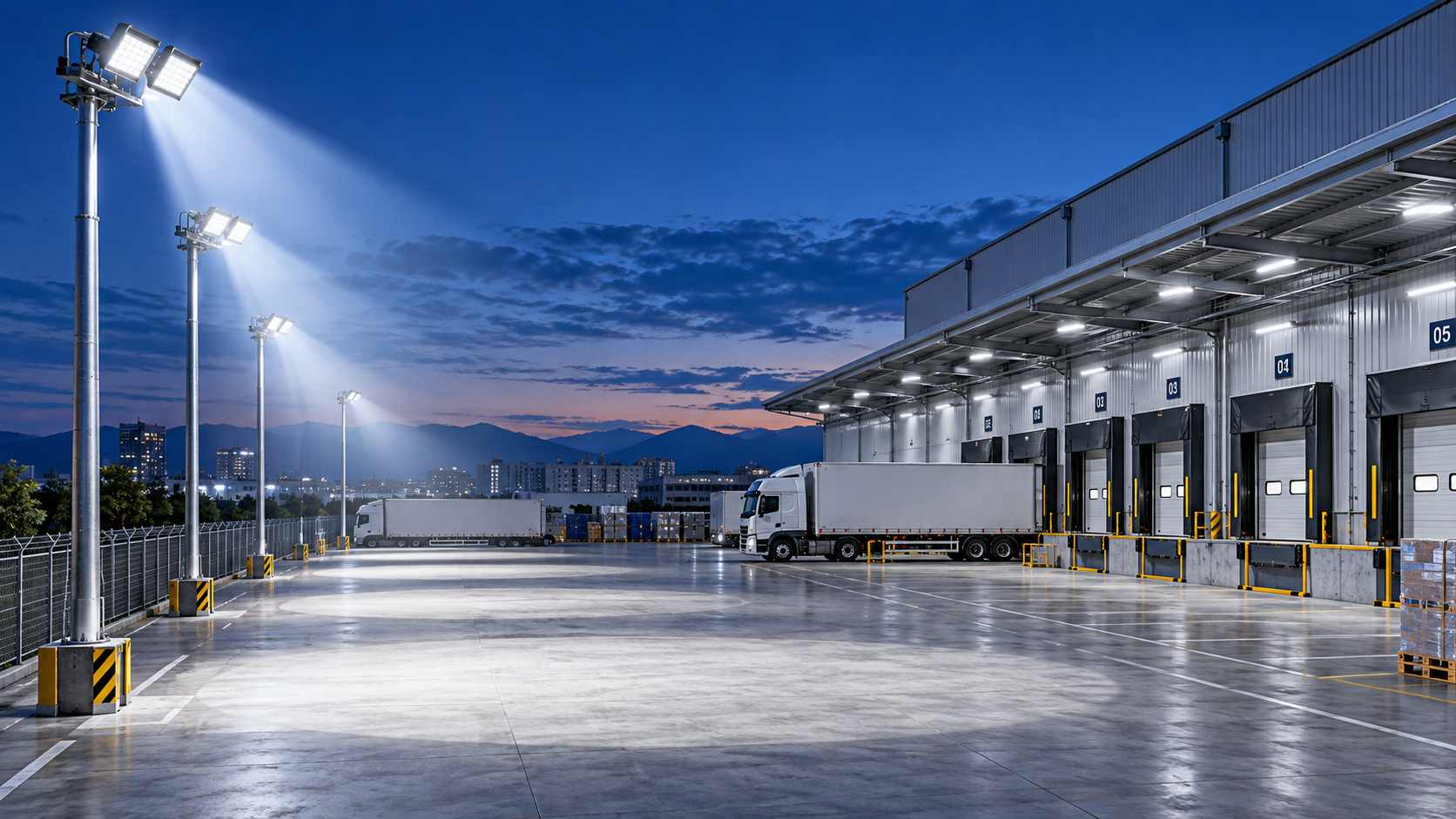
Choosing the right beam angle for commercial flood lighting in loading yards means balancing coverage, visibility, and glare—not simply selecting the widest distribution. Mounting height, pole spacing, vehicle movements, and loading-bay geometry determine where light is useful. A bright pavement does not necessarily mean a driver can see a banksman beside a trailer, or that a forklift operator can judge the edge of a dock.
The practical task is to compare optical distributions against the actual yard layout. Start with the work areas and sightlines, then use photometric calculations to decide which beam shapes, aiming positions, and mounting arrangements deserve approval.
Map the work before comparing beam angles
A loading yard rarely has one lighting requirement. The reversing apron needs usable visibility across vehicle paths; the dock face needs attention to people, equipment, and changes in level; the perimeter may need tighter spill control. Treating these as one large rectangle often produces excessive brightness near poles and weak visibility behind parked trailers.
Mark the following on the layout before reviewing luminaires:
- Dock edges, trailer parking positions, reversing routes, and pedestrian crossings.
- Available mounting points, mounting heights, and structural restrictions.
- Canopies, parked vehicles, and other objects that can block light.
- Neighbouring windows, public roads, and boundaries where spill must be controlled.
Include normal occupied conditions, not just an empty-yard drawing. A beam that crosses the yard successfully before vehicles arrive may be intercepted by the first row of trailers. Changing the beam angle alone will not solve that problem; another mounting position or local task lighting may be necessary.
What the beam-angle number actually tells you
Beam angle commonly describes the angular width between directions where luminous intensity falls to half its peak value. Check the manufacturer’s definition, particularly when comparing beam angle, field angle, and distribution labels. None of these describes a hard boundary beyond which no light exists.
For a symmetrical beam aimed vertically downward onto level ground, a useful preliminary relationship is:
Nominal beam width = 2 × mounting height × tan(beam angle ÷ 2).
As a geometry example, a 10 m mounting height gives a nominal width of about 11.5 m for a 60° beam and 20 m for a 90° beam. These are not guaranteed adequately lit areas. They describe the projected beam-angle limits under simplified conditions, not compliance with an illuminance requirement.
Once the floodlight is tilted, the footprint stretches and the far end becomes harder to illuminate. Horizontal illuminance depends on intensity in the relevant direction, distance, and incidence angle. That is why selecting a wider optic from a catalogue cannot replace a calculation.
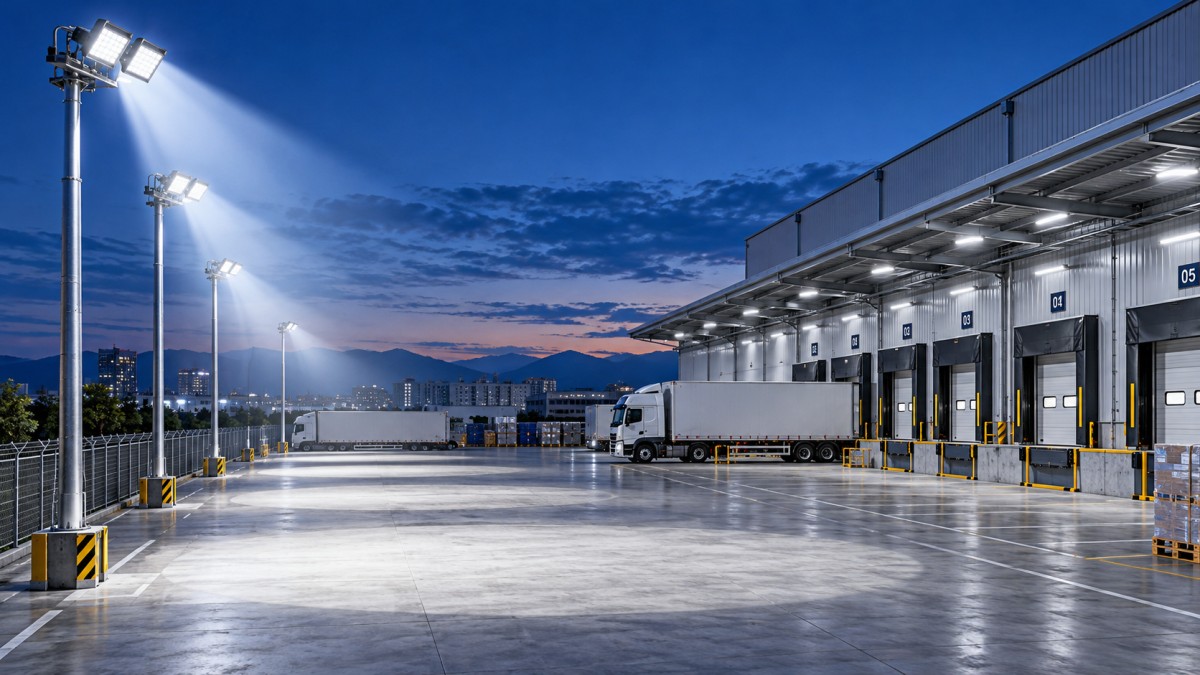
An asymmetric optic also needs more than one angle to describe it meaningfully. Request the horizontal and vertical intensity distributions and confirm their orientation. A rectangular distribution installed with the wrong rotation can send useful light across the wrong dimension of the yard.
Choose the distribution around the throw
A narrower beam is worth evaluating when a mounting point must serve a distant, defined area. It concentrates intensity, but can create a conspicuous bright patch with weak surrounding coverage. Avoid solving the farthest point while leaving the approach route uneven.
A wider distribution can suit nearby open areas where a shorter throw is sufficient. The trade-off is less directional concentration and potentially more light outside the working zone. Increasing wattage to recover distant illumination may then overlight the foreground.
For poles along a yard boundary, an asymmetric forward-throw optic is often a sensible candidate because it can direct light into the yard without relying entirely on steep fixture tilt. It still needs verification: “asymmetric” does not automatically mean low glare or zero backlight.
Mixed distributions may be preferable to one optic throughout the site. Dock approaches, open manoeuvring space, and narrow side lanes have different geometry. Standardising the luminaire platform can simplify maintenance without forcing every position to use identical optics.
Compare calculations that expose the weak points
Request an IES or LDT photometric file for the exact luminaire, output, and optic being proposed. A file from another power setting or optical variant can invalidate the comparison. Confirm mounting coordinates, tilt conventions, and any shields included in the model.
Compare alternatives using the same calculation grids, maintenance assumptions, and operating conditions. Otherwise, an apparently better result may simply reflect more optimistic inputs.
- Horizontal illuminance: inspect minimum values and uniformity across actual working areas, not only the site-wide average.
- Vertical illuminance: check relevant planes where people, vehicle sides, and dock features must be seen.
- Glare and sightlines: assess approaching drivers and reversing positions using the applicable project criteria and representative viewing directions.
- Boundary effects: review spill at sensitive locations and upward light in the installed orientation.
Set acceptance criteria from the applicable local requirements and the site’s operational risk assessment. There is no single illuminance target that suits every loading yard. Calculation grids should also capture dock edges and gaps between beams; a coarse grid can hide precisely the weak spots that matter.
Keep ancillary lighting separate from the floodlighting decision
Landscaped entrances or pedestrian areas beside a logistics facility may justify a different luminaire family. For example, LED Garden&Lawn Lighting | GLL-TY is intended for gardens, parks, and commercial landscapes, with listed pole heights of 3.5–4.5 m and rated power of 45–75 W. Its hot-dip galvanised and powder-coated construction is relevant to outdoor exposure, but does not establish suitability for vehicle manoeuvring areas.
Use that distinction when reviewing a combined site package: landscape lighting can support adjacent spaces, while loading-yard floodlights need their own optical assessment. An IP rating or wattage cannot substitute for verified distribution data.
Approve an installable scheme, not just a simulation
Record the selected optic, aiming direction, tilt, bracket arrangement, and shielding for each mounting position. Check that installers can reproduce those settings and that maintenance teams can restore them after replacement. Small aiming changes can move a concentrated beam away from its intended task area.
Lishida Smart Lighting’s integrated support across outdoor products, smart controls, and project-based solutions is relevant here: optical selection needs to remain coordinated with installation and long-term operation. Its large-scale project experience across China provides context for that delivery approach, while each yard still requires site-specific verification.
If dimming is proposed, verify the reduced-output scene rather than assuming the full-output assessment covers it. Before final acceptance, inspect the installed commercial flood lighting with representative vehicle positions, measure against the agreed criteria, and check driver sightlines. The right beam angle is the one that delivers usable visibility in those conditions—not the one with the largest coverage claim.
◉ MESSAGE

Blog
- How to avoid vendor lock-in in a government smart lighting project
- Sizing the communications power budget for smart city solar street lights
- How energy-saving mode affects solar bollard light operating time
- Comparing lead times from LED street light luminaire suppliers in Europe
- What spare parts support should a smart street light exporter offer?
- Where to place a solar garden light in a partially shaded garden
- Which battery alerts matter in remotely monitored solar street lighting?
Message