
When is solar a practical option for LED garden and lawn lighting?
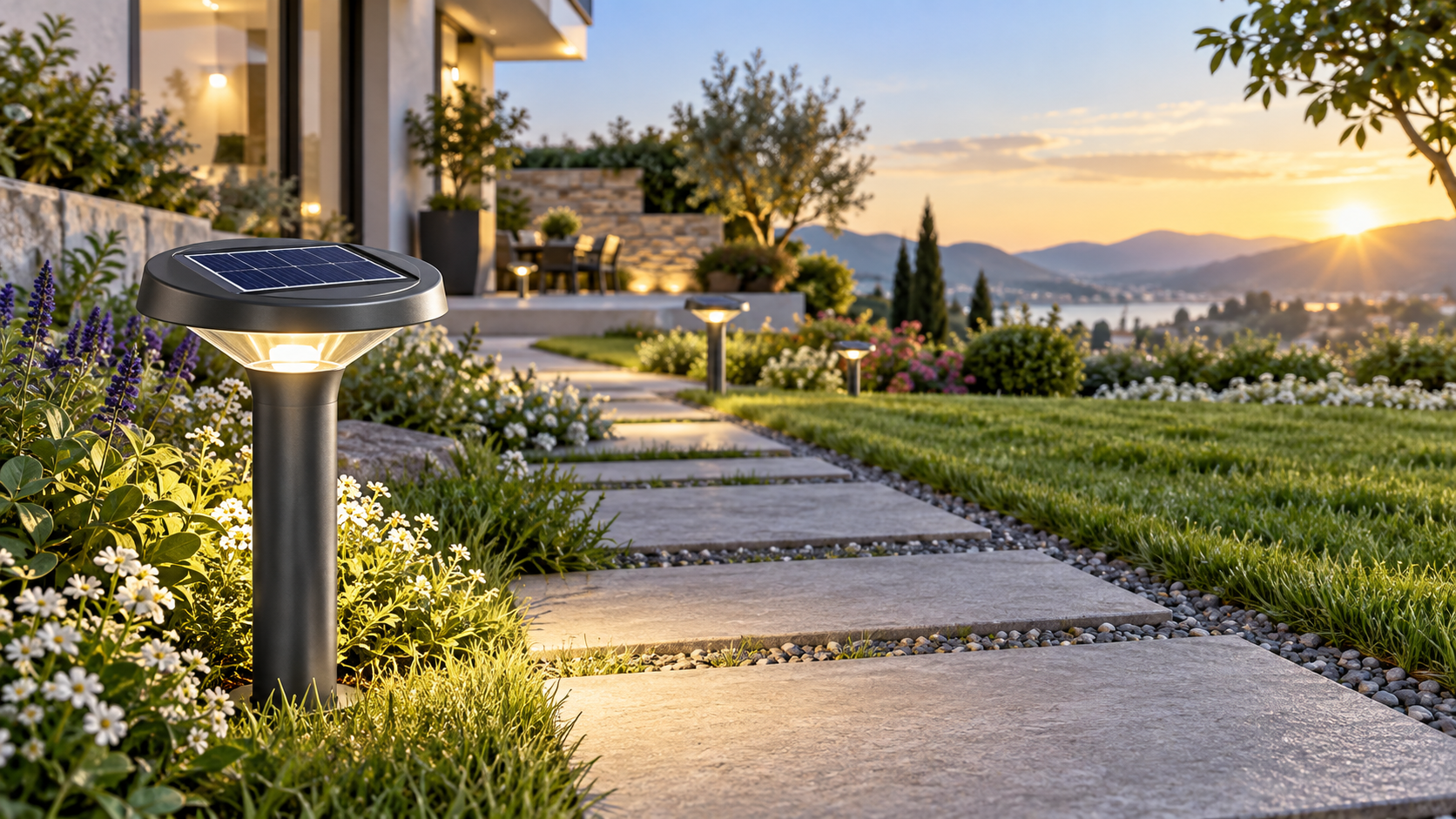
Solar is a practical option for LED garden and lawn lighting where panels receive dependable sunlight, the lighting schedule fits the available energy, and avoiding new electrical cabling offers a clear installation advantage. It is less suitable beneath dense tree cover or where uninterrupted brightness must continue through extended cloudy weather without backup power.
The useful starting point for evaluating LED garden and lawn lighting with a solar option is a defined lighting requirement: which surfaces need illumination, at what level, and for how long. A fixture that remains visibly lit until dawn has not necessarily delivered adequate light throughout the night.
Where avoiding a cable run creates real value
Detached planting beds, garden extensions, and paths beyond existing electrical infrastructure are strong candidates. Cable installation across finished paving, established lawns, or tree root zones can involve substantial excavation and reinstatement. Solar becomes attractive when individual fixtures can meet the lighting requirement without those works.
The comparison changes where an accessible lighting circuit already follows the path. Short connections to existing infrastructure can make grid power more straightforward, particularly when many closely spaced fittings need the same operating schedule. Compare complete installation scopes, including foundations, panel supports, cable protection, commissioning, and surface restoration.
Solar also requires space. A compact lawn light with an integrated panel has limited collection area. Increasing brightness or operating hours requires a corresponding increase in energy collection and storage, which can change the fixture’s size and appearance.
Assess sunlight at the panel’s actual position
An open lawn does not guarantee a useful solar location. A low panel beside a hedge may lose several hours of sunlight even when the surrounding area looks bright. Buildings, boundary walls, and tree canopies cast different shadows as the sun’s position changes through the year.
Base the assessment on the season with the tightest energy balance. In many locations, shorter days coincide with longer lighting hours. Local rainy seasons, persistent cloud, or snow cover can create a different limiting period. Annual average sunshine can conceal the conditions that determine whether the lights remain dependable.
Evaluate the proposed panel position at its installed height and orientation. Include mature planting dimensions, seasonal foliage, and planned landscape changes. A location that works before shrubs establish can become unsuitable later.
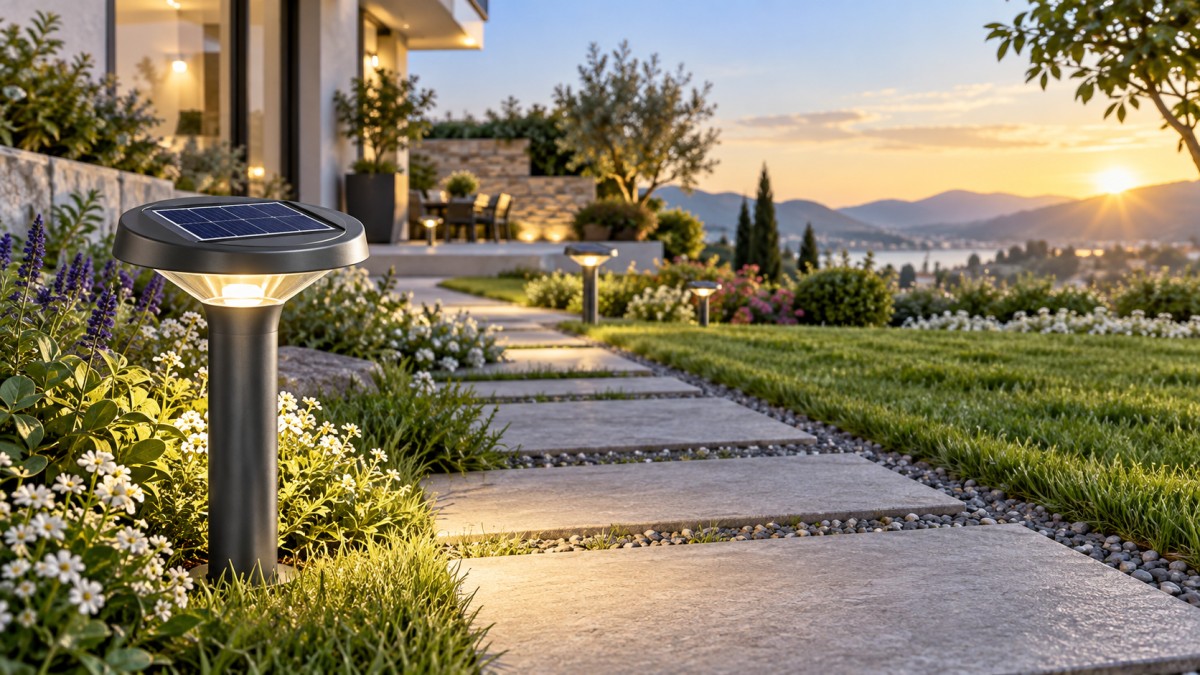
A separate panel can resolve a shaded fixture location by collecting sunlight elsewhere. That arrangement introduces cable routing, voltage-drop considerations, mounting requirements, and additional connections. Establish the permitted panel-to-fixture distance from the electrical design; remote placement does not remove all installation constraints.
Translate the lighting schedule into an energy budget
Panel wattage, battery capacity, and advertised runtime describe different things. They become useful only when connected through a daily energy calculation. Begin with electrical input power at each programmed output level, including the consumption of controls and sensors.
Nightly energy demand equals the sum of power multiplied by operating time for each lighting period. For an illustrative schedule, a fitting drawing 4 watts for five hours and 1 watt for seven hours uses 27 watt-hours before any additional control consumption or losses. These figures describe a hypothetical load, not a recommended lighting specification.
Three nights of autonomy at that schedule would require 81 watt-hours of usable stored energy before additional allowances. The battery’s nominal capacity must be higher where discharge limits, conversion losses, low temperatures, and capacity loss with age reduce available energy.
Compare batteries in watt-hours. An amp-hour figure without voltage cannot establish stored energy. Also distinguish nominal capacity from the capacity available within the controller’s permitted operating range.
The panel must replenish the energy consumed during the limiting season. A preliminary estimate multiplies panel rated power by site-specific peak sun hours, then applies appropriate system losses. Peak sun hours represent equivalent solar energy, not the number of daylight hours. Shading and poor orientation need explicit treatment.
Recovery after cloudy weather matters as much as autonomy. If normal daily generation only replaces one night’s consumption, a depleted battery has little opportunity to recover while the same schedule continues. The design needs surplus charging capacity, a temporary reduced-output mode, or backup power.
Decide which lighting changes are acceptable
Solar works well when the operating schedule follows actual use. A garden that closes in the evening can use a shorter lighting window than a path requiring illumination until morning. Reducing unnecessary operating hours often changes feasibility more effectively than increasing battery size alone.
Motion-responsive lighting offers another way to reduce consumption, provided the standby level remains appropriate and detection works across the intended approach routes. Frequent activation on a busy path can consume much more energy than a calculation based on occasional movement.
Automatic dimming needs particular attention. Some fixtures preserve runtime by reducing output as battery charge falls. That behavior is acceptable only if the reduced level still meets the agreed lighting requirement. Specify the minimum maintained output and the conditions under which the controller changes brightness.
Optics affect the energy requirement too. A controlled distribution that illuminates the path can achieve a better result than a brighter fitting spilling light into vegetation. Assess spacing, mounting height, glare, and illumination on the relevant surface together; lumen output alone cannot establish suitability.
Landscape projection should have a separate load assessment. A Laser Engineering Projector used for building or landscape imagery has a different purpose from a lawn luminaire. Its stated 8000 ISO lumens describe projection brightness, not electrical demand; those figures cannot establish compatibility with a solar lighting circuit.
Account for the conditions around the battery and enclosure
Adequate sunlight does not guarantee successful charging in every temperature. Battery chemistry and protective controls determine the permitted charging and discharging ranges. Where winter temperatures fall below the allowed charging range, the design needs suitable thermal provisions or a different power arrangement.
Heat also affects the installation. Battery compartments exposed to strong sun need assessment at expected internal temperatures, rather than ambient temperature alone. An enclosure’s ingress rating does not establish its thermal performance or resistance to prolonged standing water.
Garden fittings face irrigation spray, wet soil, grass clippings, and maintenance equipment. Position panels where routine landscaping will not bury or repeatedly contaminate them. Keep serviceable compartments accessible, and assess drainage around low-mounted fixtures. Cleaning and battery replacement become expensive when access requires disturbing planting or removing the entire fitting.
Choose the power arrangement by zone
A mixed site rarely needs one power strategy everywhere. Open lawn edges with modest evening lighting requirements can suit standalone solar fixtures. Shaded paths near existing circuits often favor grid power. Locations with useful sunlight but demanding continuity requirements warrant assessment of a properly engineered hybrid arrangement.
Hybrid operation requires defined behavior: when backup power engages, how charging is managed, and what happens after either supply fails. Adding a backup connection to an unsuitable standalone fixture is not a substitute for a compatible electrical design.
Before accepting a solar configuration, require a documented lighting schedule, seasonal energy calculation, usable battery capacity, and low-charge behavior. A representative installation can then test shading assumptions, actual charging, illumination, and controller settings. A clear-weather demonstration establishes only those conditions; performance through the limiting season needs supporting calculations and, where feasible, observation during that period.
Acceptance criteria should state the required light level and duration, permitted dimming, autonomy conditions, and recovery expectations. Those requirements make it possible to judge whether solar delivers the intended garden lighting throughout its operating cycle.
◉ MESSAGE

Blog
- How to avoid vendor lock-in in a government smart lighting project
- Sizing the communications power budget for smart city solar street lights
- How energy-saving mode affects solar bollard light operating time
- Comparing lead times from LED street light luminaire suppliers in Europe
- What spare parts support should a smart street light exporter offer?
- Where to place a solar garden light in a partially shaded garden
- Which battery alerts matter in remotely monitored solar street lighting?
Message