
What Determines the Real Service Life of an Outdoor LED Floodlight?
What Determines the Real Service Life of an Outdoor LED Floodlight?
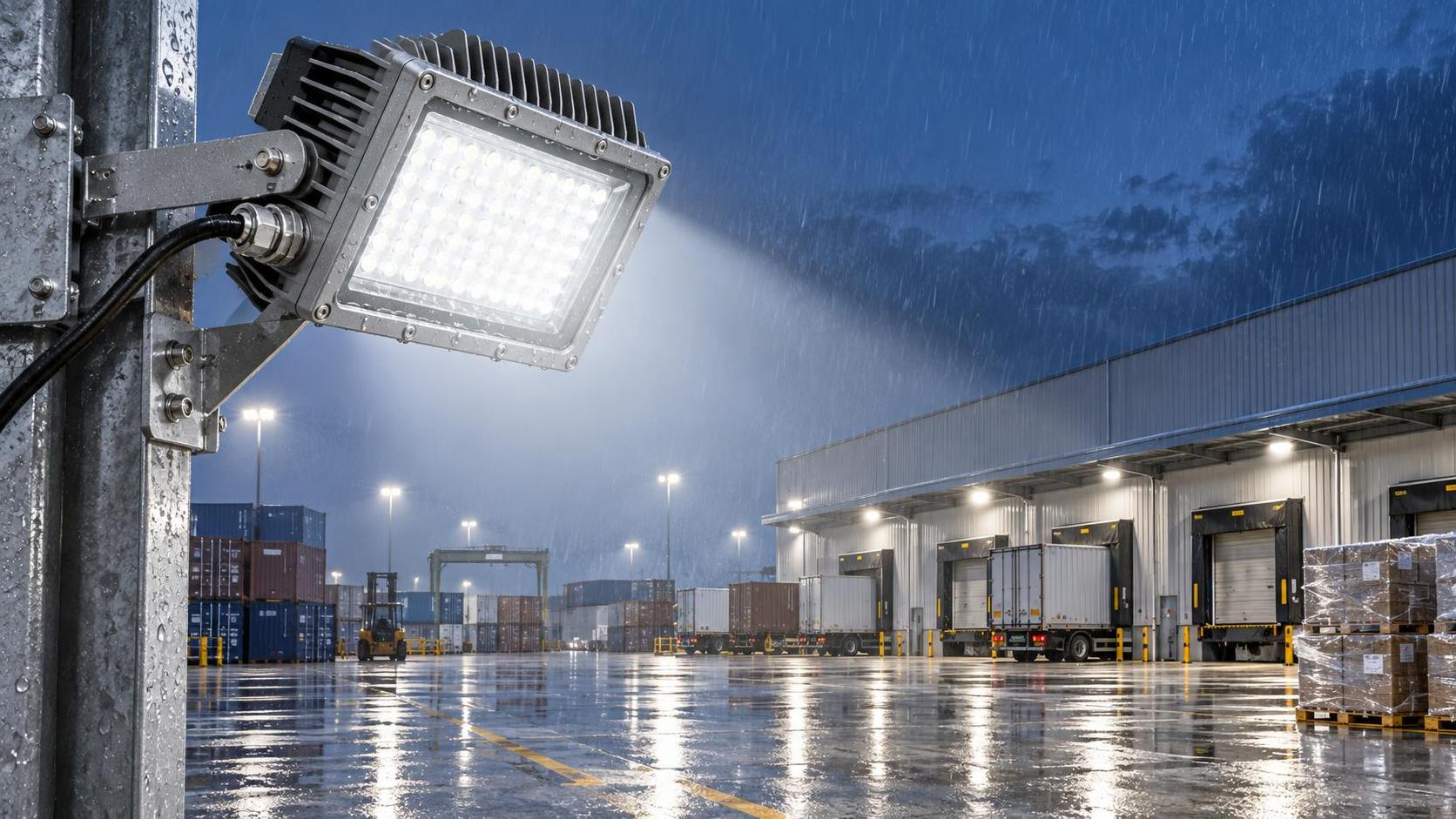
The real service life of an outdoor LED floodlight with long lifespan is rarely determined by the LED chip alone. Rated figures such as “50,000 hours” can be useful for comparing products, but they do not guarantee that a complete luminaire will keep delivering safe, stable, and usable light for that period in the field.
For quality-control and safety teams, the practical question is more demanding: how long will the floodlight maintain its required illumination, electrical safety, weather resistance, and control function after repeated heat, rain, dust, vibration, voltage variation, and maintenance activity? A fixture may still switch on after several years, yet already be unsuitable for a road junction, loading yard, public square, or industrial perimeter if light output has fallen too far or water ingress has created a safety risk.
Rated LED Life Is Only One Part of the Picture
LED lifetime is often expressed as lumen maintenance, commonly discussed through terms such as L70: the point at which light output has declined to 70% of its initial level. That is not the same as the service life of the floodlight. A luminaire can fail much earlier because its driver fails, seals age, connectors corrode, surge protection degrades, or the thermal path becomes ineffective.
This distinction matters during incoming inspection and project approval. A supplier may provide a credible LED package specification, but the project team should still ask how the complete assembled product manages temperature, moisture, electrical transients, cable entry, and replacement parts. In outdoor lighting, the weakest subsystem often sets the actual maintenance cycle.
A useful procurement habit is to separate three questions: How long will the LEDs retain light? How long will the power supply remain stable? And how long will the enclosure protect both? If one answer is vague, the claimed lifetime deserves closer review.
Heat Is the Most Persistent Lifetime Problem
Heat management is usually the first technical issue to examine. Floodlights are frequently mounted high on poles, building façades, gantries, or steel structures where airflow is inconsistent. A black housing exposed to direct afternoon sun may begin operation already hot. In enclosed courtyards, near machinery, or on industrial sites, ambient temperature can stay elevated well into the evening.
High junction temperature accelerates LED lumen depreciation and puts additional stress on driver components, particularly capacitors. A large finned housing does not automatically prove good thermal design. The quality team should look for a credible heat path from the LED board to the housing, firm mechanical contact, suitable thermal interface material, and a design that does not trap dirt between cooling fins. In dusty zones, a design that performs well in a clean laboratory can lose thermal margin after a season outdoors.
Wattage selection also deserves restraint. Using a higher-power floodlight than the lighting design requires may create unnecessary heat and glare. Better optics, mounting geometry, and beam distribution can sometimes achieve the required target illuminance with a lower thermal burden.
IP Protection Must Be Read Beyond the Label
An IP rating is important, but it is not a blanket promise that the luminaire will survive every outdoor condition. The first digit addresses protection against solid objects and dust; the second concerns water ingress under defined test conditions. It does not automatically cover poor cable termination, repeated pressure washing, standing water around a damaged gland, or long-term UV ageing of seals.
In real inspections, water often enters through details rather than through the main housing: a cracked gasket, an improperly tightened cable gland, a downward-facing connector that was installed upward, or a cable loop that guides rainwater into the entry point. Condensation is another overlooked issue. Daily temperature swings can draw humid air into an enclosure; if the product cannot manage pressure changes appropriately, moisture may accumulate over time.
For coastal roads, ports, chemical-adjacent areas, and mining operations, corrosion resistance needs its own review. Salt, pollutants, and abrasive dust can attack fasteners, brackets, coatings, and electrical contacts. The housing may look intact while the aiming bracket or cable hardware becomes the real reliability concern. Material selection and finishing should therefore be checked as part of the safety assessment, not treated as cosmetic details.
Driver Reliability and Surge Exposure Decide Many Field Failures
The driver is commonly the component that determines whether an outdoor LED floodlight with long lifespan delivers on its promise. It must operate through voltage fluctuation, switching events, heat cycles, and, in some locations, frequent electrical disturbances. A driver that works reliably in a controlled test environment may be poorly matched to a rural feeder, an industrial distribution network, or a site with unstable power quality.
Surge protection requires a project-level view. A surge protective device inside the luminaire can help, but it is not a substitute for proper earthing, bonding, cable routing, and coordinated protection in the wider installation. Long cable runs, exposed poles, and areas prone to lightning activity deserve special attention. After a surge event, a floodlight may appear functional while its protection capacity has been reduced; maintenance procedures should account for this possibility where surge exposure is significant.
Quality teams should also verify driver accessibility. If the driver is not practically replaceable, a relatively small electrical failure can turn into a full luminaire replacement, with added work-at-height exposure and traffic-management costs.
Installation Can Shorten Life Before the First Night of Operation
A well-built floodlight can still be compromised by installation. Incorrect torque on mounting bolts, cable strain, poor grounding, blocked drainage, incorrect aiming, or an incompatible dimming connection all create avoidable failure paths. On tall poles, vibration from wind or nearby traffic can gradually loosen hardware if the bracket and fasteners are not suited to the structure and loading conditions.
There is also a safety trade-off in aiming. Tilting a floodlight beyond the intended position may increase glare, expose seals more directly to rain, and create higher wind loading. The lighting layout should be reviewed before installation rather than corrected later through improvised bracket adjustments.
Commissioning should include more than a switch-on test. Inspectors should confirm electrical continuity and earthing as applicable, check cable glands and connector engagement, record aiming angles, observe dimming or control response, and verify that no housing is in contact with a surface that restricts heat dissipation. These checks are simple, but they catch failures that would otherwise appear months later.
Controls Need to Be Compatible, Not Merely Connected
Smart control systems can extend practical service life by avoiding unnecessary full-power operation, but only when the driver, control interface, and operating strategy work together. Dimming profiles should respect the driver’s stated capability. Frequent switching, incompatible control signals, or poorly configured schedules can cause flicker, nuisance faults, or premature component stress.
This becomes especially relevant in large projects where lighting includes both grid-connected floodlights and independent road or area lighting. For off-grid locations, power-system reliability is inseparable from luminaire reliability. A hybrid arrangement may be more appropriate than relying on one energy source in areas with weak grid access or variable sun exposure. For example, Wind-Solar Hybrid Street Lighting | SHL-003 combines solar input, wind generation, lithium battery storage, and an MPPT hybrid controller for applications such as coastal roads, remote sites, high-wind regions, and industrial areas. Its available configurations should still be matched to local weather, load profile, mounting height, and maintenance access rather than selected by nominal power alone.
What to Review Before Accepting a Floodlight
The most reliable projects do not rely on a single lifetime claim. They review the complete operating environment and request product documentation that can be tied to the delivered configuration. In practice, acceptance checks should cover the LED and driver combination, housing and heat-sink construction, ingress-protection details, cable and connector specification, corrosion-prone hardware, surge and grounding provisions, optical distribution, and any control-system compatibility.
For roads, public spaces, and complex urban environments, consistency across batches is just as important as the specification of one sample. Lishida Smart Lighting supports contractors and project owners with integrated lighting products, smart controls, and project-based planning, where product selection must align with installation realities and long-term system integration. That practical connection between manufacturing, engineering, and field execution is where lifetime expectations become more credible.
The best way to judge service life is not to ask, “How many hours is the LED rated for?” Ask what will happen to the complete luminaire on the hottest day, during driving rain, after a power disturbance, and when a technician needs to service it at height. The answers to those questions usually reveal whether the floodlight is built for dependable outdoor operation or only for an attractive datasheet.
◉ MESSAGE

Blog
- How to avoid vendor lock-in in a government smart lighting project
- Sizing the communications power budget for smart city solar street lights
- How energy-saving mode affects solar bollard light operating time
- Comparing lead times from LED street light luminaire suppliers in Europe
- What spare parts support should a smart street light exporter offer?
- Where to place a solar garden light in a partially shaded garden
- Which battery alerts matter in remotely monitored solar street lighting?
Message