
Integrated Smart Pole Planning: Power, Connectivity, and Maintenance Access
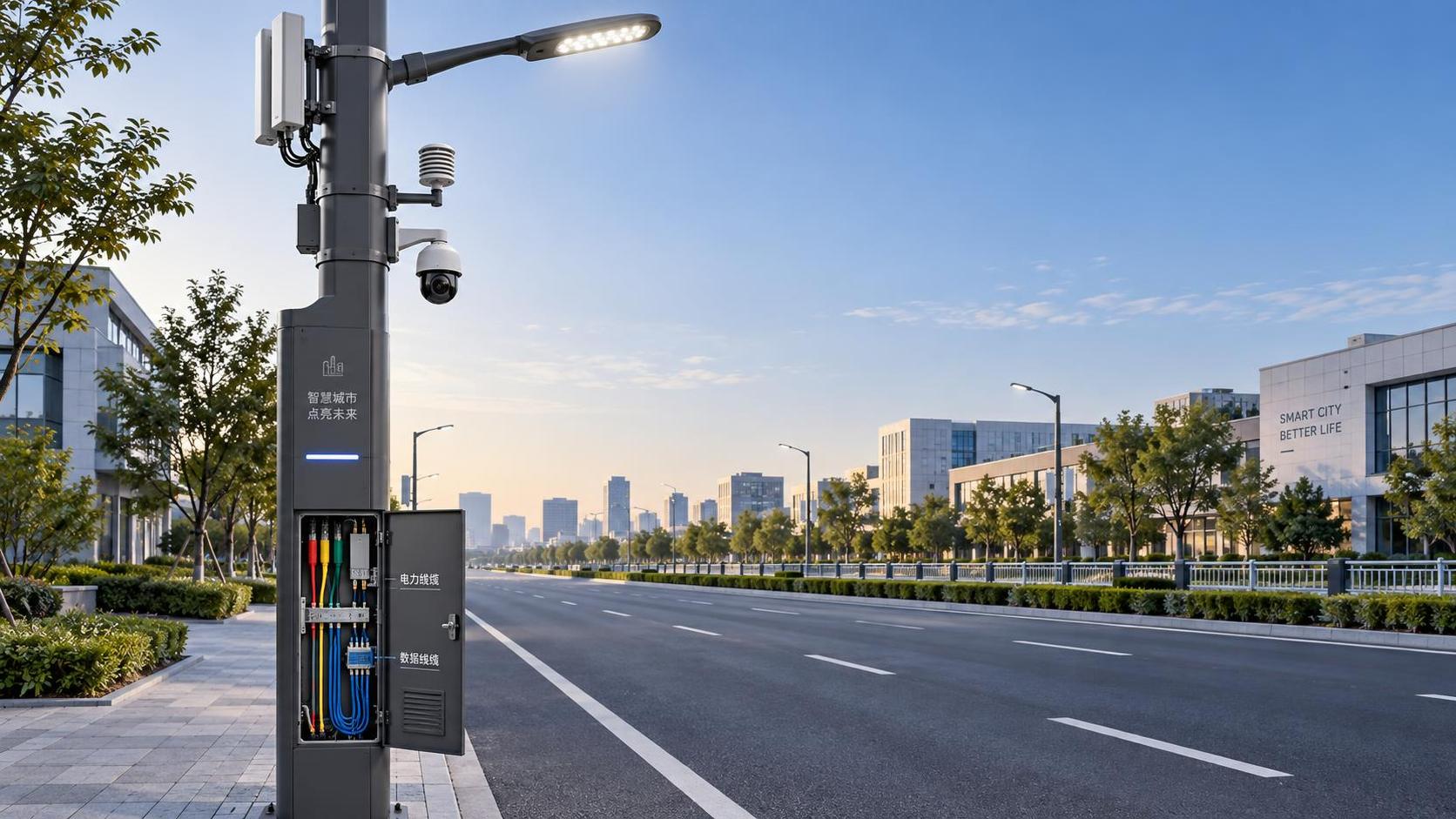
Integrated Smart Pole Planning: Power, Connectivity, and Maintenance Access
An integrated smart pole is often introduced as a visible part of a smart-city program: one structure carrying street lighting, communication equipment, cameras, sensors, public-address devices, or other urban services. For project managers, however, the difficult work is rarely the device list. It is coordinating structural loading, electrical distribution, data pathways, access arrangements, and long-term ownership before civil works and procurement lock the project into an inflexible design.
Outdoor lighting remains the foundation of many installations. It operates every night, requires dependable power, and determines the pole’s height, outreach, orientation, and spacing. Once other functions are added, the pole becomes a small piece of infrastructure rather than simply a lighting support. Early planning is what prevents a seemingly compact solution from creating crowded enclosures, difficult cable routing, inaccessible components, or capacity limits that emerge only after commissioning.
Start With a Functional Hierarchy, Not a Device Wishlist
A practical planning exercise begins by separating essential functions from optional or future functions. Roadway illumination may be essential from day one. A camera, environmental sensor, Wi-Fi node, emergency call point, or display may depend on the site, local authority requirements, network operator, and operating budget. Treating every possible attachment as mandatory can lead to oversized poles and complex cabinets that are expensive to install and still awkward to maintain.
The project team should define which equipment must remain operational during a communication failure, which loads need backup power, and which devices can be added later. Lighting should usually have a safe local operating mode even when a central control platform is unavailable. This distinction affects controller selection, circuit segmentation, cabinet space, and the level of resilience expected from the communications architecture.
It also changes the approval process. A pole on a traffic corridor may involve road authorities, utilities, lighting designers, civil engineers, telecom teams, and maintenance contractors. Their requirements are not always aligned. A communications team may favor antenna elevation; a structural engineer must account for wind area and eccentric loading; a maintenance team needs reachable equipment without excessive lane closures. These questions are easier to resolve on drawings than after foundations are poured.
Electrical Capacity Must Include the Next Stage
Power planning for an integrated smart pole should go beyond the rated wattage of the luminaire. The load schedule needs to include control gear, network hardware, auxiliary devices, internal cooling or ventilation where applicable, and a realistic allowance for planned expansion. A pole can have sufficient incoming power while still lacking usable terminal space, protective devices, cable capacity, or physical room for an additional device.
Protection coordination deserves the same attention. Lighting circuits, low-voltage auxiliary circuits, and sensitive communications equipment may need different protective arrangements. Surge protection, earthing, isolation, and cable separation must be designed in accordance with applicable local electrical rules and the equipment manufacturers’ requirements. In exposed roadside and public-space locations, grounding and surge measures should not be treated as minor accessories; they influence both equipment reliability and service safety.
Power quality can become an overlooked issue when many poles are controlled simultaneously. Dimming schedules, switching events, and connected electronic drivers should be reviewed at feeder level, especially where a project includes a large number of luminaires. The responsible electrical designer should confirm voltage conditions, protective-device ratings, conductor sizing, fault protection, and the intended method for isolating an individual pole without unnecessarily interrupting adjacent lighting.
Connectivity Is an Infrastructure Decision
Smart controls can communicate through several architectures, including wired networks, cellular connections, radio-based mesh systems, or combinations of these. No single method is automatically suitable for every road or urban district. The choice should reflect coverage, bandwidth, latency needs, cybersecurity responsibilities, ongoing subscription costs, and the organization that will operate the network after handover.
For basic lighting monitoring and dimming, data traffic may be modest, but the communications path still needs reliable signal conditions and a clear commissioning process. Adding cameras or other high-data devices changes the conversation. Network capacity, backhaul routes, data governance, enclosure heat, and equipment ownership may become more significant than the lighting control itself. A project manager should ask whether each proposed pole-mounted device has a defined power source, data route, IP address or network identity where needed, and responsible maintenance party.
Physical separation inside the pole matters too. Power and data cables need orderly routes, appropriate segregation where required, protected entry points, and sufficient bend radius. A clean schematic is not enough if installers cannot pull, terminate, test, or replace cables through the actual access openings. This is one reason that a full-size internal layout review is valuable before production begins.
The Structure Must Be Designed for More Than Height
Adding equipment to a lighting pole changes wind loading, weight distribution, vibration behavior, and maintenance access. Structural assessment should account for the complete arrangement: luminaires, brackets, antenna assemblies, cameras, banners if permitted, and any future reserved mounting positions. An apparently small device can introduce a meaningful projected area under wind. Foundations, anchor bolts, base plates, and pole geometry should therefore be evaluated as one system, using site-specific design conditions and applicable structural requirements.
Material and corrosion protection should match the exposure environment. Coastal air, industrial zones, de-icing salts, standing water, and high humidity can all influence the required protection approach. For conventional street-lighting applications, a Q235 steel pole with hot-dip galvanizing and powder coating can provide a robust starting point when the design is matched to the project environment and structural calculation. The important point is not choosing a coating description in isolation, but confirming drainage, access-door detailing, cable-entry sealing, and the repair approach for any damage during transport or installation.
A project may, for example, consider an 8–14 m street-lighting configuration such as Modern Street Lighting|MSL-HCH as part of a wider pole strategy. Its stated 4–8 mm pole thickness, hot-dip galvanized and powder-coated finish, and wind-resistance rating of at least 150 km/h provide parameters for initial technical discussion. They do not replace a project-specific structural review, because attachments, terrain, foundation design, and local wind criteria must still be confirmed.
Maintenance Access Is a Design Requirement
The weakest integrated smart pole designs are often serviceable only in theory. Equipment may fit inside the lower compartment, yet technicians cannot safely see terminals, use test equipment, remove a controller, or replace a power supply without disturbing unrelated circuits. Access doors should be sized and positioned for the actual service task, not merely for initial assembly. Door orientation, locking method, clearance from curbs or landscaping, and exposure to traffic all deserve review.
Maintenance planning should distinguish between ground-level tasks and elevated tasks. Controllers, circuit protection, and communication gateways are easier to manage at base level when environmental conditions allow. Luminaires, antennas, and high-mounted sensors may require a lift platform or lane-management arrangement. If a camera requires frequent adjustment but sits above the luminaire, the operational cost may be disproportionate to the device’s value.
Ingress protection is also connected to maintainability. A luminaire rated IP67 may be well suited to demanding outdoor exposure, but enclosure performance relies on correct installation, intact seals, suitable glands, and disciplined reassembly after service. For LED lighting, published figures such as 140 lm/W luminous efficacy and a 50,000-hour LED life are useful selection indicators, yet drivers, connectors, controls, and field conditions also shape actual maintenance demand.
A Better Review Gate Before Procurement
Before releasing an integrated smart pole package for manufacture, project teams benefit from a coordinated review covering the pole elevation, internal layout, foundation interface, load schedule, single-line diagram, network topology, and maintenance method statement. This is where conflicts become visible: an antenna bracket that affects luminaire aiming, a cabinet that has no thermal allowance, an access door blocked by a guardrail, or a future device that has no reserved conduit.
Lishida Smart Lighting supports contractors and project owners working on roads, public spaces, and complex urban environments by bringing lighting products, smart controls, and project-based engineering considerations into the same discussion. For large-scale delivery, the value lies in resolving interfaces early: luminaire output and control requirements, pole construction, manufacturing practicality, and the conditions that affect reliable operation after handover.
The best integrated smart pole is not the one carrying the greatest number of devices. It is the one whose functions, structural capacity, power distribution, communications path, and service access remain understandable and manageable throughout its lifecycle. Confirm those interfaces before fabrication, and the installation team is far less likely to inherit problems that no software platform can solve.
◉ MESSAGE

Blog
- How to avoid vendor lock-in in a government smart lighting project
- Sizing the communications power budget for smart city solar street lights
- How energy-saving mode affects solar bollard light operating time
- Comparing lead times from LED street light luminaire suppliers in Europe
- What spare parts support should a smart street light exporter offer?
- Where to place a solar garden light in a partially shaded garden
- Which battery alerts matter in remotely monitored solar street lighting?
Message