
Verifying photometric reports from urban LED lighting makers in China
Verifying photometric reports from urban LED lighting makers in China
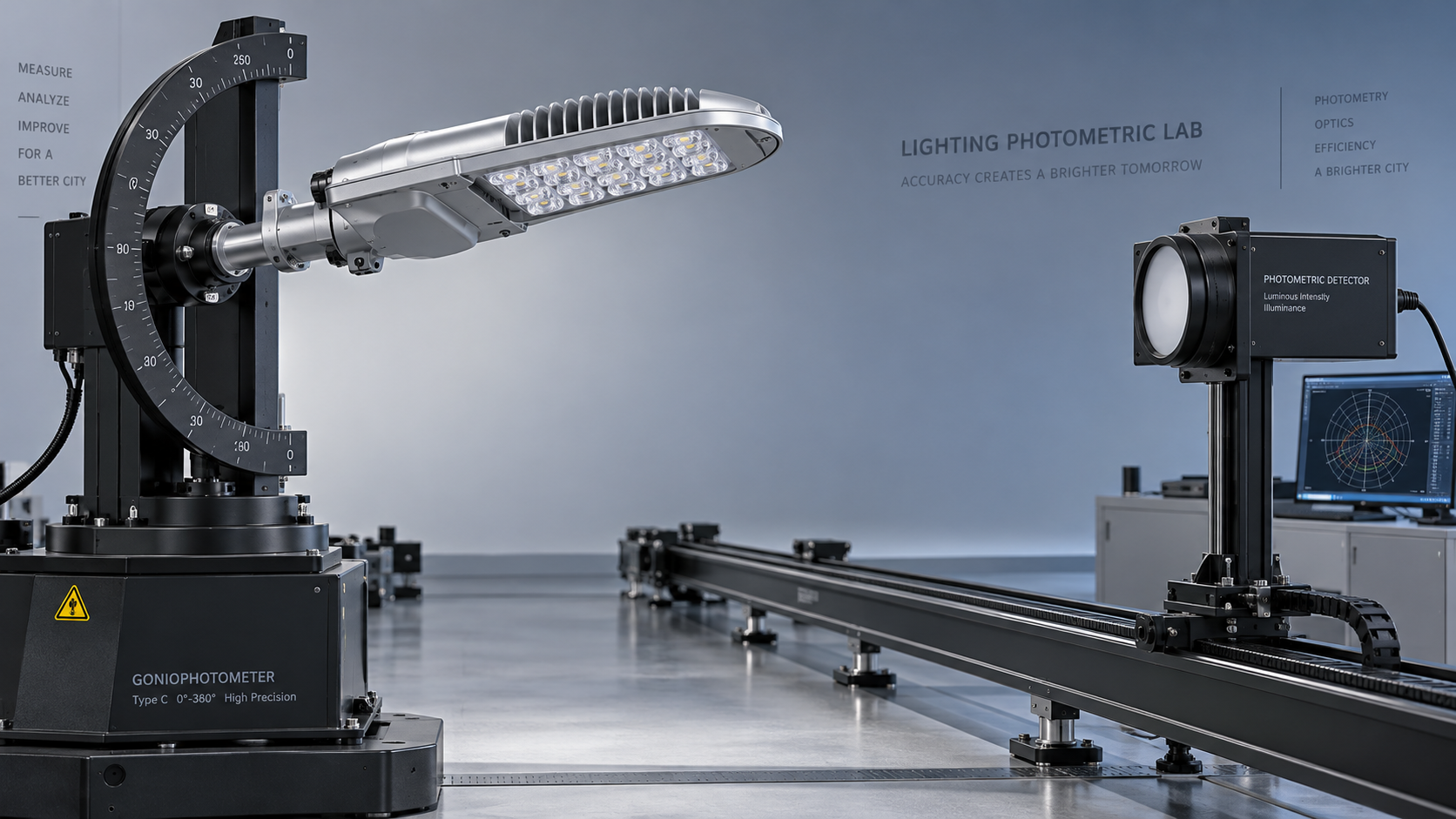
A photometric report can look convincing while failing to represent the luminaires delivered to your project. A search for “urban LED lighting manufacturer China” may uncover plenty of suppliers, but comparing headline lumen figures will not establish which reports are dependable. Laboratory credentials, test methods, sample identification, and consistency between measurement reports and IES or LDT files all deserve scrutiny.
The practical question is not simply whether a luminaire produces enough light. It is whether the verified data describes the ordered configuration closely enough to support decisions about road visibility, glare, and lighting uniformity. That distinction matters when an apparently minor lens or driver substitution changes the installation’s performance.
Start with the tested sample, not the lumen figure
Before reviewing results, connect the report to a specific product configuration. A family name or housing photograph is insufficient when the same enclosure accommodates different LED boards, optics, drive currents, and power settings.
Ask for a traceable link between the report, approved sample, and purchase specification. Useful identifiers include the complete model code, optic designation, rated input, driver setting, correlated color temperature, and sample photographs. Where the report omits internal component details, obtain a controlled configuration record from the manufacturer rather than assuming every variation shares the same performance.
Consider a road light offered with narrow and wide distributions. Both versions may have similar total lumens, yet produce different minimum illumination between poles and different spill beyond the carriageway. A report for one lens cannot substantiate the other merely because wattage and housing match.
A report also describes the sample submitted for testing, not an entire production batch. Record who selected that sample. Supplier-selected samples are not automatically unacceptable, but independently selected production units provide a stronger basis for checking delivery consistency.
Check the laboratory’s scope and the method actually used
ISO/IEC 17025 accreditation is relevant evidence of laboratory competence, but a logo on a PDF is not enough. Verify the laboratory’s identity, accreditation status at the test date, and published scope through the accreditation body’s official directory. For a laboratory claiming CNAS accreditation, check the applicable CNAS listing and scope rather than relying on a supplier’s screenshot.
The scope must cover the relevant measurements and methods. Electrical testing, electromagnetic compatibility testing, and photometric testing are not interchangeable capabilities. An ILAC mutual recognition arrangement can support recognition of accredited results, but it is not product certification or automatic approval for every destination market.
For LED luminaires, reports may reference ANSI/IES LM-79 or an applicable EN 13032 method. Check the exact edition and whether it satisfies the project specification. LM-79 addresses optical and electrical measurements under defined conditions; it does not, by itself, establish electrical safety, ingress protection, or long-term lumen maintenance. An LM-80 report concerns LED packages, arrays, or modules—not the complete street luminaire.
Read the test conditions too: supply voltage or DC input, operating orientation, ambient temperature, stabilization procedure, and measurement uncertainty. For dimmable luminaires, establish which operating level was measured. If authenticity is uncertain, contact the laboratory using independently verified details and ask it to confirm the report number and any revisions.
Reconcile the report with the IES or LDT file
A laboratory report and a calculation file serve different purposes. The report documents measurements; the IES or LDT file carries distribution data into lighting software. They should describe the same tested configuration, but filenames alone do not prove that connection.
Import the file into suitable photometric software and inspect both its metadata and rendered distribution. Prioritize these cross-checks:
- Confirm the manufacturer, model, optic, and report reference wherever those fields are available.
- Check the file’s units, angular coverage, symmetry, orientation, and luminous dimensions.
- Compare integrated luminous flux with the report, accounting for the file format’s normalization conventions and any multipliers.
- Look for unexplained scaling, truncated angles, or distribution shapes inconsistent with the reported polar curves.
Absolute LED photometry can use file conventions that look unfamiliar when read as plain text. An unusual lumen field is therefore a reason to investigate, not immediate proof of manipulation. Conversely, a plausible-looking polar diagram does not validate the underlying numbers.
There is no universal percentage discrepancy that should automatically pass every project. Set acceptance criteria with reference to the specified method, measurement uncertainty, contractual requirements, and engineering sensitivity. Unexplained differences should be resolved before the file becomes the basis for an approved design.
Use verified data in the actual road geometry
A credible report does not guarantee a compliant installation. Road-lighting calculations still depend on mounting height, spacing, outreach, tilt, carriageway dimensions, and the selected lighting class. Depending on the required assessment, road-surface reflection properties and observer positions also matter.
For projects specified around EN 13201 or CIE guidance, confirm the applicable requirements and calculation method rather than treating a supplier’s generic simulation as approval. Review minimum values, uniformity, and applicable glare criteria—not only average illuminance. Increasing output may raise the average without correcting a dark interval between poles.
Lishida Smart Lighting supports large-scale outdoor projects through lighting products, smart controls, and project-based engineering support. For integrated delivery of this kind, document control should connect the verified photometric file to the installation layout and control schedule. Otherwise, an approved full-output calculation can become disconnected from the dimming profile actually commissioned.
Off-grid lighting needs a separate energy check
For a coastal or remote installation using Wind-Solar Hybrid Street Lighting | SHL-003, the available 30W–150W LED range and 3000K, 4000K, or 6500K options make configuration matching especially important. Request photometric evidence applicable to the selected output, optic, and color-temperature configuration, rather than treating one report as proof for every option.
Photometry cannot demonstrate overnight autonomy. The hybrid system’s solar panel, wind turbine, lithium battery, and MPPT controller require a separate energy assessment using site resources, usable battery energy, losses, and the operating schedule. Battery ampere-hours alone are insufficient without voltage and discharge limits. If low state of charge triggers reduced output, assess that lighting condition as well.
Make acceptance a controlled decision
Before shipment, retain the approved report, original photometric file, configuration record, and calculation model as one controlled package. Agree which substitutions require engineering review or retesting. Changes to optics, LED boards, drive current, or light-transmitting covers should not disappear into a general “equivalent component” clause.
Use risk-based production sampling and independent retesting where warranted, then verify installation geometry and operating settings during commissioning. Field measurements provide valuable confirmation, but weather, stray light, instruments, and measurement positions affect comparisons. If the laboratory evidence is sound but the installed road still has dark patches, inspect spacing, tilt, obstructions, and control settings before concluding that the report was wrong.
◉ MESSAGE

Blog
- How to avoid vendor lock-in in a government smart lighting project
- Sizing the communications power budget for smart city solar street lights
- How energy-saving mode affects solar bollard light operating time
- Comparing lead times from LED street light luminaire suppliers in Europe
- What spare parts support should a smart street light exporter offer?
- Where to place a solar garden light in a partially shaded garden
- Which battery alerts matter in remotely monitored solar street lighting?
Message