
Sourcing Solar Street Lights in Europe: How to Vet Manufacturers
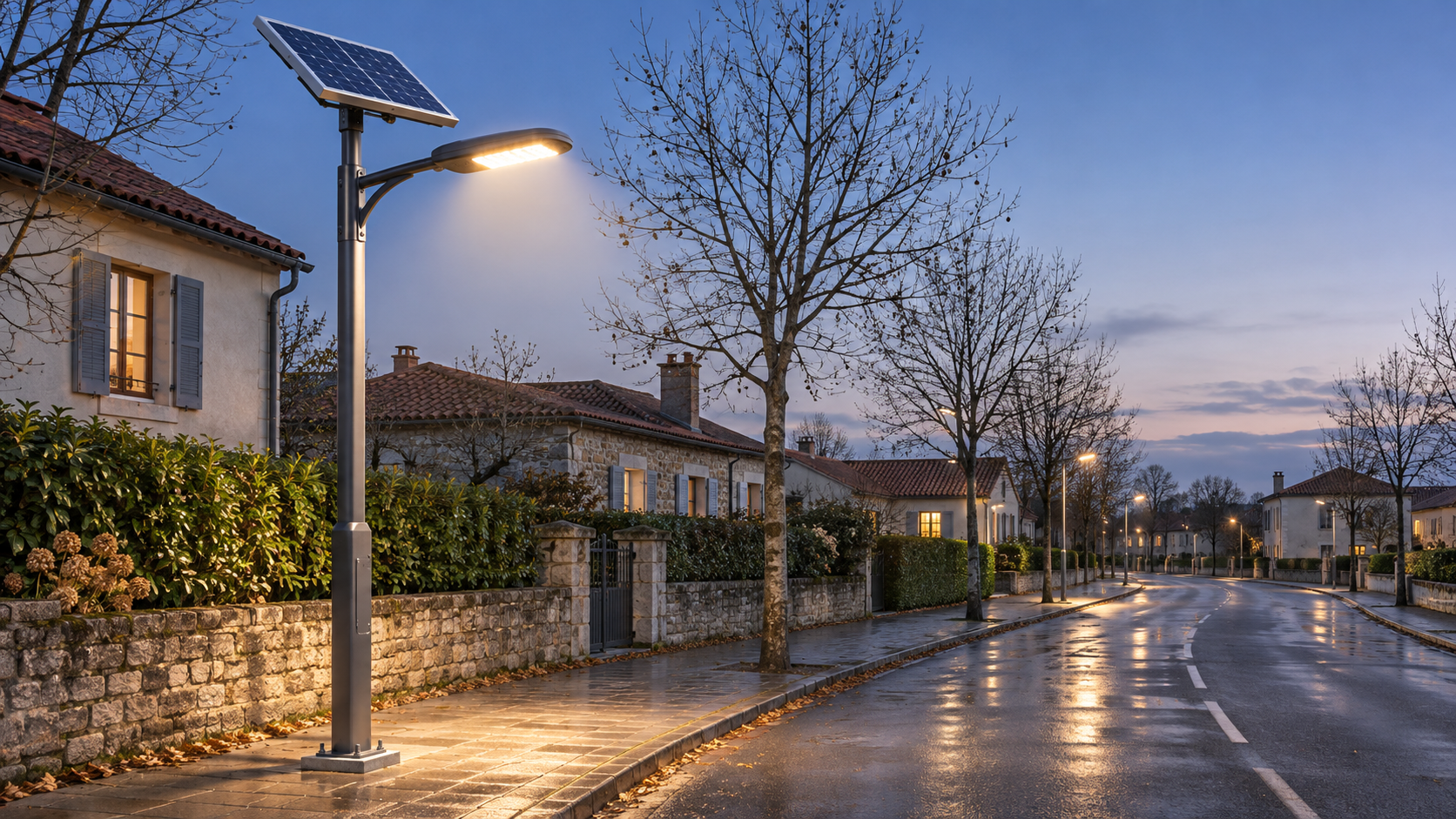
A low unit price can look reassuring when a street-lighting tender is under pressure. It becomes less reassuring if the lights cannot deliver the required illumination through a European winter, or if replacement batteries are difficult to source a few years later. For procurement teams searching for a solar powered street lighting manufacturer Europe projects can rely on, the real task is to compare suppliers on performance, documentation and lifetime cost—not just the catalogue price.
The most useful evaluation starts with the site. A residential path, a busy road and a public square have different lighting needs, exposure conditions and maintenance constraints. A manufacturer should be able to explain how its proposed system responds to those conditions and provide evidence that allows the design to be checked.
Start with the lighting design, not the solar panel size
Ask each bidder to design against the same brief: location, road or area classification, mounting height, pole spacing, operating hours and any applicable local requirements. Provide information about shading from buildings or trees, expected traffic and whether the project allows dimming during quieter periods.
A credible proposal should include a lighting calculation using the proposed luminaire’s photometric data. For road schemes, the applicable parts of EN 13201 may inform the performance assessment, alongside national and local authority requirements. Check the target lighting class with the project designer or contracting authority rather than assuming one specification fits every street.
Review maintained illuminance or luminance, uniformity and glare where relevant—not only LED wattage or initial lumen output. A brighter luminaire may consume more energy, requiring a larger panel and battery. If the supplier changes the optics, mounting height or dimming schedule after the calculation, ask for an updated design.
Can the system operate through the difficult months?
Solar street lighting is an energy balance. The panel must harvest enough energy, and the battery must store enough, to support the agreed lighting profile under the site’s conditions. A design based on annual average sunshine can conceal a shortfall during shorter, cloudier winter days.
Request a site-specific energy calculation that states the assumptions for solar resource, panel orientation, shading, system losses, battery capacity and nightly consumption. It should also show the intended number of autonomy days and explain what happens when the battery approaches a low state of charge. Some systems dim output to preserve power; that may be acceptable for one site and unsuitable for another.
Check whether the battery chemistry and charge controls are appropriate for the expected temperatures. Ask how cold conditions affect charging and available capacity, where the battery is housed, and whether it can be replaced without dismantling the entire installation. For heavily shaded or demanding sites, discuss whether a hybrid or grid-connected solution would be more dependable than a standalone design.
Test the manufacturer’s claims with project-specific evidence
A polished brochure is a starting point, not a procurement file. Request documents that identify the exact product configuration being offered, including the luminaire, panel, battery, controller and mounting hardware. If a supplier offers several component options, make sure the quotation and supporting evidence refer to the same combination.
- Manufacturing scope: Ask which operations the supplier performs in-house and which components are sourced from third parties. Confirm who takes responsibility for quality and warranty coordination across the complete system.
- Performance data: Request photometric files, luminaire output and power data, battery specifications, panel ratings and the assumptions behind stated service life.
- Environmental protection: Check the declared ingress protection and impact ratings for the relevant components, together with suitable test reports. Consider corrosion resistance for coastal or exposed locations.
- Mechanical design: Review pole and bracket suitability, wind loading assumptions, foundations and access for maintenance. Confirm who is responsible for the structural design and local approvals.
- Quality control: Ask about incoming component checks, production testing, traceability and the process for handling defects discovered before or after shipment.
For a substantial order, a sample or pilot installation can reveal issues that paperwork does not: difficult access to connectors, confusing controller settings or inconsistent assembly. Agree in advance on what the pilot is intended to verify and which results would trigger a design change.
European compliance: verify applicability and responsibility
Requirements depend on the product configuration, destination and how the equipment is placed on the market. Ask the supplier to identify the applicable EU or national legislation and standards, and obtain the relevant EU Declaration of Conformity where required. CE marking is a manufacturer’s declaration of conformity with applicable requirements; it is not a substitute for reviewing the supporting technical evidence.
Depending on the equipment, the review may involve electrical safety, electromagnetic compatibility, radio equipment rules for wireless controls, and restrictions on hazardous substances. Battery, waste electrical equipment and packaging obligations may also affect the importer or other economic operator. Confirm responsibilities with the parties placing the product on the market and, where necessary, a qualified compliance adviser. For projects outside the EU, check the destination’s own rules rather than assuming EU documentation is sufficient.
Compare the full cost of ownership
Two quotations are only comparable if they cover the same performance and scope. One may include poles, foundations, freight and commissioning; another may quote only the solar luminaire assembly. Ask suppliers to separate equipment, shipping, duties where applicable, installation support, software, spare parts and recurring charges.
Then consider the costs likely to appear after handover. Battery replacement is particularly important: request the expected replacement procedure, indicative spare-part availability and the conditions that affect battery life. Also examine access equipment, labour, controller replacement and whether the panel or battery can be serviced independently.
Warranty wording deserves the same attention as price. Establish its duration and coverage for each major component, exclusions, claim procedure and whether the remedy includes labour, transport or only a replacement part. A long warranty with unclear conditions can be less useful than a shorter one with a practical local support route.
Smart controls and integration: clarify what is actually included
Dimming schedules, fault alerts and remote monitoring can make a large installation easier to manage, but only when the control architecture suits the owner’s operating model. Ask whether the system works without a network connection, what data it reports and how a failed controller affects the light’s operation.
For connected systems, establish who supplies connectivity, hosts the platform and owns or can export the data. Request details of protocols, access permissions, cybersecurity updates and any subscription fees. If integration with an existing city platform is required, make interoperability a tested acceptance criterion rather than relying on a general compatibility claim.
Some public-space projects also include architectural lighting alongside functional street lighting. In that context, the LED Wall Washer is a separate option for facades and landscapes, with IP66 protection and RGB/DMX control options. It should be assessed as architectural lighting, not as a substitute for the solar street-lighting design or its energy budget.
Make supplier selection easier to defend
Before awarding a contract, put the competing proposals into a common evaluation matrix. Record whether each supplier meets the lighting brief, demonstrates an adequate winter energy balance, supplies relevant compliance documentation and identifies a workable maintenance route. Score price against the same included scope, then examine any exceptions rather than averaging them away.
It is also worth asking who will remain involved after the purchase order. Lishida Smart Lighting supports contractors and project owners with outdoor lighting products, smart control systems and project-based solutions, drawing on experience delivering large-scale projects in China. For a European procurement, the relevant discussion should focus on the specific design, documentation, integration and support required for the destination and project.
The strongest supplier is not necessarily the one with the most impressive specification sheet. It is the one that can explain its assumptions, substantiate its proposed configuration and make clear how the installation will be supported throughout its working life.
◉ MESSAGE

Blog
- Urban Lighting Solutions: Comparing Grid and Solar-Powered Systems
- Lawn Streetlight EPC Contractors: Assessing Installation Capability
- Dusk-to-Dawn Urban LED Lighting: Photocells vs Astronomical Timers
- Waterfront Pedestrian LED Lighting: Addressing Glare and Salt Air
- LED Street Light Manufacturers: Evaluating Warranty and Support
- Connected Smart Poles: How Connectivity Enables Remote Monitoring
- Solar Highway Lighting: Managing Battery Failures on Remote Roads
Message