
Solar Security Light Placement Strategies to Eliminate Outdoor Blind Spots
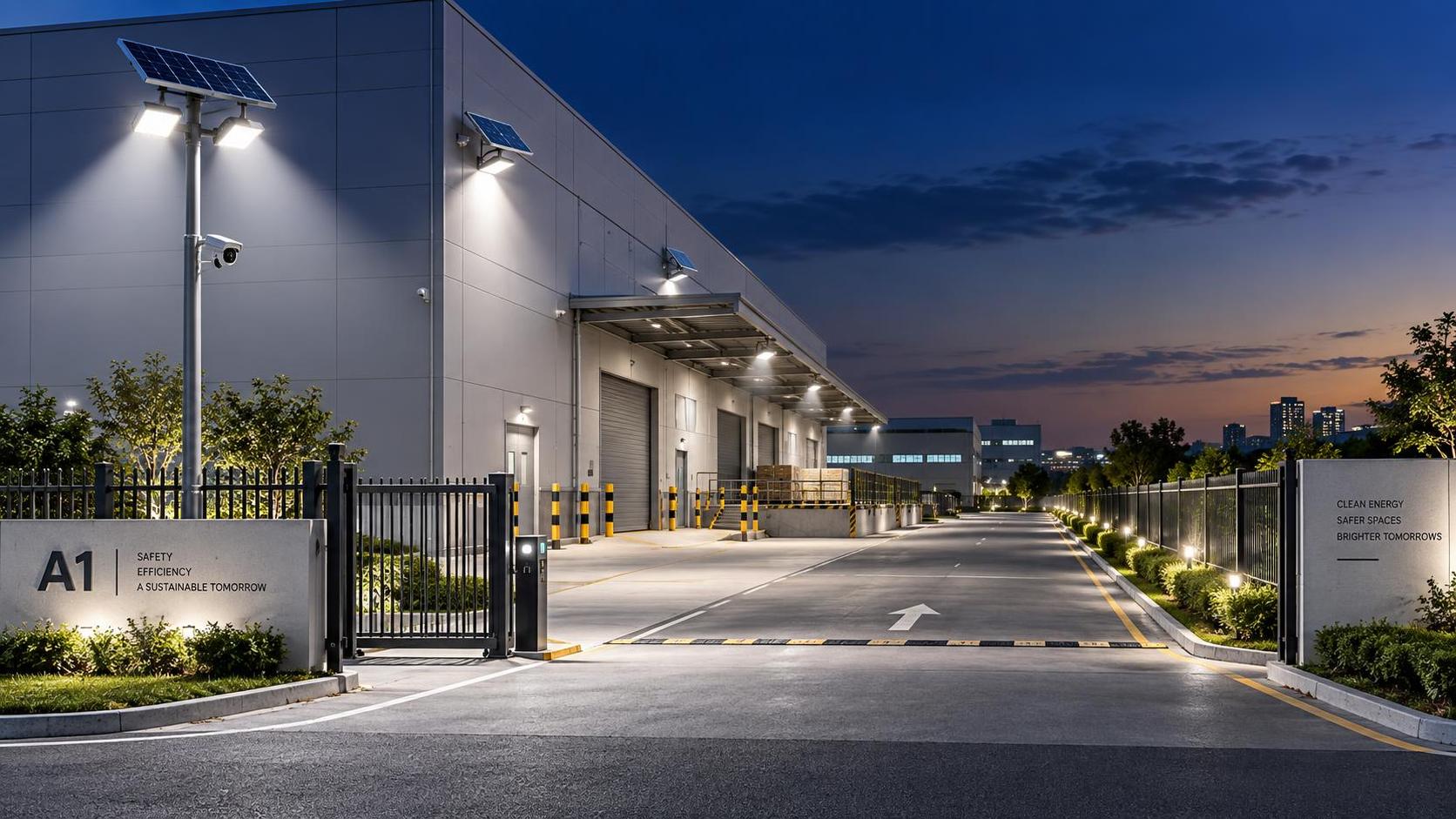
Outdoor blind spots rarely disappear because a site adds more fixtures. They disappear when the lighting layout follows how people, vehicles, and intruders can actually move through the property after dark. For quality control and safety managers, solar security light placement should begin with a risk map of the site, then be checked against sensor reach, mounting conditions, solar exposure, and the minimum light level needed for surveillance or safe movement.
A fixture that looks bright from directly beneath its pole can still leave the spaces between buildings, behind parked vehicles, along fence returns, and at service entrances poorly controlled. Those are the areas where a placement plan needs to be more deliberate.
Start with movement routes, not fixture locations
The most useful first question is: where can a person or vehicle enter, travel, pause, or leave without being seen? Plotting these routes exposes blind spots that are easy to miss on a daytime walkthrough. A perimeter may look continuous on a drawing while a gate recess, loading-bay corner, or change in ground level creates a shadowed approach in use.
Divide the site into four functional zones before selecting mounting points:
- Approach zones: vehicle entrances, pedestrian gates, access roads, and paths leading from public areas to the property.
- Transition zones: corners between buildings, stairways, ramps, passageways, and the space where a driver or pedestrian changes direction.
- Protected asset zones: equipment yards, storage areas, refuse compounds, loading docks, fuel points, and external plant rooms.
- Escape and perimeter zones: fence lines, rear boundaries, drainage corridors, undeveloped edges, and routes leading away from secured areas.
Each zone needs a different lighting response. A long fence line may need overlapping fields of light at gates, corners, and likely crossing points rather than uniformly spaced units along its full length. A loading area may need steady illumination for work and camera use, while a secondary pedestrian approach can often use motion-triggered output. Treating both zones the same often wastes stored solar energy in one place while leaving the other underlit.
Use overlap to remove gaps, but control glare
Solar security lights should be arranged so their useful illumination overlaps at the edge of a coverage area. The design target is not a bright pool under every fixture. It is a continuous visual route with no dark break large enough to conceal a person, obscure a trip hazard, or prevent a camera from identifying movement.
Overlap matters most at corners, intersections, entrances, and the ends of rows of parked vehicles. At a building corner, placing one light directly on the corner can create strong contrast on adjacent walls and leave the return path uneven. Two fixtures aimed along each facade, or one fixture positioned to cover the approach before the corner, often produces better recognition distance and fewer abrupt dark zones.
More output is not always the answer. Excessive brightness can create glare for guards, drivers, and camera systems, particularly where the fixture is mounted low or aimed toward an access road. It can also make nearby unlit areas appear darker by comparison. Check the view from the likely observer position: a gatehouse, roadway, footpath, camera location, or patrol route. If the source is visible at eye level before the route is illuminated, adjust the mounting point, optic, shielding, or aiming angle.
Check coverage in the direction people travel
Many layouts are reviewed from an overhead plan only. That is useful for spacing, but it does not show whether approaching faces, obstacles, and vehicle edges can be seen from the direction that matters. At pedestrian gates, for example, light should support identification before a person reaches the access-control point. At vehicle entrances, the driver must see the barrier, kerb, pedestrians, and any instructions without a direct glare source in the line of sight.
For camera-supported areas, avoid placing a security light where it shines into the camera lens or creates a heavily backlit subject. The lighting and CCTV plans should be reviewed together. A camera may detect movement in a bright background but still fail to provide usable identification at the point where an incident occurs.
Mounting height changes the security result
Mounting height affects spread, vertical illumination, glare, maintenance access, and resistance to vandalism. A low-mounted solar security light can provide strong local brightness but may produce harsh shadows behind bins, vehicles, or landscaping. A higher mounting point broadens coverage, yet the light level at ground level and on faces can fall if the fixture output and distribution are not selected for that height.
For compact access points, low-to-medium mounting can work where the fixture is protected and its sensor can clearly see the approach route. For open yards, internal roads, and broad perimeter approaches, a higher pole-mounted arrangement may be more appropriate. The pole should be positioned so that trees, signs, containers, or building projections do not block either the luminaire or its solar collection surface.
Where a project already uses road or public-space poles, it may be practical to coordinate security coverage with the broader lighting infrastructure rather than install separate fixtures at every location. A pole system such as Modern Street Lighting|MSL-HC is configured for 8-14 m mounting heights and can support higher-level roadway or circulation lighting where a site requires durable, long-term coverage. That does not replace a solar security light at a remote gate or isolated service path; it helps avoid gaps between local security lighting and the main circulation network.
Physical installation deserves the same scrutiny as photometric placement. A pole at the correct height still becomes a weak point if its foundation, fasteners, corrosion protection, or cable-free solar assembly cannot withstand local wind, impact exposure, and long-term maintenance conditions. In high-risk areas, locate equipment where it cannot be easily reached, climbed, covered, or redirected.
Sensor coverage must match the operating environment
Motion sensing can extend battery runtime and draw attention to activity, but a sensor should not be treated as a substitute for planned lighting coverage. Its detection pattern may be wider than the illuminated area, narrower than expected at the edge of a path, or affected by mounting height, temperature, rain, vegetation, and moving traffic.
Walk-test the sensor after installation from every realistic approach direction. Movement across the sensor field is commonly detected more reliably than direct movement toward it, so a fixture aimed solely down a long path may react later than expected. At gates and vehicle routes, confirm that normal traffic does not cause constant activation. At remote boundaries, confirm that an intruder approaching slowly or along the edge of the field cannot remain outside the activation zone.
False triggers have a security cost. A light cycling repeatedly because of tree movement, passing vehicles, or wildlife can drain stored energy and make personnel less responsive to a genuine event. Trim vegetation, avoid aiming sensors toward public roads where possible, and set sensitivity and hold time for the location rather than applying one setting across the property.
Solar placement requires an energy check, not just a lighting check
A solar security light can be correctly located for security and still perform inconsistently if the panel is shaded during the period when it needs to charge. Nearby walls, mature trees, roof overhangs, signs, construction equipment, and seasonal vegetation all matter. A site inspection should consider sun exposure across the year, not only the conditions visible on installation day.
Battery capacity, panel orientation, local weather patterns, operating mode, sensor activations, and desired nighttime duration form one operating system. A high-output setting at every point may look effective immediately after installation but can reduce consistency after consecutive low-sunlight days. For critical routes, define what must remain illuminated through the night and reserve motion-boost modes for locations where a short higher-output response is sufficient.
This distinction is particularly important at emergency exits, stairways, primary gates, and areas used for overnight operations. Those locations usually need predictable baseline visibility. Remote fence corners, temporary storage zones, and low-traffic side paths may be better candidates for sensor-led operation.
Inspect the layout after the site changes
Blind spots are not fixed. A new container stack, a parked fleet, replacement landscaping, temporary fencing, or a new CCTV pole can change the effective coverage without anyone moving a lighting fixture. Include night-time lighting checks in site-change procedures, especially where security incidents, near misses, or camera visibility issues have occurred.
- Walk principal pedestrian and vehicle routes after dark from the user’s eye level.
- Check corners, gate recesses, and the far side of stored materials for hard shadows.
- Confirm that sensors activate before a person reaches the protected point.
- Review whether glare affects drivers, guards, neighbors, or camera images.
- Inspect panels for shading, dirt, damage, and newly grown vegetation.
- Record failed activations, reduced overnight runtime, and recurring false triggers as layout issues as well as maintenance issues.
A strong solar security lighting plan is therefore a controlled combination of route coverage, sensible overlap, appropriate mounting, reliable energy availability, and repeat inspection. When each fixture has a defined security purpose, blind spots become easier to identify, correct, and prevent as the site evolves.
◉ MESSAGE
Blog
- How to Qualify a Wind-Solar Hybrid Street Light Supplier for Remote Sites
- Solar Security Light Placement Strategies to Eliminate Outdoor Blind Spots
- LED Street Luminaire Specifications That Matter for Roadway Projects
- What to Evaluate When Selecting a Smart Street Lamp Manufacturer
- How to Prepare a Compliant Solar Lighting Bid for Public Infrastructure Projects
- LED Street Lighting Solutions for Urban and Municipal Roads
- LED Street Light Installation Guide for Road Projects
Message