
Solar Powered Flood Lights: Matching Lumen Output to Security Coverage
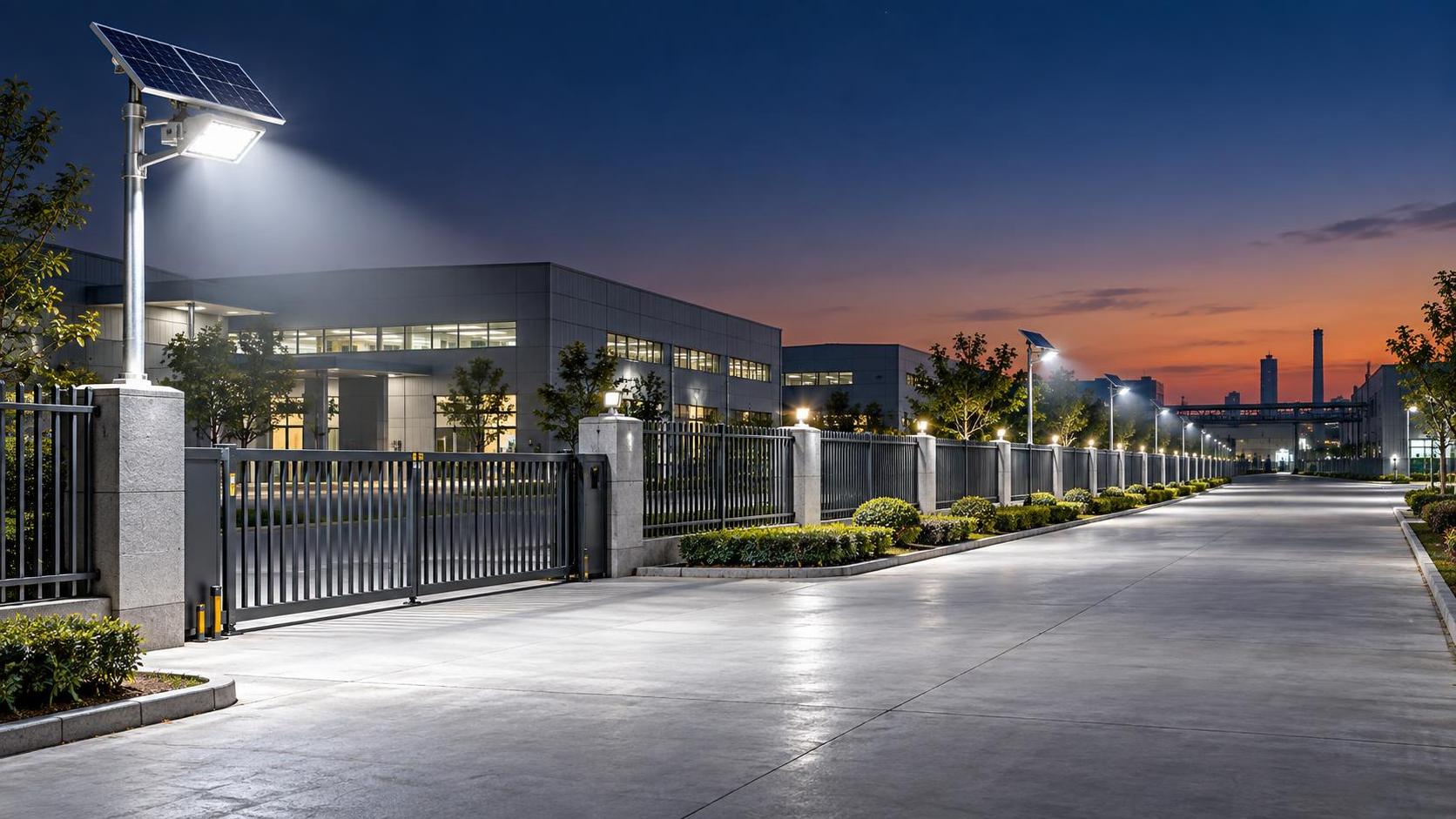
Solar Powered Flood Lights: Matching Lumen Output to Security Coverage
Choosing a solar powered flood light is not a matter of finding the highest lumen figure on a specification sheet. In security work, useful light is the light that reaches the right surface, at the right time, with enough consistency for people and cameras to identify movement, boundaries, vehicles, or hazards.
A high-output fitting can still leave a gate, fence line, loading bay, or pedestrian route poorly protected if its beam is too narrow, its mounting position is wrong, or its battery cannot sustain the required overnight operating profile. Conversely, an oversized unit may create glare, uneven contrast, and unnecessary maintenance exposure. The practical task is to match lumen output with the area, risk level, beam pattern, mounting height, and local solar conditions.
Lumens Matter, but Illuminance Determines Coverage
Lumens describe the total light emitted by a fixture. They do not show how much light arrives on the ground or vertical surfaces where security activity actually takes place. That result is illuminance, commonly assessed in lux, and it changes with distance, beam angle, mounting height, aiming direction, obstructions, and surface reflectance.
For example, two flood lights with the same rated output can produce very different results. A narrow beam concentrates light over a smaller target zone and can be effective for an entrance, guard post, or gate lane. A wide beam spreads the same output across a broader area, which may suit a yard or pedestrian route but will reduce intensity at any individual point. The rated lumen number alone cannot tell a project team whether either approach will provide adequate visibility.
This is why photometric distribution should be reviewed alongside output. A lighting layout based on fixture spacing and target light levels is more reliable than selecting units by wattage or marketing descriptions such as “high brightness.” Where a site has formal security, road, workplace, or public-space requirements, the applicable local standards and project documents should guide the final acceptance criteria.
Start with the Security Task, Not the Product Range
Different areas need different forms of coverage. A perimeter fence is usually a long, narrow visual task. The goal is often to reveal intrusion attempts and maintain a usable view along the boundary, rather than to flood adjacent land with light. A vehicle entrance needs stronger vertical illumination near barriers, identification points, and turning areas. In a storage yard, the concern is usually broad horizontal coverage, shadow control between stacked materials, and safe circulation after dark.
Public spaces add another consideration: visual comfort. Excessive brightness near paths, residential edges, or open plazas can make darker surroundings appear even darker. It can also reduce the ability of a person or camera to see detail beyond the bright pool of light. A well-designed solar powered flood light installation therefore aims for evenness and controlled direction, not simply a bright central hotspot.
- Fence lines and service corridors: prioritize continuous overlap and limit dark gaps between poles.
- Gates and checkpoints: assess vertical light on faces, vehicle fronts, controls, and signage.
- Yards and compounds: check shadowing caused by containers, trees, machinery, and parked vehicles.
- Walkways and public approaches: balance visibility with glare control and acceptable spill light.
The Four Variables That Change the Lumen Decision
Mounting height and pole spacing
Higher mounting positions extend reach, but light levels at the target fall as distance increases. Raising a fixture without changing the optical distribution can create a large but weakly lit area. Reducing pole spacing may improve uniformity, yet it adds foundations, installation work, and maintenance points. The correct arrangement is usually a compromise informed by site geometry, access for maintenance, and the required viewing task.
Beam distribution and aiming
Flood lights are often installed with little attention to aiming, even though a small change in tilt can move usable light away from the target. Excess upward tilt wastes energy, increases glare, and may create unwanted spill. Too steep a downward angle can leave the far edge of a protected zone underlit. Quality checks should verify the actual mounting orientation after installation rather than relying only on drawings.
Battery autonomy and seasonal charging
Solar lighting must be evaluated as an energy system, not only as a luminaire. The battery must support the chosen output and operating schedule through periods of reduced solar input. A unit that performs well after a clear day may not meet security needs after several cloudy days, during shorter winter daylight hours, or when panels are partially shaded.
Review the stated operating mode carefully. Dusk-to-dawn output, timed dimming, motion-triggered boost, and adaptive control all place different demands on the battery. Motion sensing can be practical for low-traffic perimeter sections, but it should not be treated as a substitute for continuous lighting where camera monitoring or regular vehicle movement requires a stable baseline.
Environmental exposure
Dust, salt air, wind loading, high ambient temperature, foliage growth, and vandalism risk can all affect real-world performance. Solar panels need clear exposure, not just an unobstructed view on installation day. Battery replacement access also deserves early consideration. A fixture positioned where maintenance requires traffic closure, lifting equipment, or entry into a restricted zone may impose costs that were invisible during procurement.
Avoiding Common Selection Errors
One frequent mistake is comparing products solely by nominal wattage. LED efficacy, optical losses, driver behavior, battery capacity, and control programming mean wattage is not a dependable proxy for useful site illumination. Another is using a single fixture to cover a large, irregular area. The result is often a bright point near the pole and poor visibility around the edges.
Quality teams should also be cautious about headline lumen claims without a clear test basis or supporting photometric information. It is reasonable to request product data, battery and solar-panel specifications, IP protection information, operating profiles, and layout calculations where they are relevant to the project. For a critical area, a trial installation or measured on-site verification can expose glare, shadows, and charging limitations before the full rollout.
Security lighting rarely operates in isolation. Facade lighting, wayfinding, landscape features, CCTV locations, and access-control points can all influence the night-time visual environment. For architectural zones adjacent to a secure site, products such as the LED Linear Light can provide controlled, continuous accent illumination on building facades or landscape edges, while dedicated flood lighting remains focused on functional security coverage. Its IP66 protection, multiple beam options, and configurations from 3W to 60W illustrate why each exterior lighting layer should be selected for its own visual task rather than forced into a single fixture type.
A More Reliable Review Process
Before approving a solar flood-light scheme, identify the areas that must remain visible, the hours when they matter, and what people or cameras need to detect. Mark obstructions, likely future changes to the site, and every source of panel shading. Then assess fixture output, beam distribution, mounting height, spacing, and expected battery operation as one system.
For large outdoor projects, this coordination is often where delivery risk sits. Lishida Smart Lighting supports contractors and project owners with integrated outdoor lighting products, smart controls, and project-based planning across roads, public spaces, and complex urban environments. The useful contribution is not simply supplying a luminaire; it is helping align the lighting layout, control logic, installation conditions, and long-term service expectations before they become site issues.
The strongest solar powered flood light decision is usually the one backed by a defined coverage plan, credible operating assumptions, and a practical maintenance route. If these points are clear, lumen output becomes a meaningful selection parameter instead of a misleading shortcut.
◉ MESSAGE

Blog
- How to avoid vendor lock-in in a government smart lighting project
- Sizing the communications power budget for smart city solar street lights
- How energy-saving mode affects solar bollard light operating time
- Comparing lead times from LED street light luminaire suppliers in Europe
- What spare parts support should a smart street light exporter offer?
- Where to place a solar garden light in a partially shaded garden
- Which battery alerts matter in remotely monitored solar street lighting?
Message