
LED Tree Ring Light Design Considerations for Public Landscape Safety
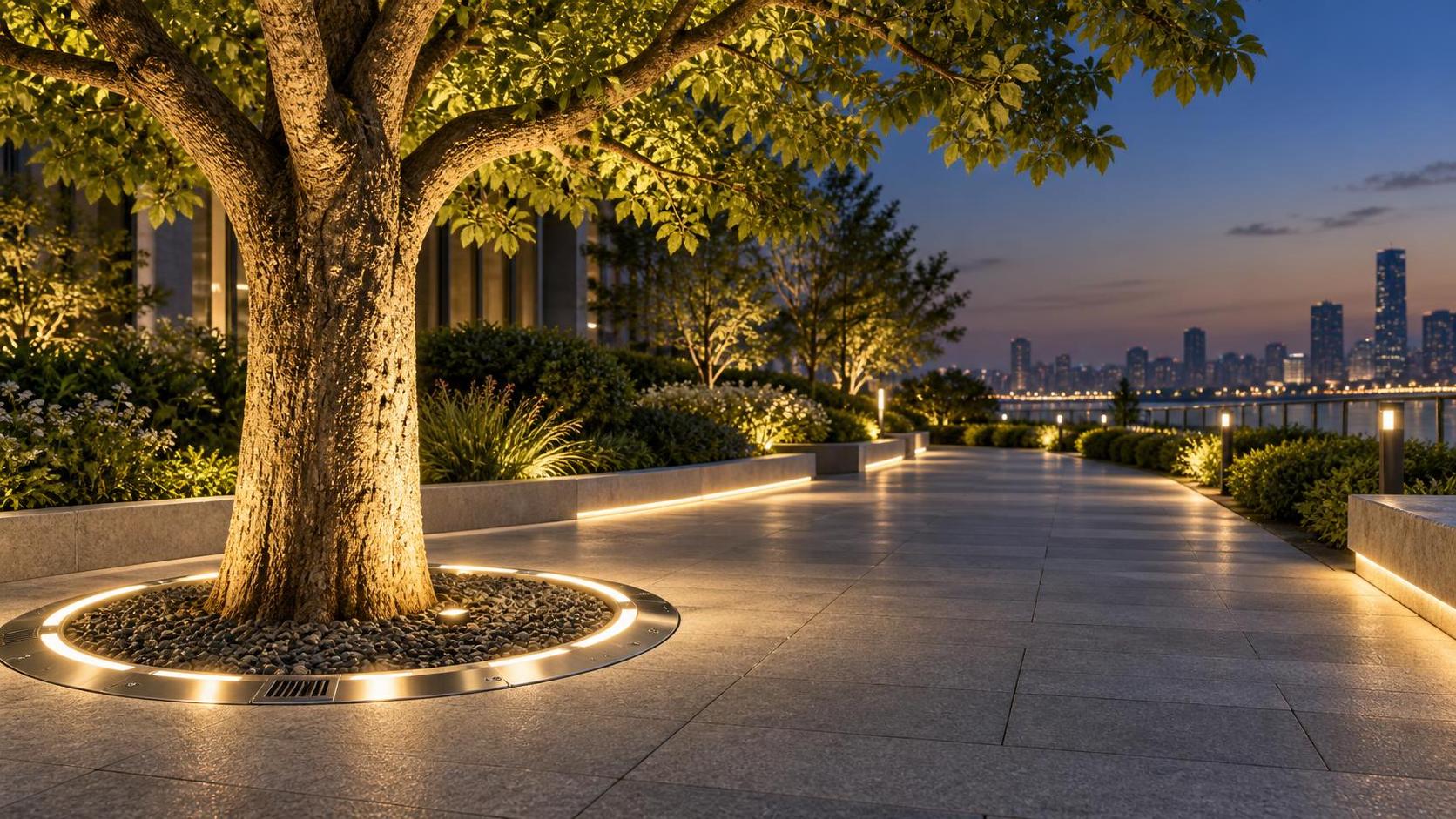
An LED tree ring light in a public landscape should be evaluated as a safety-critical ground-level installation, not simply as an accent fixture. Its location around the trunk exposes it to pedestrians, irrigation, soil movement, landscaping equipment, standing water, and occasional impact. A design that produces an attractive uplight effect but leaves exposed cables, overheated drivers, unstable covers, or excessive glare can create maintenance and liability problems long before the LEDs reach their stated service life.
For quality control and safety managers, the first question is whether the fixture design remains safe when the landscape is no longer pristine. Public parks, streetscapes, plazas, and pedestrian corridors change over time: mulch is added, roots expand, drainage patterns shift, and maintenance crews work around the fixture. The selected LED tree ring light should tolerate those conditions without creating a trip hazard, electrical risk, or obstruction to tree health and routine landscape work.
Start with the installation environment, not the visual effect
Tree ring lighting is often specified for the dramatic result it creates after dark, but the installation detail determines whether that result can be maintained safely. Before approving a fixture, the project team should define whether it will be installed in soil, gravel, paving, lawn edges, raised planters, or a hardscape surround. Each condition changes the requirements for drainage, mechanical protection, cable routing, and access.
A ring installed flush with paving needs a cover and frame that can remain level after settlement. Even a small raised edge can catch shoes, wheeled maintenance equipment, or mobility devices. In planted soil, the concern shifts toward soil compaction, water retention, root pressure, and the likelihood that the fixture will become buried by mulch or displaced during planting work.
The ring diameter also requires more scrutiny than it often receives. A close-fitting opening may appear neat at installation, yet it can restrict trunk expansion or become distorted as the tree matures. The fixture should allow a clear, non-constraining relationship with the trunk and root flare. Lighting hardware should never be used to define the tree’s growing space.
Questions to resolve before specifying the housing
- Will pedestrians, bicycles, carts, or maintenance vehicles cross the installation area?
- Where will surface water flow during heavy rain, irrigation, or blocked-drain conditions?
- Can the fixture be removed or serviced without excavating around roots?
- Will mulch, leaves, soil, or gravel cover the optical surface during normal maintenance cycles?
- Does the mounting detail accommodate future root growth and local ground movement?
These questions may lead to different fixture choices within the same landscape project. A decorative pedestrian plaza and a lightly accessed planting bed should not automatically receive the same construction detail.
Waterproof ratings need to be read as part of a system
Ingress protection is necessary for outdoor lighting, but an IP rating alone does not prove that a tree ring installation will remain dry or electrically reliable. The rating applies to the fixture as tested in its intended assembled condition. Field performance depends on cable glands, connectors, junction boxes, end caps, drainage layers, and the workmanship of every connection below or near grade.
For installations exposed to irrigation and rainwater, the fixture enclosure, driver compartment, cable entries, and joints should be assessed together. A nominally sealed luminaire can still fail when its cable entry faces upward, a connector sits in a wet planting cavity, or a recessed mounting sleeve traps water around the housing. Drainage cannot be treated as a landscaping issue alone; it is part of the electrical protection strategy.
Where a project uses central drivers or remote power supplies, the route from the driver to each ring deserves equal attention. Low-voltage systems may reduce some shock hazards, but they still require suitable cable insulation, protected connections, voltage-drop calculations, and clear segregation from irrigation components. For mains-powered arrangements, access control, grounding continuity, overcurrent protection, and residual-current protection should align with the applicable local electrical code and project specification.
Quality inspection should therefore include more than a visual check of the front cover. Inspectors should verify enclosure seals, fastener torque where specified, cable strain relief, connector compatibility, grounding points, and the condition of the recessed mounting cavity before the final landscape finish conceals the installation.
Thermal design affects both reliability and public safety
An in-ground or near-ground ring has less freedom to reject heat than a pole-mounted luminaire. Soil, mulch, decorative gravel, and enclosed mounting sleeves can all reduce airflow around the housing. If the fixture depends on exposed fins or an air gap for cooling, the intended thermal path must remain available after installation.
Heat management matters for more than LED lumen maintenance. Persistent high temperature can accelerate driver degradation, harden gaskets, weaken cable insulation, and increase the chance of moisture entering an aged enclosure. A fixture that operates acceptably during a brief commissioning test may behave differently after its cavity fills with debris or after summer irrigation repeatedly cools and wets the housing.
Thermal evaluation should consider the planned operating schedule. Long nightly run times, high-output scenes, warm climates, dark paving, and enclosed landscape details can combine to raise component temperatures. Dimming should be considered as an operational control where illumination requirements vary by time of night. It can reduce energy use, but it should be configured to preserve wayfinding and surveillance visibility rather than simply lowering output across the site.
Smart-control capability can be useful when tree lighting is part of a wider public-space lighting scheme. For example, a roadway system using an LED Street Light Luminaire with PWM, PLC, or 0-10V dimming may operate on a different schedule from adjacent landscape accents. The interface should be planned early so that control zones, fault reporting, emergency operating conditions, and maintenance access remain clear. A visually coordinated site is not automatically an electrically coordinated one.
Control glare before adding output
Tree uplighting can create glare when the source is visible from a pedestrian’s normal line of sight. The issue is especially relevant near paths, benches, crossings, playgrounds, and building entrances, where people look ahead rather than downward. Increasing wattage to achieve a brighter canopy often makes the source more intrusive at ground level and can reduce visual comfort in the surrounding space.
The preferred response is usually optical control: shielding, louvres, recessed placement, appropriate beam distribution, and careful aiming. Narrow beams can be useful for taller trunks or vertical crowns, while wider distributions may suit lower canopies. Neither is inherently safer without reviewing fixture position, mounting depth, tree form, nearby reflective surfaces, and the observer’s likely viewing angle.
Colour temperature should also be selected for the site rather than treated as a decoration setting. Warmer light may suit some heritage, hospitality, or residential landscape conditions; cooler light can change the apparent brightness and color of foliage and paving. The safety decision is less about a universal preferred CCT than about whether the selected output, distribution, and contrast help people see path edges, changes in level, and nearby users without creating harsh point-source glare.
Mechanical integrity is a lifecycle requirement
At ground level, the lens and trim face a different form of abuse from elevated luminaires. Foot traffic, dropped tools, cleaning equipment, stones, lawn-care machinery, and deliberate tampering can damage covers or loosen hardware. The material selection should account for impact resistance, UV exposure, corrosion, cleaning chemicals, and the potential for a damaged lens to retain water or expose sharp edges.
Load-bearing claims should be matched to the actual access conditions. A fixture suitable for occasional pedestrian loading may not be suitable for service carts or vehicles, even when both are described broadly as “public landscape” use. The design documentation should state the allowable loading condition, mounting method, and any required protective barrier or exclusion zone. It should also identify whether the trim ring remains safe if the adjacent paving settles.
Fasteners and joints deserve particular attention in coastal, high-humidity, or chemically treated landscape environments. Corrosion at a screw, hinge, or mounting bracket can turn a serviceable fixture into one that must be excavated and replaced. Specifying replaceable optical modules or drivers has limited value if the housing cannot be opened safely after several seasons outdoors.
Make maintenance part of the acceptance criteria
A tree ring system should be accepted only after the team can describe how it will be inspected, cleaned, isolated, and repaired. This is especially important where fixtures are distributed across large parks or urban corridors. A single failed ring may be tolerable visually, but repeated partial failures can create inconsistent lighting and drive expensive reactive maintenance.
Practical acceptance criteria should include access to electrical isolation points, identification of circuits and control zones, spare-part availability, a method for replacing failed drivers or light engines, and a defined process for restoring the ground finish after service. The inspection plan should cover lens cleanliness, water accumulation, gasket condition, cable damage, loose trim, uneven paving, and vegetation encroachment.
The best LED tree ring light design is therefore one that remains stable after landscaping, weather exposure, and routine public use have altered the site. When drainage, thermal behavior, glare control, mechanical loading, and service access are resolved together, the lighting can support the intended nighttime landscape without introducing avoidable safety burdens for the people responsible for the site.
◉ MESSAGE
Blog
- LED Tree Ring Light Design Considerations for Public Landscape Safety
- Where Modern Street Lighting MSL-XM Fits in Urban Road Renewal Plans
- How to Qualify a Wind-Solar Hybrid Street Light Supplier for Remote Sites
- Solar Security Light Placement Strategies to Eliminate Outdoor Blind Spots
- LED Street Luminaire Specifications That Matter for Roadway Projects
- What to Evaluate When Selecting a Smart Street Lamp Manufacturer
- How to Prepare a Compliant Solar Lighting Bid for Public Infrastructure Projects
Message