
LED Street Light Specifications: What Buyers Need to Know
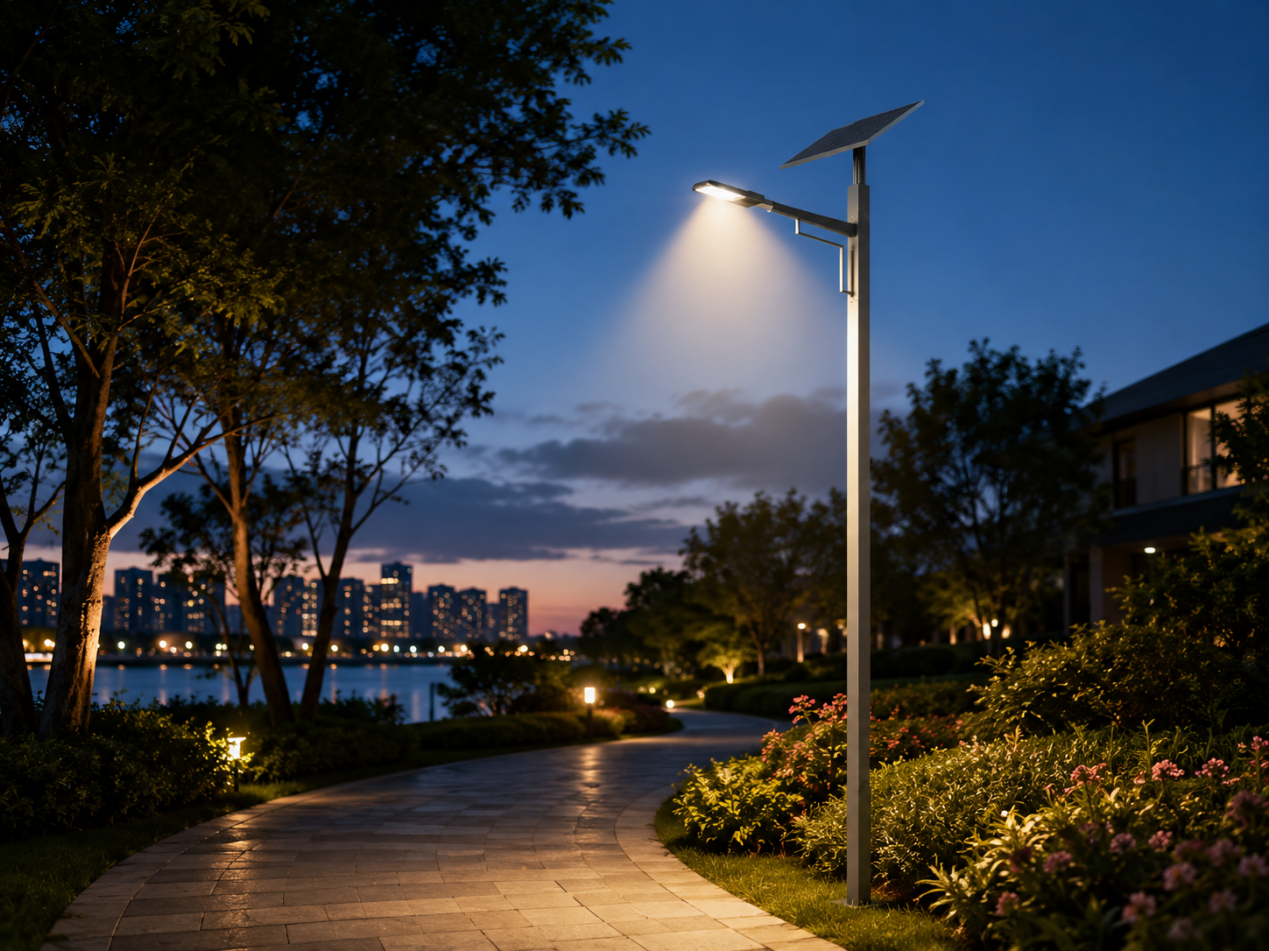
LED street light specifications shape how a lighting project performs after installation, not just how it looks on a quotation sheet. A fixture with the wrong wattage, poor optical control, weak surge protection, or an unsuitable housing material can create uneven roads, frequent maintenance, and unnecessary replacement work. Reading specifications properly means connecting each number to the actual site condition: road width, pole spacing, mounting height, ambient temperature, salt exposure, traffic pattern, and control strategy.
Wattage and lumen output are only useful in context
Rated power is often the first figure people compare, but wattage alone says very little about whether a street light will suit a project. Two luminaires with the same 100W input can perform very differently if the LED package efficiency, optical losses, and thermal design are not equal. Lumen output adds more value, yet even total lumens should not be treated as the final answer. A high-lumen fixture may still waste light outside the target area if the lens system is poorly matched to the roadway geometry.
It is better to read wattage together with luminous efficacy, mounting height, and distribution type. On a narrow road, excessive power can produce glare and bright spots under the pole while leaving the spaces between poles visually inconsistent. On a wide carriageway or multi-lane route, underpowered fixtures may force shorter pole spacing, which affects civil work, cabling, and installation rhythm. The specification sheet should therefore be reviewed against the lighting layout, not in isolation.
Beam angle and light distribution decide usable illumination
Street lighting does not behave like floodlighting. What matters is controlled forward throw, lateral spread, and uniformity along the road surface. A fixture may advertise strong brightness, but if the beam is too narrow, the pavement between poles may fall into visible dark bands. If the distribution is too wide, light spill can reach building facades, trees, or pedestrian areas that were never part of the original design scope.
Optical distribution should be selected according to roadway classification, pole height, arm length, setback, and whether poles are arranged on one side, both sides, or a median. Curved roads, intersections, zebra crossings, and mixed pedestrian-vehicle zones usually need separate attention because standard straight-road optics do not always handle these transitions well. When comparing fixtures, lens material and optical control deserve as much attention as raw LED output.
Ingress protection and housing details affect service life
IP rating is often read quickly, but its practical meaning depends on the environment and the quality of sealing execution. For outdoor roads, public spaces, and urban corridors, dust ingress, driving rain, standing moisture, and pollution all put pressure on the luminaire enclosure. An IP rating such as IP66 or IP67 can be appropriate, but the number itself is not enough if cable glands, gasket quality, and compartment design are weak.
Material choice also changes long-term behavior. Die-cast aluminum housings are common in street lighting because they combine structural strength with heat dissipation. In coastal or industrial settings, corrosion resistance, coating thickness, and fastener quality should be reviewed carefully. Even small details, such as whether the driver compartment is easy to access without disturbing the optical chamber, can reduce future maintenance difficulty.
Similar specification logic appears in adjacent outdoor applications. In landscaped public areas, a product such as LED Garden&Lawn Lighting | GLL-WJ uses IP67 protection, 120 lm/W luminous efficiency, and an operating temperature range of -40℃ to +70℃, showing how enclosure sealing, thermal tolerance, and structural durability remain relevant beyond roadway fixtures alone.
Thermal management is hidden in the specification, but visible in the field
LED chips are efficient, but they still generate heat. If heat is not moved away effectively, lumen depreciation may accelerate and driver stability may decline. This is why ambient temperature range should not be treated as a minor line item. In locations with prolonged summer heat, enclosed urban canyons, or poor airflow around the fixture, a luminaire that performs acceptably in mild conditions may age much faster.
Look for realistic operating temperature limits, heat sink design, and how the driver is integrated. Compact housings can be attractive from a design standpoint, yet overly dense internal layouts may trap heat. A long-rated service life such as 50,000 hours or more should be read together with thermal path quality, not as a standalone guarantee of field performance.
Driver quality and electrical protection deserve close reading
Many outdoor lighting failures are electrical before they are mechanical. Driver specifications should cover input voltage range, power factor, surge protection, and dimming compatibility where controls are required. In areas with unstable grid conditions, a broad input tolerance may reduce nuisance failures. Surge protection is especially relevant on exposed roads and high-pole installations, where transient events can damage electronics even when the LED module itself remains intact.
Projects that use central monitoring, photocells, astronomical timers, or adaptive dimming should confirm communication and control interfaces early. A fixture described as “smart-ready” may still require separate nodes, compatible drivers, or reserved mounting space. If this coordination happens late, wiring changes and commissioning delays can follow.
Color temperature and glare influence perceived road quality
Color temperature is often selected from habit, but roadway and public space conditions may call for different choices. Cooler light can support strong visual contrast in some urban traffic environments, while warmer light may be preferred near residential streets, parks, or mixed-use zones where visual comfort matters more than a bright visual impression. The specification sheet should also be checked for color consistency and color rendering index where object recognition is important.
Glare control is another area where simple comparisons often fail. A fixture with intense point-source brightness can create discomfort even when average illumination seems acceptable. Lens design, shielding angle, mounting height, and tilt setting all influence glare. On-site complaints are often linked less to nominal power and more to poor optical comfort.
Mechanical specifications influence transport and installation
Street light evaluation should include more than photometric and electrical data. Fixture weight, spigot size, adjustable tilt range, bracket compatibility, and access method all affect installation speed and error rate. If pole arms vary across a project, incompatible mounting details can create rework at site. Transport packaging matters as well, particularly for large-volume shipments where vibration, stacking pressure, and moisture exposure may damage lenses or housing coatings before installation begins.
For integrated public-space schemes, nearby decorative or pedestrian-scale luminaires may introduce their own structural considerations. Some models use stainless steel 201, pole heights around 3.5-4.5 m, pole thickness of 2-3 mm, and square or round base plates for anchor bolt installation. Those details are not road-light specifications, but they illustrate the same principle: dimensions and mounting interfaces should be checked before civil foundations and hardware are finalized.
Specification review should include maintenance logic
A luminaire that is difficult to open, clean, rewire, or replace can increase long-term maintenance burden even if the initial purchase looks efficient. Review whether the driver can be serviced separately, whether optical parts are replaceable, and whether standard tools can access the housing. In tunnels, elevated roads, and busy urban routes, every maintenance visit has traffic and labor implications, so serviceability becomes part of specification quality.
It is also useful to verify consistency across batches. If LED binning, driver configuration, or lens options vary without clear documentation, replacement units installed later may not match existing rows in brightness or color appearance.
Common reading errors on specification sheets
- Comparing wattage without checking luminaire efficacy and optical losses.
- Treating IP rating as complete proof of durability while ignoring housing material, gasket execution, and cable entry details.
- Accepting service life claims without considering ambient temperature and thermal structure.
- Using a standard beam distribution for intersections, bends, or mixed pedestrian zones where layout conditions clearly differ.
- Assuming a control-ready fixture will connect directly to an existing smart system without confirming interface compatibility.
Good specification review is a translation exercise between paper data and site reality. The useful question is not whether a fixture has impressive numbers, but whether those numbers fit the pole arrangement, environment, maintenance conditions, and control plan already built into the project.
◉ MESSAGE
Blog
- LED Street Luminaire Specifications That Matter for Roadway Projects
- What to Evaluate When Selecting a Smart Street Lamp Manufacturer
- How to Prepare a Compliant Solar Lighting Bid for Public Infrastructure Projects
- LED Street Lighting Solutions for Urban and Municipal Roads
- LED Street Light Installation Guide for Road Projects
- LED Street Light Lifespan: How Long Do LED Road Lights Last?
- LED Street Light IP Rating: What Should Buyers Choose?
Message