
LED Street Light Wattage Guide for Different Road Types
LED Street Light Wattage Guide for Different Road Types
Choosing the right LED street light wattage is essential for safety, energy efficiency, and long-term project performance. Different road types require different lighting levels, pole heights, and distribution patterns, making wattage selection more than a simple product choice. In practice, the same wattage can perform very differently depending on mounting height, road width, optics, pole spacing, and surrounding environment. That is why street lighting design should start with the road itself, not with a lamp catalog.
For contractors and project owners, wattage is often the easiest number to compare, but it is rarely the most useful one on its own. A 100W fixture with efficient optics may outperform a higher-wattage product that throws light in the wrong places. In large-scale outdoor lighting projects, the better question is usually: what lighting result is required, and what fixture configuration can deliver it reliably over time?
Why wattage alone can be misleading
In older street lighting projects, wattage was often treated as a rough shortcut because conventional light sources had more predictable performance gaps. With LED systems, that shortcut is less reliable. Luminous efficacy, beam distribution, driver quality, color temperature, ingress protection, and thermal management all affect how usable the light will be on the road surface.
This is especially important in municipal and infrastructure work, where under-lighting can create visibility problems and over-lighting can waste energy, increase glare, and complicate compliance with local lighting standards. A road that looks bright from a distance is not necessarily well lit for drivers, pedestrians, or cameras.
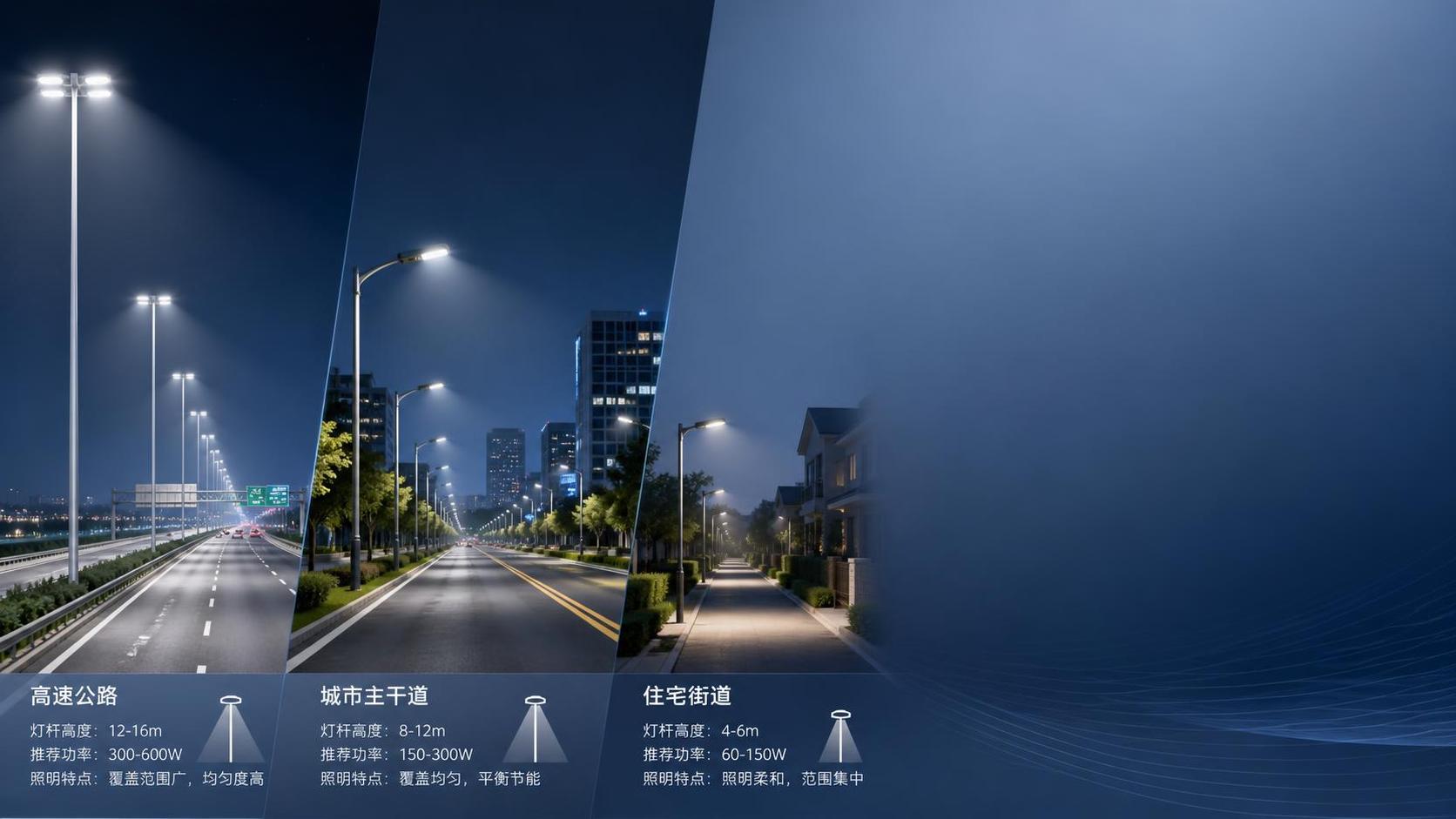
Typical wattage thinking by road type
There is no universal wattage rule for every market, because required illuminance or luminance usually depends on local standards, traffic conditions, and road classification. Still, some practical ranges are commonly used as a starting point during early planning.
These ranges are only a starting point. A narrow urban road with close pole spacing may need less wattage than a wide collector road using the same fixture family. Likewise, an interchange, bridge, or road with difficult geometry may require a different optical approach rather than simply more power.
How road type changes the lighting decision
Highways and expressways
High-speed roads generally need strong uniformity and forward throw. It is not just about brightness. Drivers need stable visual guidance over long distances, especially near curves, ramps, and merging zones. That usually pushes projects toward higher mounting heights and higher wattage ranges, but the optical design matters just as much. Poor distribution at 200W can still create dark gaps or excessive glare.
Urban arterial roads
Urban main roads are more complex than highways because the lighting has to serve several users at once: drivers, pedestrians, cyclists, and often nearby businesses or public transport stops. This is where fixture selection becomes a balance between road surface visibility, sidewalk coverage, and visual comfort. In many projects, the right answer is not the maximum wattage, but the right combination of pole height, arm outreach, and beam pattern.
Residential streets
Residential areas usually need gentler lighting. Overpowered fixtures can make neighborhoods feel harsh and can increase complaints about glare entering windows. Lower wattage fixtures, warmer color temperature options, and closer spacing often create a better result than fewer high-output luminaires. Where security is a concern, uniformity is often more valuable than peak brightness.
Public areas and mixed-use spaces
Parks, plazas, and public-access roads sit in a different category. They may share street lighting hardware, but the visual goals are broader. Facial recognition, orientation, visual comfort, and nighttime appearance can all matter. That is why these spaces often benefit from integrated lighting systems rather than a simple road-lighting formula.
What experienced project teams check before locking wattage
On large outdoor lighting projects, wattage should usually be confirmed after a few basic checks:
- Road width, lane count, and median layout
- Pole height and actual spacing
- Required lighting class or local project standard
- Surrounding ambient light and glare sensitivity
- Maintenance access, corrosion risk, and weather exposure
- Whether the system will later include dimming or smart control
This is also where integrated support becomes valuable. In real project delivery, product selection is tied to installation method, control strategy, and long-term reliability. Teams working across roads, public spaces, and urban environments usually run into the same challenge: a fixture may look acceptable on paper, but once pole conditions, wind load, maintenance cycles, and control compatibility are added, the choice narrows quickly.
That is one reason companies like Lishida Smart Lighting often support contractors and project owners beyond fixture supply alone. On complex projects, street lighting, smart control systems, and execution details need to fit together from the start, otherwise wattage selection becomes a disconnected decision that creates problems later.
A practical example of specification thinking
For a modern urban road using 12 m poles, a designer may consider a lighting system in the 150W to 250W main-light range, especially where wider coverage and stronger road presence are needed. In that context, structural and environmental details matter as much as output. A solution such as Modern Street Lighting | MSL-GH shows how these decisions are often packaged in practice: Q235 steel construction, 4-8 mm pole thickness, hot-dip galvanized corrosion protection, wind resistance of at least 150 km/h, IP67 protection, and luminous efficacy of at least 140 lm/W. Those parameters do not tell you the final wattage by themselves, but they do show whether the system is built for demanding street environments.
The same applies to light quality. Options such as 3000K or 4000K for the main light may suit different road and urban design priorities, while LED chip selection, color rendering, and driver stability affect how well the installation performs over years of operation, not just during commissioning.
Common mistakes in LED street light wattage selection
One common mistake is replacing legacy fixtures on a one-for-one wattage basis. LED retrofits rarely work that simply, because fixture efficiency and optics are different. Another is choosing wattage before confirming pole spacing. If spacing is fixed and too wide, even a higher-power fixture may struggle to deliver uniform lighting.
There is also a tendency to focus on initial power savings and ignore maintenance conditions. In coastal, humid, or windy locations, corrosion resistance, sealing performance, and structural durability can be just as important as energy reduction. A lower-wattage fixture that fails early is not an efficient solution.
The better way to make the decision
If the project is still in planning, start with the road classification, required lighting level, pole layout, and maintenance conditions. Then compare fixture performance, not just nominal wattage. If the project is already under execution, check whether the chosen wattage still makes sense after installation constraints, control requirements, and local approval standards are taken into account.
A good street lighting decision is rarely about finding the highest or lowest wattage. It is about matching road type, optics, structure, and lifecycle expectations closely enough that the installation performs well for years. When that match is right, the numbers on the spec sheet start to mean something. When it is wrong, even an impressive wattage range will not fix the road.
◉ MESSAGE

Blog
- Road Lighting Project Handover: What to Inspect Before Acceptance
- SL-007 Wind-Solar Hybrid Street Light: How the System Works
- Road Lighting Tenders: Writing Measurable Technical Specifications
- Why Solar Pathway Lights Stop Working and How to Diagnose Them
- LED Smart Street Light Suppliers: Questions to Ask Before Ordering
- Weatherproof Solar Bollard Lights: Checks for Rain and Corrosion
- Sourcing Solar Street Lights in Europe: How to Vet Manufacturers
Message